Free printable
B.E.S.T. Writing Student Checklist
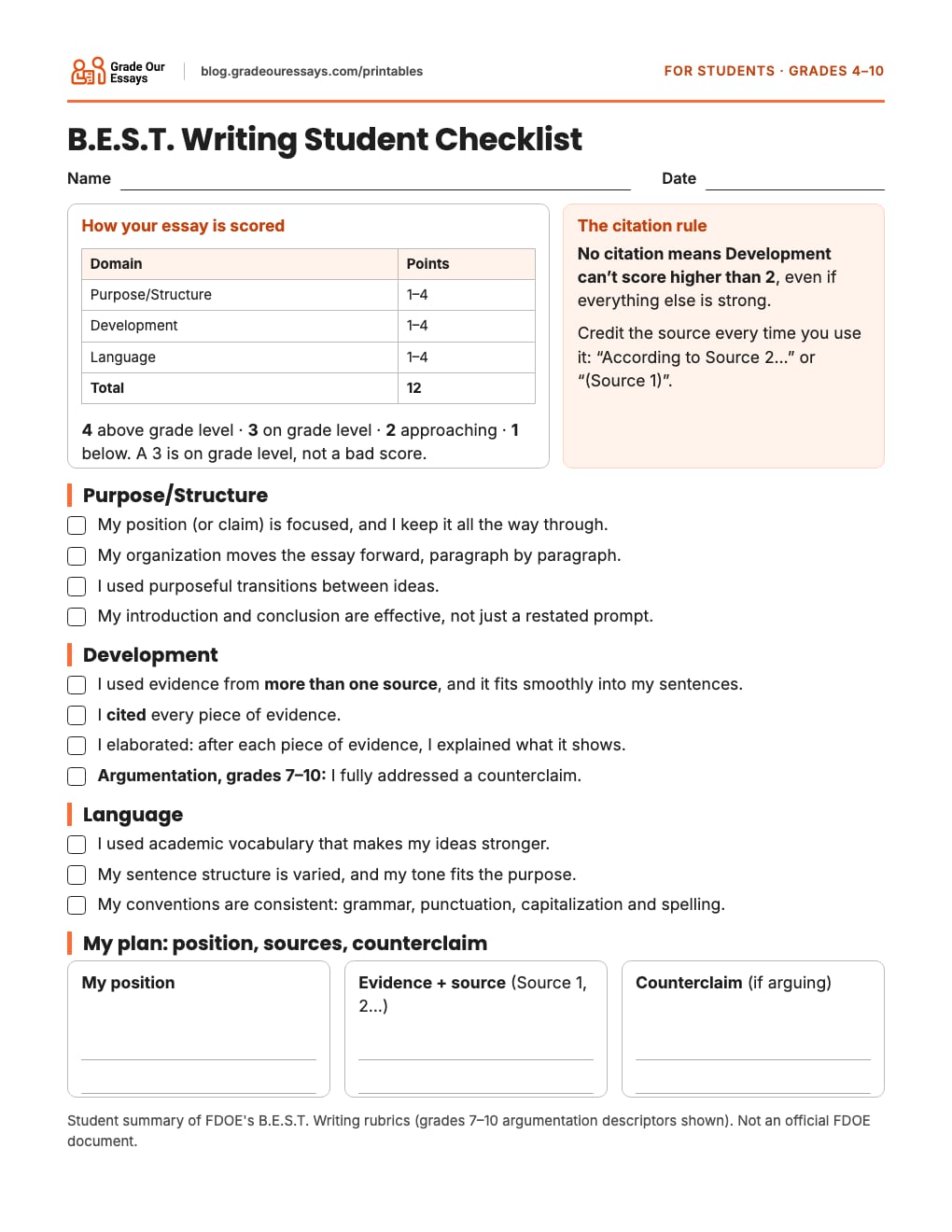
A one-page student checklist for Florida's B.E.S.T. Writing test: the three 4-point domains, what a 4 looks like in each, and the citation rule that caps Development at 2.
For students · Grades 4–10 · 1 page · PDF
Download free PDFFree to copy for classroom use. No sign-up needed.
How to use it: The B.E.S.T. Writing Test Explained: A Guide for Florida Teachers
What's on the sheet
How your essay is scored
| Domain | Points |
|---|---|
| Purpose/Structure | 1–4 |
| Development | 1–4 |
| Language | 1–4 |
| Total | 12 |
4 above grade level · 3 on grade level · 2 approaching · 1 below. A 3 is on grade level, not a bad score.
The citation rule
No citation means Development can’t score higher than 2, even if everything else is strong.
Credit the source every time you use it: “According to Source 2…” or “(Source 1)”.
Purpose/Structure
- My position (or claim) is focused, and I keep it all the way through.
- My organization moves the essay forward, paragraph by paragraph.
- I used purposeful transitions between ideas.
- My introduction and conclusion are effective, not just a restated prompt.
Development
- I used evidence from more than one source, and it fits smoothly into my sentences.
- I cited every piece of evidence.
- I elaborated: after each piece of evidence, I explained what it shows.
- Argumentation, grades 7–10: I fully addressed a counterclaim.
Language
- I used academic vocabulary that makes my ideas stronger.
- My sentence structure is varied, and my tone fits the purpose.
- My conventions are consistent: grammar, punctuation, capitalization and spelling.
My plan: position, sources, counterclaim
My position
Evidence + source (Source 1, 2…)
Counterclaim (if arguing)
Student summary of FDOE's B.E.S.T. Writing rubrics (grades 7–10 argumentation descriptors shown). Not an official FDOE document.