Free printable
ECR Level Up Self-Check
A student self-assessment for extended constructed responses: what each score level usually looks like, the one move that reaches the next level, and space to plan a revision.
For students · Grades 4–12 · 1 page · PDF
Download free PDFFree to copy for classroom use. No sign-up needed.
How to use it: From 1 to 4: How Students Can Level Up Their ECR Responses
What's on the sheet
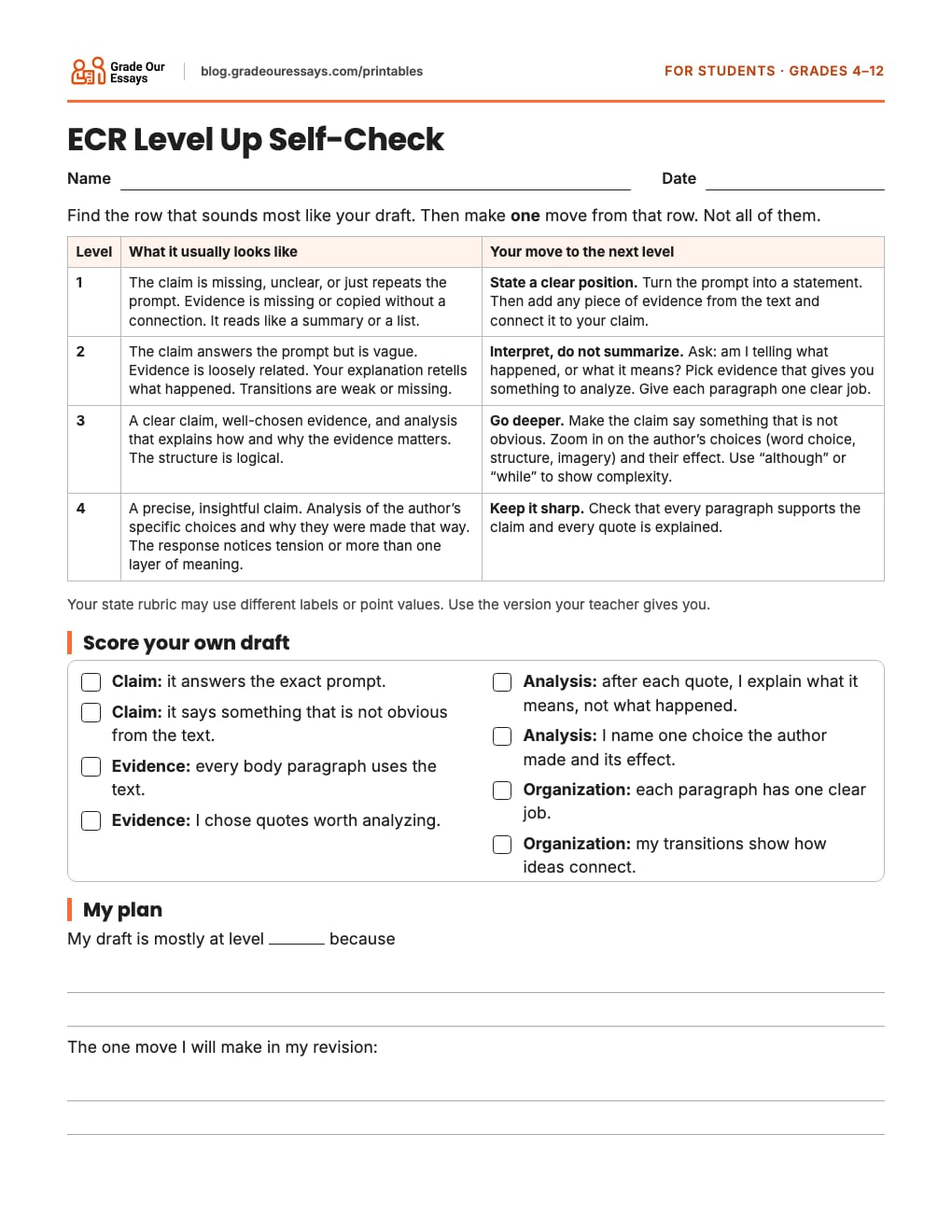
Find the row that sounds most like your draft. Then make one move from that row. Not all of them.
| Level | What it usually looks like | Your move to the next level |
|---|---|---|
| 1 | The claim is missing, unclear, or just repeats the prompt. Evidence is missing or copied without a connection. It reads like a summary or a list. | State a clear position. Turn the prompt into a statement. Then add any piece of evidence from the text and connect it to your claim. |
| 2 | The claim answers the prompt but is vague. Evidence is loosely related. Your explanation retells what happened. Transitions are weak or missing. | Interpret, do not summarize. Ask: am I telling what happened, or what it means? Pick evidence that gives you something to analyze. Give each paragraph one clear job. |
| 3 | A clear claim, well-chosen evidence, and analysis that explains how and why the evidence matters. The structure is logical. | Go deeper. Make the claim say something that is not obvious. Zoom in on the author’s choices (word choice, structure, imagery) and their effect. Use “although” or “while” to show complexity. |
| 4 | A precise, insightful claim. Analysis of the author’s specific choices and why they were made that way. The response notices tension or more than one layer of meaning. | Keep it sharp. Check that every paragraph supports the claim and every quote is explained. |
Your state rubric may use different labels or point values. Use the version your teacher gives you.
Score your own draft
- Claim: it answers the exact prompt.
- Claim: it says something that is not obvious from the text.
- Evidence: every body paragraph uses the text.
- Evidence: I chose quotes worth analyzing.
- Analysis: after each quote, I explain what it means, not what happened.
- Analysis: I name one choice the author made and its effect.
- Organization: each paragraph has one clear job.
- Organization: my transitions show how ideas connect.
My plan
My draft is mostly at level because
The one move I will make in my revision: