Grade handwritten essays faster by fixing the page before you collect it. A header box, skipped lines, a wide margin for codes, and a rubric strip of two or three rows let you score those rows and write one next step. Lines you cannot read go back to the student for a short reread before you put down a score.
Moving the draft onto paper lets you see who held the pen. It also removes the comment bank, the search box, and the margin Google Docs used to give you. Replace them with a page you can mark, four codes, and a folder that stays in the room.
Why Paper Essays Take Longer to Grade (and Where the Time Goes)
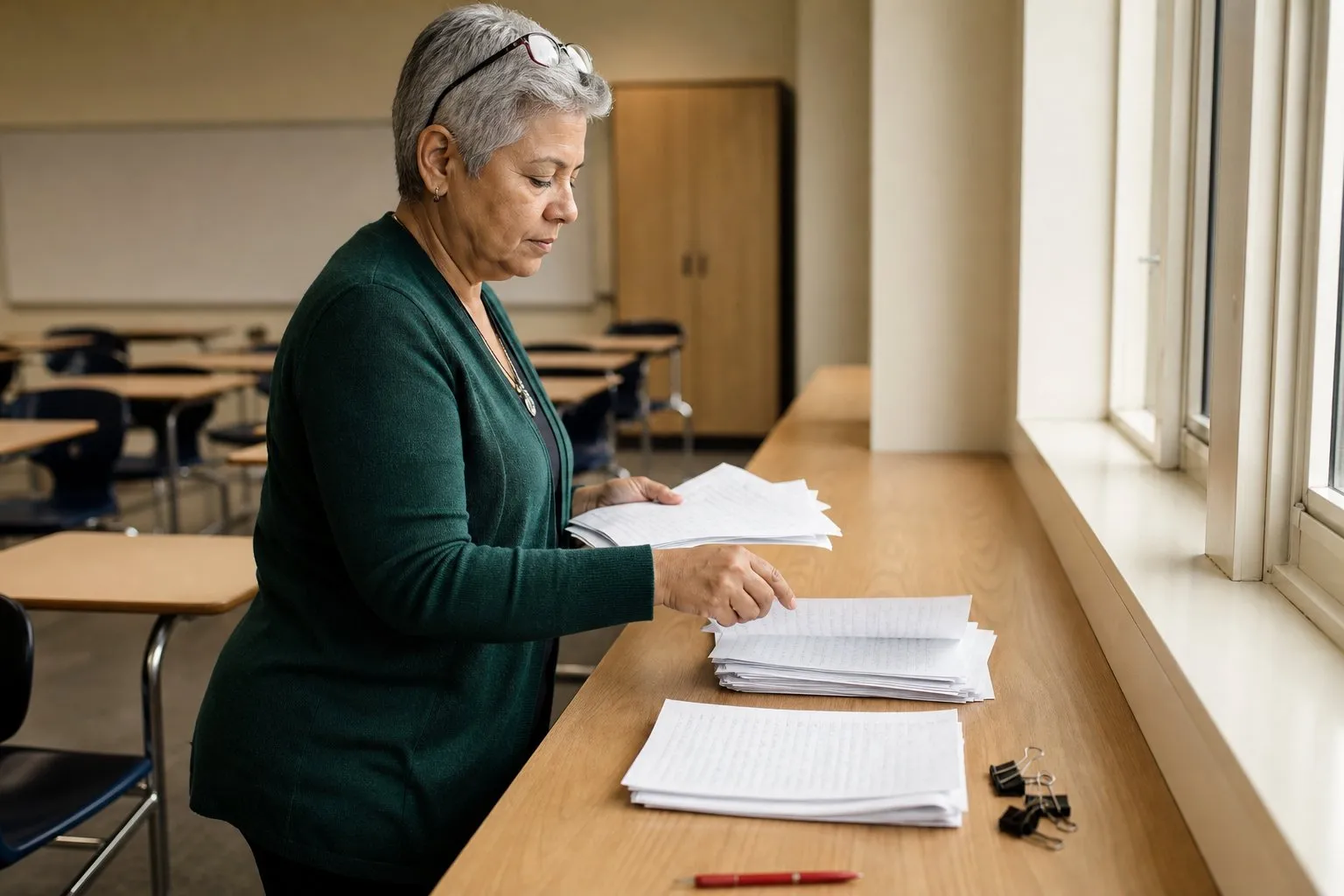
Picture four sections of 10th grade English, about 30 students each. The assignment is a literary argument of about two pages: was a character right to hide a letter, using one line from the book. Students wrote it in class, in pen. You collect it on Friday of the quarter’s last week. About 120 essays. No comment bank. No search. Three pages you cannot read. One period folder missing from the bin.
The first essay still gets the Docs treatment. You rewrite a thin sentence, suggest a better quote, and start a note on the ending. Twelve minutes later that paper looks coached, and 119 are untouched. By 9 p.m. the notes are a circled score. You also lose time on unmarked claims, the same note written again, and the missing folder.
You collected the paper so the draft is one you watched. That trail is a process folder: the claim from class, the partner check, the short conference. This post does not rebuild that gate. It is how you mark the page you already have.
Treat the timing as a plan you can check with a timer, not as a study. At 12 minutes a paper, 120 essays are 1,440 minutes, or 24 hours. At 5 minutes a paper, the same stack is 600 minutes, or 10 hours. A page with no margin runs past 5 minutes.
How Should Students Set Up the Page So You Can Grade It Faster?
Teach the setup on the day you assign the essay. A strong argument you cannot mark still costs those 12 minutes. If the layout is wrong, the page goes back before you score the thinking.
- Skip a line, so the code has a blank to land on.
- Leave about an inch and a half blank on the right. A sentence that runs into that space is rewritten above the line before you score.
- Header box: name, period, and the prompt letter, A, B, or C. You sort by period without reading the essay.
- Number the paragraphs. “Paragraph 2” is a place a student can find.
- Underline the claim and box the quoted line, so both show before you read around them.
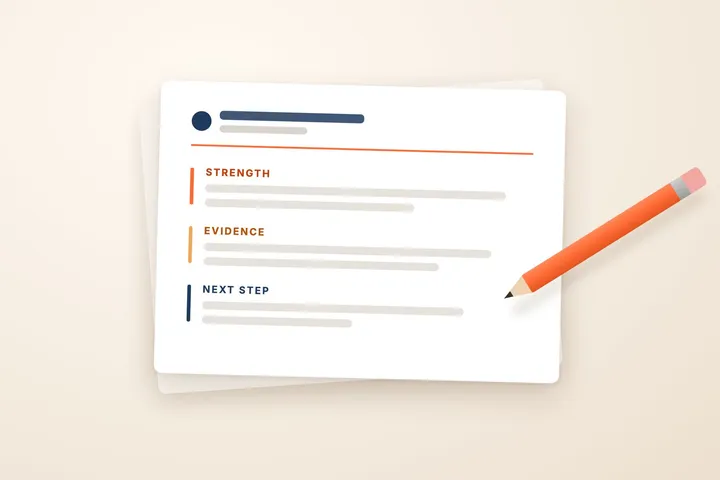
- Staple a rubric strip to the top. A rubric of two or three criteria fits there: claim, evidence, and explanation, with room to circle a level.
Put it on the board once: name, period, prompt B, skip lines, blank edge, underlined claim, boxed line. A dense block from edge to edge does not get a score yet. The student recopies it in class. You are not grading penmanship. You are refusing a page that hid the work.
What Do You Do When You Can’t Read a Student’s Handwriting?
Circle the phrase you cannot read. Do not guess, and do not zero the essay because one line is a scrawl. Next class the student rereads that phrase aloud or rewrites the sentence, and then you score. If you are stuck, ask a colleague in the building to look at the word with you. Post that rule before the first essay, not after the first zero.
Keep penmanship out of the argument rubric. A messy page with a clear claim can still meet the claim row. An unreadable claim waits until someone can read it. If neatness counts as argument, a tidy empty paragraph beats a messy specific one. Give the circled lines about 10 minutes next class, on the page or a clipped half sheet, while everyone else starts the coded paragraph.
Students who already type, dictate, or use a scribe keep that support. You want a draft you watched and can read, not cursive. They can dictate while you or a scribe writes, or type on a device that stays in the room until you have seen the page. NCTE’s statement on professional knowledge for the teaching of writing says teachers need ways to accommodate students who find writing physically challenging, including oral rehearsal and other options that still let them develop the thinking. A reread, dictation, or support the student already has fits that. Scoring the handwriting as the argument does not.
Replace Docs Comments With a Paper Feedback Code
A highlight, a pasted comment, and a resolved thread do not exist on paper. Writing that sidebar by hand is the 12 minute habit. Replace each piece with one mark.
| Docs habit | What you do on paper | Example time |
|---|---|---|
| A saved bank of comments | Four margin codes: C claim, E evidence, X explain more, ? unclear | Under a minute, once the four are familiar |
| Highlighting a sentence | Underline the claim and box the quoted line | Part of the same read |
| Suggested edits | One next step at the bottom, naming the paragraph | About a minute |
| A long end comment | Circled level on the rubric strip, plus that sentence | Included in the minute above |
| Resolving comments | Student writes the fix beside the code next class | Their time, about 15 minutes |
Those times are a ceiling you check on your own stack, not a published average.
Try the codes on this paragraph. “The character was right to hide the letter. In the book she put it in the desk so nobody would find it. This shows she is a good person who cares about people.”
C goes on the first sentence. A reader could disagree, so the claim row can be met and you leave the wording alone. E goes on the desk sentence, the specific action. X goes on “good person who cares,” which never says what the hiding costs. A question mark is only for a word you cannot read.
One sentence at the bottom: “Paragraph 2, after the boxed line: say what hiding the letter costs the sister.” Leave the sentence that runs on, and the missing capital. If conventions are today’s lesson, they take one code and another row waits.
Then stop. The four minute scoring pass is the same idea: a few rows, one comment, done. For this handwritten length, set about five minutes before paper one, finish the next step, and do not save the sentences for tomorrow.
When students type a final later, Grade Our Essays can draft feedback on each trait of that typed essay. It is aligned to 500+ state rubrics across all 50 states, and you approve every score before students see it. A free 14 day trial does not ask for a credit card. The codes on the handwritten page do not depend on it.
Keep the Stack From Getting Lost
One folder per period, labeled with the period and the prompt letter, papers in the order you will hand them back. A pile of 120 you will sort later is how a folder disappears between the desk and the car. Keep a bin in the room. If you carry work out, take one folder and bring it back the same day.
Before a set leaves your hands, photograph it on a device the school issued, into storage the school controls. Follow district rules. Do not put the photos in a personal camera roll, a personal cloud account, or a scanning app on your own phone. The photo is the backup when a folder is missing. You still grade from the paper, or from a scan the school already uses, and you still decide the score. If a folder is gone, check the bin, then the photo, then ask that period whose essay is missing.
How Do Students Revise When the Essay Is on Paper?
A handwritten draft is one you watched, and it spends the periods a second full draft at home used to get. Waiting for a complete rewrite means the code is still unread when quarter grades close. Revise one paragraph.
The What Works Clearinghouse practice guide on teaching secondary students to write effectively is for grades 6 through 12. It recommends teaching writing strategies in a model, practice, and reflect cycle, and using assessments of student writing to inform instruction and feedback. The code is the assessment. The half sheet is the practice. Model it, or the time produces a neater sentence that still misses the point.
On the board, replace the sample X with one sentence: “Hiding the letter keeps the sister from answering it, so the character’s safety costs the sister a choice.” Then give about 15 minutes. Students clip a half sheet to the original, copy the code and the paragraph number, rewrite only that paragraph, and add one line on what changed. You read the half sheet against that row. About a minute, not a new pass through the essay.
If the rewrite still restates the quote, send it back with the same code. The typed final has to include that rewritten paragraph. A file that drops the paper claim is not finished. A stuck student can say what the code means, then write the first sentence before leaving the desk.
Try This Tomorrow
- Put a header box on the next draft: name, period, prompt letter, and a reminder to number the paragraphs.
- Post four codes: C claim, E evidence, X explain more, ? unclear. Add one X example so “explain more” does not become “add adjectives.”
- Label a folder per period and set out a bin that stays in the room. File loose pages before you grade another essay.
- Print rubric strips for the two or three rows you will score, and staple them on before you start.
- Pull the pages you cannot read. Tomorrow, about 10 minutes: those students reread or rewrite the circled lines, then you score.
Frequently Asked Questions
Should I take points off for messy handwriting?
No, not on an argument rubric. Circle what you cannot read and have the student reread or rewrite it before you score. A messy page can still meet the claim row. An unreadable claim waits.
Is it OK to photograph or scan student essays?
Yes, on a school device and in school storage, if you follow district rules. Do not upload essays to a personal app or a personal cloud account. You still read the page and you still decide the score.
What about students with accommodations for typing?
Keep the support they already have. They can type or dictate in class, on a device that stays until you have seen the draft. You are collecting writing you watched, not a handwriting sample.
Can students type the final after a handwritten draft?
Yes. Draft by hand in the room, then type once the claim, the quoted line, and your code are on the paper. The typed final has to carry that next step.
How long should grading one handwritten essay take?
About five minutes for an essay of about two pages that already has a header, skipped lines, a margin, and a rubric strip. That ceiling is one you set with a timer, not a result from a study.