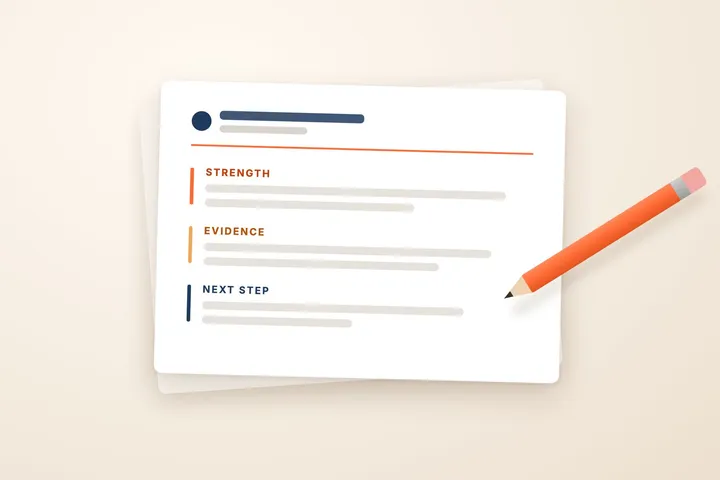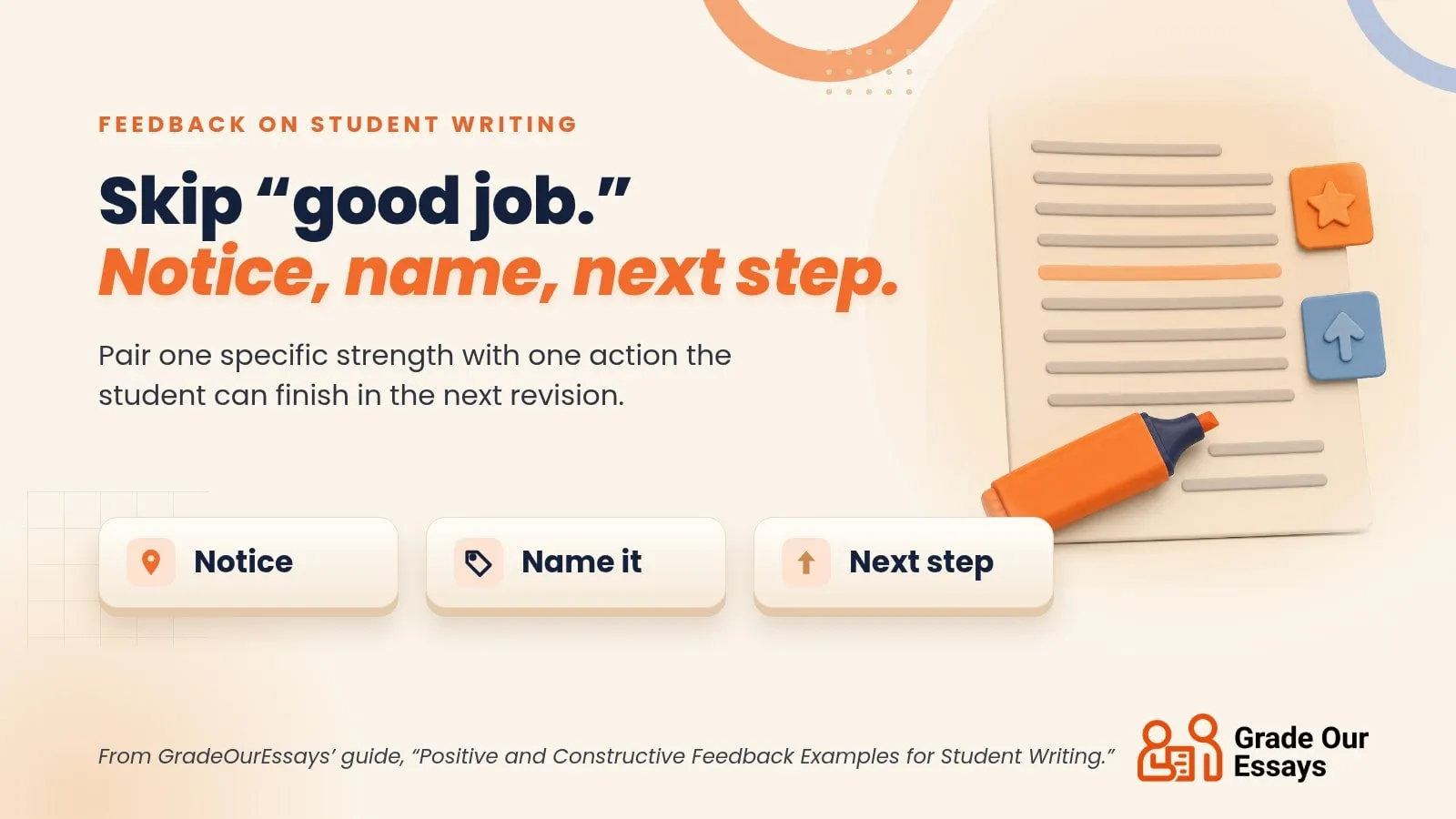
Good feedback on student writing names one thing that works, points to where it happens in the draft, and gives one next step the student can finish in the next revision. “Your second paragraph explains why the quote matters, so do the same after your first quote” is constructive and positive at once. “Good job” and “needs more detail” are neither, because the student can’t act on either one.
Below are feedback examples sorted by writing trait and grade band, a quick way to turn a vague comment into a useful one, and a routine for writing them fast enough to finish a stack.
Why “good job” and “add more detail” don’t help
Picture a 7th-grade argument essay on whether the school day should start later. A student writes a clear claim, quotes a sleep article, and then moves straight to the next point without saying what the quote proves. You write “Nice work!” at the top and “explain more” next to paragraph two. The student reads the score, sees the cheerful note, and puts the paper away. Next week the same gap shows up in the next essay.
Neither comment was wrong. They just stopped too soon. “Nice work” doesn’t tell the student which choice to repeat. “Explain more” doesn’t say what to explain or where. A student who already knew how to explain the quote would have done it the first time.
This is the frustration teachers keep describing this fall. We spend an evening writing comments, and students skim them or skip to the grade. Some of that is a reading problem, which is why routines that make students do something with the comments matter (an Edutopia piece on helping students engage with feedback suggests giving them ten minutes to paraphrase what you wrote). But a lot of it is the comments themselves. If a comment has no action in it, there’s nothing to do with it.
What makes feedback constructive and positive at the same time?
Positive feedback isn’t softness, and constructive feedback isn’t criticism. In a useful comment they work together. The praise tells the student what to keep. The next step tells them what to try. Both point at the same draft.
A comment that does both usually has three parts:
- Notice. Point to a specific spot. “In paragraph two…” or “Your opening line…”
- Name the move. Say what the writing did in the language of your rubric. “That’s explaining your evidence” or “That’s a transition that shows a shift in time.”
- Next step. One action, small enough to finish in a single revision session, ideally tied to the move you just named.
The University of Minnesota’s guide to commenting on student writing makes the same point about praise: it works when it both notices something and explains why it succeeds, so the student can repeat the choice on purpose. That second half is the part most of us skip when we’re tired.
One rule keeps this honest. Only praise what’s actually there. If the evidence is weak, don’t call it strong to soften the blow. Find something true (a clear claim, a good choice of quote, a paragraph that stays on topic) and praise that instead. Students can tell the difference, and empty praise makes your next critical comment easier to dismiss.
Turn a vague comment into a useful one
Most of us have a handful of comments we write without thinking. Here’s how to rewrite the common ones. The fixed versions are a little longer, but they replace three or four follow-up questions.
| Vague comment | Constructive and positive version |
|---|---|
| Good job! | Your claim in the first sentence is clear and arguable, and every paragraph comes back to it. Keep doing that. |
| Add more detail. | You tell us the dog ran off. Slow that moment down: add one thing you saw and one thing you heard. |
| Explain your evidence. | You picked a strong quote in paragraph two. Add two sentences after it that say what it proves about your claim. |
| Awkward. | This sentence tries to hold two ideas. Split it after “practice” and see if both parts get clearer. |
| Weak conclusion. | Your conclusion repeats your claim word for word. Try ending with why this matters to someone your age. |
| Watch your grammar. | Most of your errors are run-ons. Read paragraph one out loud and add a period wherever you take a breath. |
| Organization? | Your third paragraph is your strongest reason. Try moving it to the end so the essay builds. |
Notice that every fixed version points to a place in the draft. That’s the habit that matters most. Students can’t revise “the essay.” They can revise paragraph two.
Feedback examples by writing trait
These are written for grades 6 to 10, but the moves work at any level. Adjust the vocabulary to match your rubric so the comment and the score use the same words.
Ideas and claim
- Positive: “Your claim takes a side and gives a reason in the same sentence. A reader knows exactly what you’re arguing by line one.”
- Constructive: “Right now your thesis names the topic (school uniforms) but not your position. Add the word ‘should’ and a reason.”
- Stretch: “Your claim is clear. Can you add the strongest point someone would make against it, and answer it in one sentence?”
Evidence and explanation
- Positive: “You introduce each quote with who said it and why they’d know. That makes your evidence feel trustworthy.”
- Constructive: “Your quote in paragraph three sits by itself. Add a sentence that starts ‘This shows…’ right after it.”
- Stretch: “You explain what the quote says. Now explain what it reveals about the character that she wouldn’t say out loud.”
Organization
- Positive: “Each body paragraph opens with a topic sentence that matches one part of your thesis. Easy to follow.”
- Constructive: “Paragraphs two and three make the same point. Combine them, then use the space for your second reason.”
Word choice and sentences
- Positive: “‘Trudged’ tells us how tired he was without saying ‘tired.’ That’s a strong verb doing the work.”
- Constructive: “Four sentences in a row start with ‘Then.’ Rewrite two of them to start with when or where it happened.”
Conventions
- Positive: “Your dialogue punctuation is correct all the way through. That’s hard, and you got it.”
- Constructive: “Pick one paragraph and check every ‘their/there/they’re.’ Fix those, then do the same for the rest.”
Keep conventions comments to one pattern per paper. If you mark every error, students fix the commas and skip the thinking. This matters even more for students still learning English, and we wrote a separate guide on giving feedback on multilingual learners’ essays without marking every mistake.
How do I adjust feedback for younger or older writers?
The structure stays the same. The length and vocabulary change.
Grades 3 to 5. One praise and one next step, spoken or written in kid language. “You used a ‘first, next, last’ order, so I could follow your steps. Next time, add one sentence that tells how you felt at the end.” For a lot of elementary writers, saying it out loud during a two-minute conference works better than writing it.
Middle school. Two comments per paper is plenty: one strength and one priority. Tie both to the rubric row you taught most recently. If this unit was about explaining evidence, comment on evidence, even if the conclusion is thin too.
High school. You can use more precise language (line of reasoning, commentary, counterclaim), and you can add one stretch comment for strong writers. Strong students often get “great job” and nothing else, which means they plateau. A single “here’s the next level” comment respects their work and gives them a reason to revise.
A routine for writing feedback faster
Specific feedback takes longer per comment, so you need to write fewer of them. Here’s a routine that keeps a stack of 30 short essays manageable.
- Pick the focus before you read. Choose one or two rubric rows that match what you taught. You’ll comment on those and nothing else.
- Read the first five papers without commenting. You’ll see the patterns. Usually three or four issues show up again and again.
- Write your bank from your own class. For each pattern, write one positive comment and one next step, in your words, using your rubric’s language. Now you have eight or so comments you can adapt, and they actually fit these students.
- Personalize the first clause. Paste the comment, then change the “notice” part so it points to the student’s actual paragraph or sentence. That one change is what makes it read like you read their paper.
- Track the class pattern. Tally which next step you gave most often. That’s tomorrow’s mini-lesson.
A bank built from your own stack beats a generic list of 70 comments, because it matches what your students wrote this week. For more on keeping the per-paper time down, see our guide on how to grade an essay faster.
If you’re grading against a state rubric and want a first draft of trait-level comments to edit, Grade Our Essays drafts feedback aligned to the rubric you choose, and you review and approve every score and comment before students see it (there’s a free 14-day trial, no credit card needed). Whatever drafts the first pass, the personalize step above still applies. A comment that could fit any student’s paper won’t change this student’s next draft.
Try This Tomorrow
- Rewrite your three most-used comments using the table above. Keep them in a doc you can paste from.
- On the next stack, comment on one rubric row only, and tell students that’s the focus so they don’t assume everything else is perfect.
- Start every comment with a location: a paragraph number, a quoted phrase, or “your first sentence.”
- Give students five minutes in class to write one sentence about what they’ll change based on your comment. Collect it with the revision.
- Pick one strong student and give them a stretch comment instead of “great job.”
When report card season comes, the same notice, name, next step pattern works for families too, and our report card comments for writing guide has examples written for that audience. If students still aren’t using your comments after all this, the problem may be the revision routine rather than the comment, and this revision loop can help.
Frequently Asked Questions
What is an example of constructive feedback on student writing?
“You picked a strong quote in paragraph two. Add two sentences after it that explain what it proves about your claim.” It points to a specific spot, names what worked, and gives one action the student can finish in a single revision.
How do you give positive feedback on writing without being vague?
Point to the exact sentence or paragraph, then name the skill it shows in your rubric’s language. “Your topic sentence matches the second reason in your thesis” tells the student what to repeat. “Great job” doesn’t.
How many comments should I write on a student essay?
For most essays, one or two focused comments plus one positive note is enough. More comments usually mean students fix the easiest ones, like punctuation, and skip the bigger revision.
Is the compliment sandwich a good way to give writing feedback?
It can bury the one thing you want the student to do. Pair one specific strength with one clear next step instead, so the action isn’t lost between two compliments.
Should feedback be different for strong writers?
Yes. Strong writers need a stretch comment that shows them the next level, like addressing a counterclaim or explaining what a detail reveals. Praise alone can leave them stuck at proficient.