Give each essay one comment that names a single change, set aside class time for students to make that change, and hold the grade until you can see it. Students read essay feedback when the comment is a job and the score depends on doing the job. They skip it when the number is already final and the note is a paragraph they can ignore.
Picture three sections of 10th grade English, about thirty literary analysis essays in each. You spent Sunday on a novel chapter. Every paper got a score and a few margin notes: a claim that could fit any chapter, a quote with no explanation, a tangled sentence, and one line you liked. On Monday the class opens the file. The score sits at the top. Most students look at the number and move on. A few accept every spelling suggestion and resubmit before the bell. One or two rewrite the claim. You can tell, because the argument changed.
Feedback became a postscript. A revision loop changes that: one required reply, checked in about a minute, with no second weekend of grading.
Why the comments lose and the score wins
The score is what lands in the gradebook. Students have learned that the number is what adults ask about. A comment feels optional unless the period makes it required.
A full margin of notes reads like a closed case. Watch what students touch when six marks come back. They fix the easiest one, usually a comma or a repeated word, and leave the claim alone. The comment that would have moved the score is the one they do not try.
Digital drafts add another exit. Suggesting mode and spelling suggestions turn “revision” into a click. The student did not reread the quote. The underline went away. You then see the same essay with cleaner commas. The writing did not get another look. The file did.
The class may care. The routine still never asked them to use a comment while the grade was open.
What does a revision loop actually require?
A revision loop is not a second essay, and it is not a full rewrite of every paragraph. It has four parts:
- One comment that names a change.
- A short note, in the student’s own words, saying which comment they used.
- That change, visible in the draft.
- Your check of the note and the new lines only.
Some teachers keep the number off the paper until the note is done. Printed drafts make that easy. In a shared doc, wait to enter the grade until after the revision block. Tell the class which day the grade posts, and post it that day. A date they can see feels like a deal. A number that moves at random feels like a trick.
If the platform always shows the score at the top, say the number is provisional and name the comment that can move it. “This is the difference between a 2 and a 3 on evidence” gives a reason to work. “Maybe I will add a point” does not.
If a student asks to see the number the same day, show it, and still require the note. Holding the score is a routine, not a punishment.
You will touch the stack twice. Keep the second touch small or you will drop the loop by the next essay of the quarter. Read the note. Reread the whole paper only when the note claims a change you cannot find.
How should a comment be written so a student can use it?
Write the comment as a job: a verb and a place in the draft. “Develop your ideas” is a mood. “After the quote in paragraph 2, add one sentence about what Mara’s choice costs her” is a job. Students can finish a job. They cannot tell when a mood is done, so they skip it.
Stay on one trait. If the claim is thin, do not also assign a new opening and a comma hunt. Point the job at one row of a clear rubric so they can see which score moves. Praise, if you add it, is one sentence that names a move worth repeating. Then stop. The same shape works for report card comments for writing: one strength the family can see in the work, and one next step.
Teaching students how to revise works better as one problem at a time, not a rebuild of the whole essay. Revision verbs: add, cut, move, replace, split. Spelling and punctuation are a later pass. Say which pass this is.
| Comment they skip | Comment that assigns a job | What they hand back |
|---|---|---|
| “Develop your ideas and watch grammar.” | “Rewrite the last sentence of paragraph 1 so it names Mara’s choice and what it costs her.” | The new sentence at the top, old sentence underneath |
| “Awkward.” | “Split the first sentence of paragraph 3 into two sentences.” | Both sentences, typed by the student |
| Suggested commas, and nothing on the quote | “Suggesting mode is off. After the quote, add one sentence of explanation in your own typing.” | A sentence no suggestion could have contained |
Skip the page of comments. If you already grade an essay faster by writing less, the loop is what makes the short note work. Two comments is the ceiling. One is often enough.
How do you run the loop in one class period?
Run it the day you return the essays. Handing them back at the bell is how comments land in a backpack.
Before anyone opens a file, put the rule on the board: answer one comment, accepted suggestions do not count, and the grade goes in after the note. If the score is already on the screen, name the comment that can still change it.
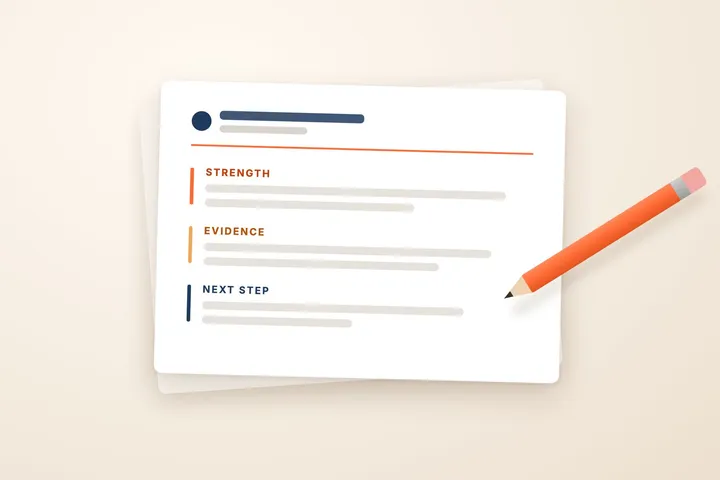
Students paste three lines at the top, or use a half sheet:
- Comment I am using:
- What I changed:
- New sentence:
Having students write about the feedback in their own words keeps comments from sliding past. This note goes further. Spelling does not count, and the new sentence has to show up in the draft.
Set 12 to 15 minutes. Point a score gazer back at the verb in your comment. You will not meet all thirty. Help the few who cannot tell what the job is. A stem on the board is enough for many: “Mara chooses ___, and it costs ___.”
A finished note for the claim comment looks like this. Comment I am using: name the choice and the cost. What I changed: the last sentence of the introduction. New sentence: “When Mara hides the letter from her brother, she keeps dinner calm and loses his trust.” Leave the old line (“The main character learns that family matters”) under it so the swap is obvious.
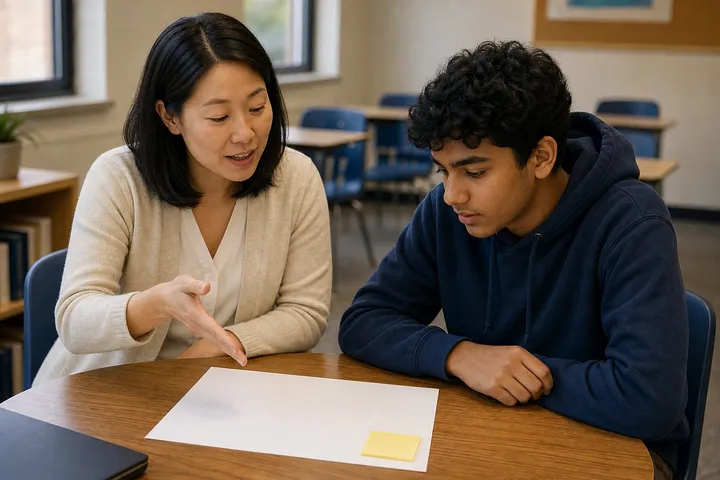
Collect the note before the period ends. Early finishers may answer a second comment if you wrote one. They do not start a new essay. End any conference by having the student type the new sentence while you are there. When a long meeting will not fit the roster, a three minute conference rotation keeps that same rule. Talk without new lines disappears by the next period. While a draft is still open, students ask if it is good. A one criterion reply keeps a quick yes from sounding like the grade.
What if they only accept the suggested edits?
The first time, call that resubmit unfinished. Then hold the line.
Editing fixes spelling, punctuation, and a repeated word. Revision adds, cuts, moves, or replaces an idea: the claim, the order, the quote, or the sentence after the quote. A click on Accept can be editing. It is rarely revision. Often the student did not choose the comma. The software did.
- Turn Suggesting mode off, or tell students to reject suggestions and type the change. Skip version history on the full set. The note is the check you can afford. Open history on two or three files if a note looks empty.
- Ask for a sentence no suggestion could contain. “Add one sentence after the quote” cannot be finished with Accept.
- If the drafts differ only in spelling, keep the score and say why in one line: “The comment asked for a new claim. This draft only changed spelling.” Students test this once. They stop when the number stays put.
Keep speech to text, spellcheck, and starters. They help a student get a sentence down. They do not do the thinking you assigned. A stuck writer can ask for the stem during the work time. If you suspect the whole essay was generated, a detector score will not settle it. Collect the paper trail before anyone types, and score the typed draft only when it still matches.
Save suggested edits for a later editing pass. On this pass the comment is a sentence they have to write, not a replacement they can accept.
Where does your time go, and where should it stop?
The loop collapses when the second look becomes a second grading. Treat the times below as a plan, not a study:
- First pass: one strength, one sentence long, and one job.
- Class: 12 to 15 minutes you already have. No new homework essay.
- Second look: about a minute a note, or half an hour for a class of 30. Read the note and the new sentence. If it does the job, enter the grade and move the score when you said you would. If the note says “fixed grammar” and you asked for a claim, the original score stands. Leave the same comment.
For extended responses, a simple framework for grading ECRs faster keeps the first pass to a score plus one growth area. The loop is what turns that growth area into a change you can see.
If Sunday disappears into the first comments, Grade Our Essays can draft feedback on each trait, aligned to state writing rubrics. You review and approve every score before students see it. The period in class is still yours. A free trial for 14 days does not require a credit card. Paper and a pen run the same loop. Any tool only buys back the first pass. The note is what gets the comment read.
Try This Tomorrow
- On the next set, write one comment per essay. Start with a verb: rewrite, add, cut, split, or replace. Name the paragraph.
- Put 15 minutes on the plan for the day you return the work. Do not hand essays back at the bell.
- Paste the three line note at the top of the doc, or print it, before students open scores.
- For that period, turn Suggesting mode off. Tell the class that accepted suggestions will not count as the revision.
- When you record grades, read notes only. If you start editing the second draft line by line, stop at the note and go to the next student.
Frequently Asked Questions
Do I have to let students rewrite the whole essay?
No. Ask for the change your comment named. A full rewrite becomes a second pile. Students may keep going after that required sentence is in.
What if grades are due before we can revise?
Enter the number if the school needs it, say it can change after the note, and change the ones that earned it. If the window is already shut, run the loop on the next assignment. A comment nobody can use teaches students to skip comments.
Should comments be questions or direct jobs?
A question helps a student who is close: “What does this quote cost Mara?” A direct job helps a student who is lost: “Add one sentence after the quote that names the cost.” The note still has to change the draft. A reply that stays in the margin is not done.
What if a student refuses to revise?
The original score stays. Offer the same 15 minutes, and do not add a longer comment. If nothing comes in, record the grade and repeat that comment next time.
Does this work on short constructed responses?
Yes. Use two lines and one missing explanation after the quote. One comment, one sentence, about a minute to check. A full conference is too large for a short response.