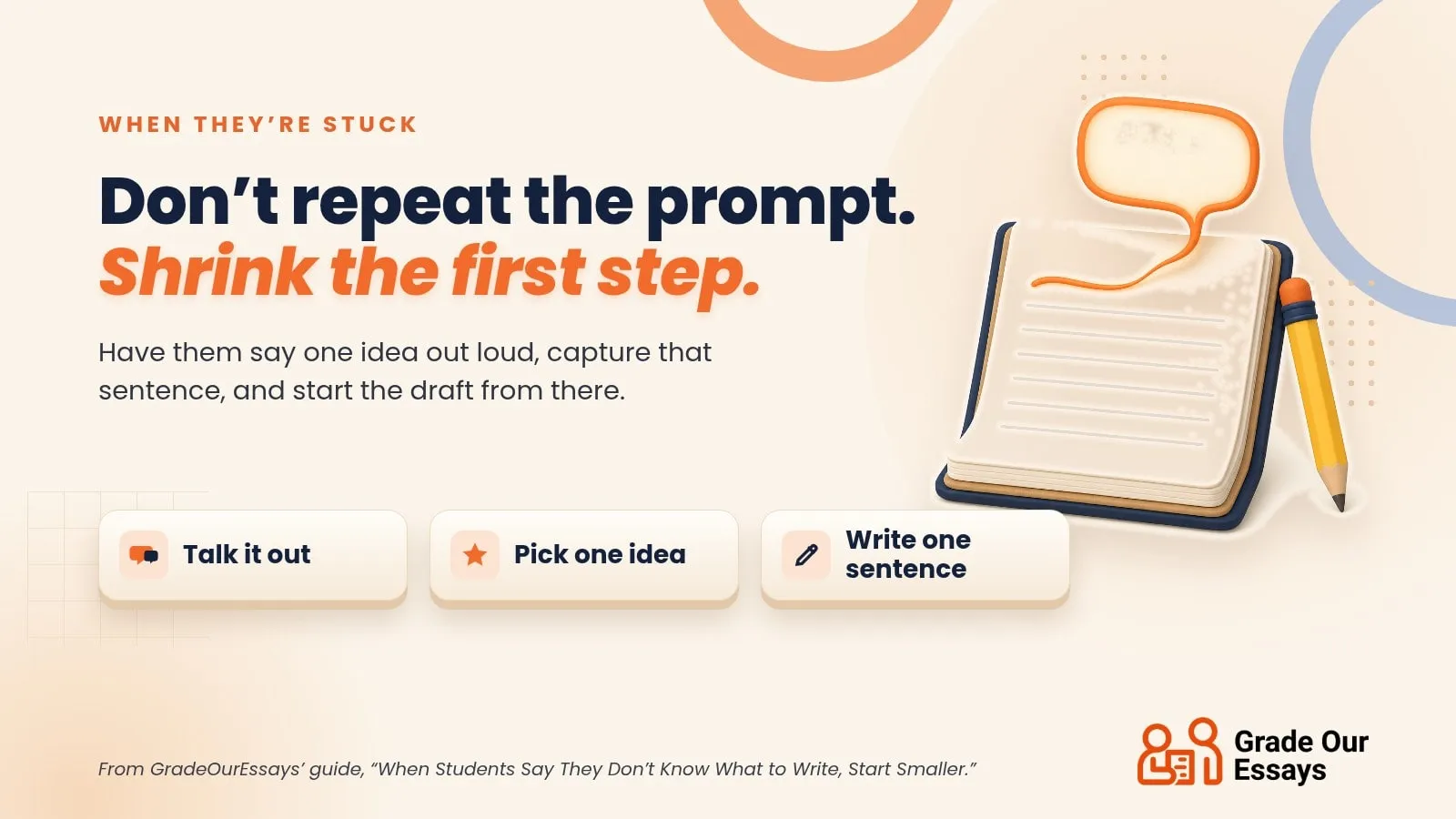
When a student says they don’t know what to write, don’t repeat the prompt. Shrink the first step. Have them say one idea out loud, capture that sentence, and start the draft from there. A blank page usually means too many jobs at once, not an empty mind.
Picture an 8th-grade period in mid-November. The class has finished a short story, and today’s job is a one-page literary analysis: one claim, two pieces of evidence, and a short explanation after each quote. You put the prompt on the board, walk the rubric, and start a 25-minute draft. Half the room begins. The other half sharpens an already sharp pencil, asks to go to the bathroom, writes three words, and stops. If you repeat the prompt, the stuck students hear the same oversized job again. They still don’t have a first sentence. Standing over a desk and saying “just start” or “you know this” has the same problem. The student is not missing encouragement. They are missing a first move small enough to finish in the next minute.
This is the moment teachers describe when they ask what to do about “I don’t know what to write.” The student may look unmotivated. Often they are overloaded. Writing asks them to recall an idea, choose one, hold it in mind, find words, spell them, and form letters or find keys, all at the same time. Recent classroom writing research notes that when the mechanics of producing text take too much attention, students can lose the idea before it reaches the page. The fix is not a pep talk. It is a smaller first step that separates talking from writing long enough for a sentence to exist.
Why a blank page is usually a traffic jam
“I don’t know what to write” is a useful sentence to take literally and then test. Some students truly do not understand the prompt. Many can talk about the story, the article, or the weekend in complete thoughts, then freeze when the notebook opens. The idea is there. The path from speech to a first line is not.
You can test this in 30 seconds. Ask the student to tell you, out loud, what they would say if they did not have to write it. If a clear idea appears, the problem is transfer, not knowledge. If they still cannot name a moment, a claim, or a fact, go back to the text or the prompt and shrink the question again.
That gap shows up across grade bands. A 3rd grader asked to write about the weekend may say “I don’t know,” then, after two specific questions, describe a soccer game with a sibling. A 9th grader asked to argue a position may talk for a minute about a rule they think is unfair, then stare at a blank document. In both cases, the first problem is initiation, not a lack of material.
Fear of a bad first line makes the jam worse. If the student believes the opening sentence has to be good, they write nothing, because nothing can be revised later. A messy sentence on the page is usable. An empty page is not.
Spelling and handwriting can also crowd out the thinking. A student who speaks in precise sentences may switch to short, general words to avoid a spelling they are unsure of. Another may start with energy and fade after a few lines because forming letters is still hard work. Those are not the same problem as having nothing to say, and they need a different first move. Still start with talk. Then decide whether the draft should be handwritten, typed, or dictated so the idea can get down.
What should I do in the first two minutes?
Resist the urge to re-explain the whole assignment. The student already heard it. Give them one smaller question that has a possible one-sentence answer.
For the literary analysis, that might be: “Which moment in the story are you going to write about?” Not “What’s your thesis?” and not “How does the author develop the theme?” One moment is small enough to name out loud.
For an argument essay: “What is one rule or decision you would change?” For a lab write-up: “What is one thing you noticed in the data?” For a weekend journal: “What is one thing you did, even if it felt ordinary?”
Then have the student say the answer in a complete sentence. If they give a fragment (“the scene at the river”), prompt once: “Say it as a sentence I could write down.” You or they write that sentence at the top of the page. That sentence is the start of the draft, not a warm-up they throw away.
Here is how that sounds in the literary analysis. You ask, “Which moment are you writing about?” The student says, “When she stands at the gate and will not go in.” You say, “Give me a sentence.” They say, “Janie stands at the gate and will not go in, and that shows she wants a different life.” You write that at the top of the page and point to it: “Start under this line. Your first quote should come from that moment.” The student now has a job they can finish, not a blank page they have to invent.
This is oral rehearsal, and it works because it reduces the number of decisions the student has to make at the same time they are forming letters. Teachers who use prewriting this way describe the same pattern: a student who looks stuck can often start once the first idea is narrowed and spoken. Talking is not a substitute for writing. It is how you get language ready before the pencil has to keep up.
If you cannot conference every stuck student in those two minutes, run it as a partner routine for the whole class. “Turn to a partner. Each person has 45 seconds to say the sentence they will start with. Write your partner’s sentence on a sticky note and hand it back.” You have now given every writer a first line, including the ones who would have hidden in the bathroom line.
A start-the-draft routine you can copy
Use this as a whole-class launch, not a special intervention for one student. It takes about 12 minutes, and it leaves time to write.
- Restate the job in one line on the board. “One claim about the character. Two quotes. One sentence after each quote that explains the quote.” Keep it shorter than the original prompt.
- Give two minutes for talk. Partners say a possible first sentence. Students who prefer to work alone can whisper the sentence or record it on a device and play it back.
- Capture one sentence. Every student writes that sentence at the top of the draft, even if it is awkward. No erasing yet.
- Start a timer for eight to ten minutes of silent drafting. The only goal is to continue from that sentence. They may use a sentence starter if they stall after the first line (“For example,” “This matters because,” “In the text,”).
A continued draft from the gate sentence might look like this:
Janie stands at the gate and will not go in, and that shows she wants a different life. For example, she watches the road instead of going back to the house. This matters because the gate is the first place she chooses a direction of her own.
That is not a finished essay. It is three sentences a stuck writer can actually produce in ten minutes, and it is enough to revise later.
- At the buzzer, students star the sentence they want to keep and box one place to continue tomorrow. Do not collect a grade from this burst. You are building a page that can be revised.
If a student is still stuck after step 3, shrink again. Point to one word in the prompt or one sentence in the text and ask, “What do you notice about that?” Write what they say. The first line can be observational (“Janie stands at the gate and will not go in”) rather than a polished claim. They can raise it to a claim later. A later conference is the place to refine it, especially if the student then asks whether the draft is any good. When that happens, name one criterion and one sentence instead of giving a yes or no.
Struggling writers who freeze on constructed responses often need this same shrink-and-start move, then a short frame for evidence. The scaffolds that help a student begin an SCR still work after the first sentence exists. They do not help much before it does.
What the student says, and the first move
Use this table when you are standing next to a stuck writer and need a decision in 20 seconds.
| What they say | What it often means | First move |
|---|---|---|
| “I don’t know what to write.” | Too many decisions at once | Ask one smaller question and write the spoken sentence down |
| “I don’t get the prompt.” | The finished job is unclear | Restate the job in one line and show what a first sentence can look like |
| “I have nothing to say.” | The idea appears in talk, not on the page | Oral rehearsal, then capture that sentence at the top of the draft |
| “I can’t start” or they erase the first words | Fear of a bad opening | Four-minute “messy draft” timer, no erasing |
| “This is too hard,” or output fades after a few lines | Spelling or handwriting may be crowding out the idea | Keep the talk step, then let them type, dictate, or use a word bank for the draft |
A word bank, a spell-check that stays off during drafting, or speech-to-text does not lower the thinking if the student still has to choose the idea and the evidence. Those tools keep the mechanics from interrupting the sentence they already said. Turn spelling feedback back on later, when the job is rereading, not getting words down.
Once a class set of drafts exists, you can spend your time on the students who are still stuck instead of commenting on blank pages. A first-pass tool such as Grade Our Essays can draft trait-level feedback against your rubric, and you review and approve every score before students see it. A 14-day free trial does not require a credit card. The start-the-draft routine still works with a notebook and a timer alone.
What if they only produce one sentence?
Keep it. One sentence is a start, and it tells you what to teach next. If the sentence is a claim with no evidence, the next mini-lesson is “add one quote under this line.” If it is a plot summary, the next question is “What does that moment show about the character?” If it is off the prompt, the next move is to point back to the one-line job on the board and ask them to rewrite only the first sentence, not the whole assignment.
Do not turn the leftover class time into a lecture about effort. The student who produced one sentence after a freeze already did the hardest part. Give a short, specific next step and a two-minute timer to try it. Then move to the next writer.
On a timed state writing test, students cannot turn and talk. Practice a silent version of the same routine in the week before a benchmark: read the prompt, whisper a first sentence, write it immediately, then keep going. The habit you want is the same. Get one sentence down before you try to organize the whole response.
Try This Tomorrow
- Write the assignment job in one line on the board before you start the timer, shorter than the official prompt.
- Give the whole class two minutes to say a first sentence to a partner, then have every student write that sentence at the top of the page.
- Keep a four-minute “messy draft” option ready for students who erase their opening. No erasing until the timer ends.
- For one period, turn off live spelling marks during drafting, then turn them back on for a two-minute proofread at the end.
- Spot-check five stuck students with a single question: “Say the sentence you want at the top of the page.” Write it for them if their pencil will not move yet, and have them continue from your handwriting.
Frequently Asked Questions
Is talking before writing a crutch?
No, if you require the spoken sentence to land on the page and then you keep writing time. Talk is the rehearsal. The draft is the work. Fade the partner step over a few weeks by moving from partner talk, to whispering the sentence alone, to writing the first line with no warm-up on shorter tasks.
Should I just hand them a graphic organizer?
A graphic organizer helps once the student has something to put in the boxes. If they cannot start, an empty organizer is another blank page. Get one sentence down first, then let the organizer hold the evidence and the explanation.
What if I do not have time to conference every stuck student?
You don’t need a long conference to start a draft. Use the two-minute partner routine so every student gets a first sentence without waiting for you. Then spend your walking time on the few who still have a blank page.
Can students type or dictate the first draft?
Yes, when the goal of the period is ideas, organization, or evidence, not handwriting. Typing, dictation, or a scribe can keep a strong spoken idea from disappearing while the student is still building fluency with a pencil. Keep handwriting practice in a short, separate burst so the accommodation does not become the only way they ever write.
How is this different from giving students the first sentence?
You are not supplying the idea. You are asking a smaller question, writing down their words, and handing those words back. If you invent the claim for them, they still will not know how to start tomorrow. If you capture their sentence, they have a model of their own thinking in their own language.