Students analyze a quote, rather than restating it, when you name the gap in that paragraph and ask one smaller question for that gap. “Explain more,” “this quote shows,” and a broad probe still come back as the quote in new words, because none of them says which job was missing. Check four gaps before you comment: they did not understand the line, the claim is too vague to need it, the quote already states the point, or they have never seen what an analysis sentence contains.
A 10th grade paragraph that only repeats the quote
Picture a 10th grade class on day three of a literary analysis paragraph about the novel they have been reading. The prompt asks how the writer shows a character pulling away from her family. Project this practice sentence, or a similar exit from the book: she left the kitchen before anyone could ask where she was going.
This is the paragraph that comes back.
The character is pulling away from her family. She “left the kitchen before anyone could ask where she was going.” This quote shows that she left the kitchen before anyone could ask where she was going, so she did not want them to question her.
The line fits the prompt. The sentence after it is the line again. You write “explain” in the margin. The next draft swaps in “which demonstrates” and keeps the rest. The student can find evidence. The comment never changed the sentence’s job.
Which gap is the paragraph actually showing?
Read the sentence after the quote before you praise the citation. Put the paragraph in one row. Ask that row’s question only. Four questions at once is just “think harder.”
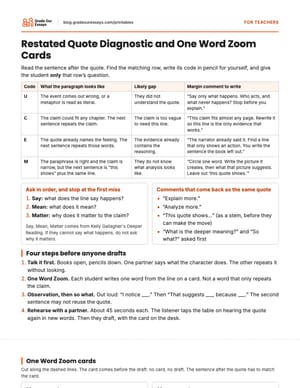
| What the paragraph looks like | Likely gap | One question or move | Sample margin comment |
|---|---|---|---|
| The event comes out wrong, or a metaphor is read as literal. New wording, flipped plot. | They did not understand the quote. | Pencils down. They say what happens, and what does not, before anyone writes. | “Say only what happens. Who leaves, and what question never gets asked? Stop before you explain.” |
| The claim could fit any chapter. The quote is specific, and the next sentence repeats the claim. | The claim is too vague to connect to this line. | Ask what this line proves that a different chapter could not. They rewrite the claim in one clause. | “This claim fits almost any page. Rewrite it so this line is the only evidence that works.” |
| The quote already names the feeling. The next sentence repeats those words and stops. | The evidence already contains the reasoning. | Ask which words already state the point, then swap in an action the narration does not explain. | “The narrator already said she is lonely. Find a line that only shows an action. You write the sentence the book left out.” |
| The paraphrase is right and the claim is narrow. The next sentence puts “this shows” on the same line. | They do not know what analysis looks like. | One word zoom. Which word does the work, and what changes if it disappears? | “Circle one word. Write the picture it creates, then what that picture suggests about her choice. Leave out ‘this quote shows.’” |
On the kitchen line, “her family asked where she was going and she told them” is a misread. Stop there. “The theme is family” is too wide for this quote. “She felt alone and did not want their questions” already finished the thinking. The sample paragraph is the last row: the reading is fine, and nothing new got written.
Selecting and integrating the quote comes first. This table starts once the quote is on the page.
Why does “explain more” come back as the same quote?
“Explain more” says the paragraph is short. The student adds the only sentence they know, a paraphrase of the quote.
“This quote shows” has an empty slot, and a synonym fills it. After the student can make the move, a reasoning starter is a fair way to begin. Before that, it only smooths the restatement.
“What is the deeper meaning?” and “so what?” ask for the whole interpretation at once. The student reaches for the only meaning they trust, the one already printed in the line. A smaller question has one job: the event, one word, the claim, or a better line.
The National Writing Project’s Teach Write Now page describes Say, Mean, Matter, from Kelly Gallagher’s Deeper Reading: what the line says, what it means, and why it matters. Keep the three questions. Ask them in order, and stop at the first one the student cannot answer. If they cannot say what happens, do not ask why it matters.
That order lines up with how explanation is scored. On the Texas STAAR informational writing rubric for grades 6 through English II, a top score for organization and development of ideas wants evidence from the text that is “clearly explained.” A lower score may include evidence that is “insufficiently explained.” A restated quote lands in that lower band. If your rubric words the row differently, match the question to that line.
What do you write instead of “analyze more”?
“Analyze more” is a verdict. The student can nod and still not know the next sentence. Write one question from the matching row, then stop. A long margin note is a second essay they will not finish.
On a class set, mark the evidence row and leave the other rows for later. A pencil code is for you: U if the line was misread, C if the claim is too wide, E if the quote already explains itself, M if they need a model. The student sees the question, not the letter.
Ask the question in a conference and wait. They write the new sentence while you are standing there. Talk that never becomes a line is gone by the next period. Once the paper is turned in, a revision loop holds the same line: one comment, one change you can point to, before the grade is final.
If you want a first look at the evidence row before those conversations, Grade Our Essays can draft trait-level feedback aligned to state writing rubrics. You review every score before a student sees it. A free trial for 14 days does not require a credit card. Use the draft to spot restatement. The margin question is still yours to choose.
Use four steps before they write the paragraph
Run this before anyone drafts. The times below are a plan for one period.
- Talk it before writing it. Two minutes, books open, pencils down. One partner says what the character does. The other repeats it without looking. If the repeat turns into the theme, they were not on the line. Switch. Nobody writes yet.
- One word zoom. Each student writes one word on a blank card, not a word that only repeats the claim. On this line, “before” does more than “kitchen.” The card holds that word only.
- Observation, then so what. Still out loud. “I notice ___.” Then “That suggests ___, because ___.” The second sentence may not reuse the quote. “So what” belongs here, after an observation the narrator did not already supply.
- Oral rehearsal with a partner. About 45 seconds each. The listener taps the table when they hear the quote again in new words. They do not hand over a better sentence. The writer tries once, then drafts, and the card stays on the desk. The sentence after the quote has to match the card.
Model the tap with a weak sentence you wrote, then the repair. Keep the current class’s papers off the board. If the tap becomes a joke, repair one example in front of the class and send them back to the draft.
The same quote with a second sentence that analyzes
Same kitchen line. The student understood it, then repeated it.
Before: She “left the kitchen before anyone could ask where she was going.” This quote shows that she left before they could ask where she was going, which shows she is pulling away from her family.
After: She leaves “before anyone could ask.” The word “before” means the question never starts. She is not turning an answer down. She is making sure there is nothing to refuse, and that is how the chapter shows her pulling away.
A wrong after sentence can still be analysis, and you can coach it. A photocopy leaves you nothing to coach. This one names a word and adds a distinction the quote never states: refusing an answer is different from refusing the chance to be asked.
A vague claim needs a different repair. “The theme is family” fits too many pages to need this quote. “She would rather skip the talk than be seen leaving” gives the line a job. Fix the claim before you ask for more sentences.
Try This Tomorrow
- Write four short paragraphs yourself, one per gap, and have the class match each one to a question before they open their draft.
- On the next literary paragraph, the card comes first: one word, the picture it creates, and what that picture suggests. No card, no draft.
- Copy the four margin comments onto a half sheet. Write only the comment that matches your code. “Analyze more” stays off the sheet.
- Stay until the new sentence is on the page. If you have to move on, they write the spoken line before you leave, and you initial the card.
Frequently Asked Questions
What if they can say the analysis and still write a restatement?
Talking and drafting are different jobs. Have them write the sentence they just said before they add anything else. If that line slides back into the quote, they are not ready for a new question.
Should I ban the phrase “this quote shows”?
Ban it for the week you teach the move, so the stem cannot hide a paraphrase. When the sentence after the quote adds a thought that is not already in the line, let the phrase back. Keep checking that the thought is actually new.
Does this fit a short constructed response, or only a full paragraph?
An SCR often has room for one quote and one sentence after it, so that sentence is the whole analysis. Use the one word zoom and skip the partner steps. The four gaps stay the same.
What if there is no time to meet with every student?
Meet first with the misreads. A wrong reading spoils every sentence they add later. For the other gaps, they answer the margin question in writing beside the quote, and you sample those replies before you accept the set.