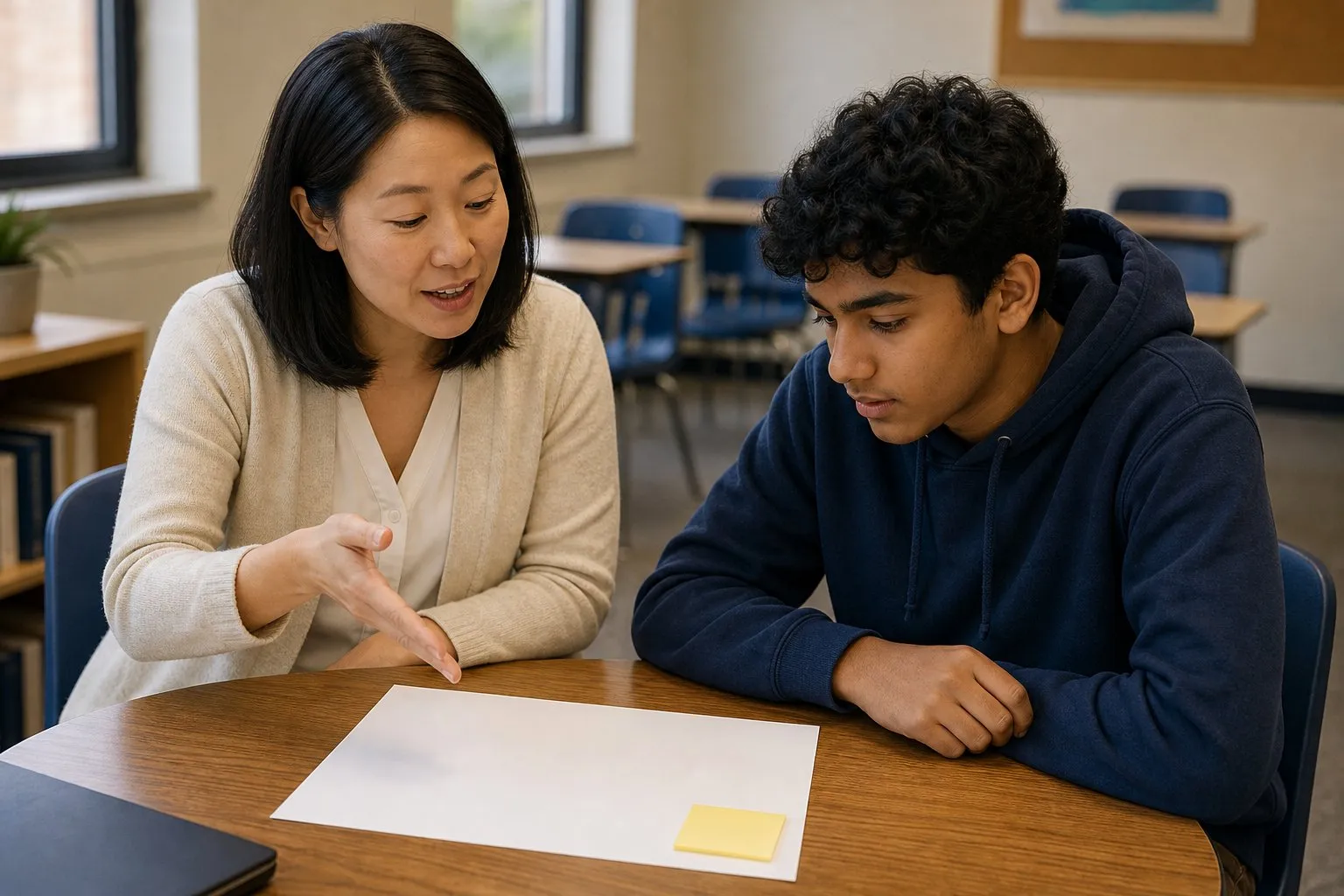
Run writing conferences with a large class by meeting each student for about three minutes on one sentence, and by rotating six students a period so a class of thirty is done in a week. Five sections at that pace is about 150 students, inside the periods you already teach. The student brings a note that names one rubric row and one sentence. You say whether that sentence does the job, name the next change, and stay until the new line is on the page.
A fifteen minute talk about the whole draft does not fit this load. Most writers would never get a chair. The short meeting works because the job is the same every time, and the rest of the class has work while you are busy.
A corner table and five classes of thirty
Picture five sections of 10th grade English, about thirty students in each. A literary analysis is due next week: how the author shows that a character is afraid to tell the truth. Last time, you wrote comments. Students opened the file, looked at the score, and left the note. A few fixed a comma. Almost nobody touched the sentence after the quote.
A conversation is the feedback they can repeat, so a small workshop books fifteen minutes and rereads the draft. Thirty students at fifteen minutes each is seven and a half hours for one class. Five classes eat the week. Keep the corner table. Drop the fifteen minutes.
Why do students skip the comment and still want a conference?
The score is what goes home. A paragraph of notes feels optional once the number is on the paper. Spoken feedback is harder to walk past, because you are waiting for an answer and the next student can see the timer.
Hours of written comments still get treated as a postscript. A long meeting with every writer assumes a small class. On a roster of 150, talk through one sentence on the essay that matters this month.
NCTE’s statement on professional knowledge for the teaching of writing describes a writing conference as talk while a draft is still in progress: the student explains the work, and the teacher suggests a change. That judgment is not the final grade. Say it in the chair: “Nothing I say here is your score.”
What fits in three minutes?
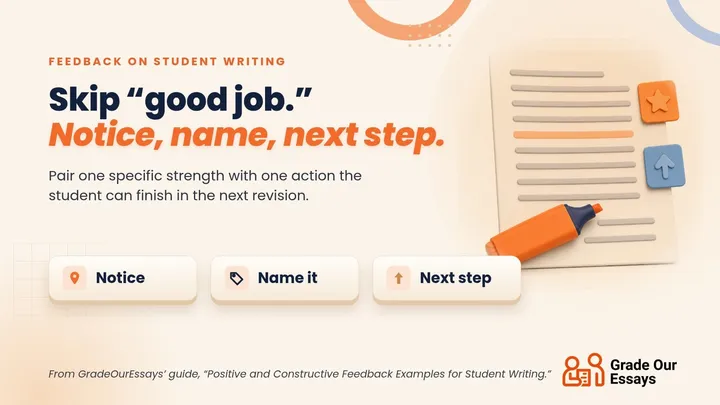
An NCTE article on short writing conferences describes the meeting as one focus, one strength the writer already showed, and one next step. Hunting every error does not survive a timer.
Use one row from a rubric of two or three criteria. If this essay is claim, evidence, and explanation, those are the only rows. Commas wait for an editing day on the calendar. Mention spelling on the way out, and spelling becomes the conference.
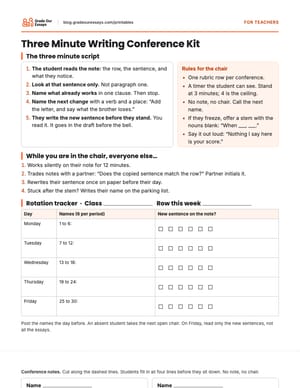
- The student reads the note: the row, the sentence, and what they notice. “How do you think it went?” eats the first minute.
- You look at that sentence only. Start at paragraph one and the timer dies on the introduction.
- Name what already works, in one clause. “You did answer the prompt.” Then stop.
- Name the next change with a verb and a place. “Add the letter, and say what the brother loses.”
- They write the new sentence before they stand. You read it. They put it in the draft before the bell.
A finished exchange sounds like this. The note says evidence, sentence 3: “This shows the theme of honesty.” You say: “That line names a theme and never uses the text. Add the letter Mara hides, and say what it costs her brother. Write it now.” The new sentence: “When Mara hides the letter, her brother finishes dinner without knowing she already chose for him.” You say: “Put that in place of sentence 3. I am not scoring today.”
If they freeze, offer a stem and leave the nouns blank: “When Mara ___, her brother ___.” Dictate the sentence and you held the conference with yourself.
Set a timer the student can see. Stand up at three minutes even if the line is rough. Four minutes is the ceiling, for a writer who needed the stem. Five minutes means you started editing, and the last name loses a chair.
| Written comments on the set | Fifteen minute conference | Three minute rotation | |
|---|---|---|---|
| What the student gets | A score and a paragraph they can skip | The whole draft, talked through | One row and one new sentence |
| One class of 30 | A weekend of comments, then a hope they read them | About 7.5 hours | Six students a day, done in a week |
| Five classes, about 150 | Notes that shrink by Thursday | Does not fit the school day | Six students each period, done by Friday |
| Where it fails | The number lands and the note does not | Most students never sit down | You reread the essay and the list collapses |
Treat the hours as arithmetic you can check with a timer, not as a study. Still seated at five minutes means the script slipped.
How do you reach 150 students in a week?
See six students in each of five periods, thirty conferences a day. Each class keeps its own list and finishes on Friday.
Post the names the day before. A surprise conference feels like a trap. A posted list is something they can prepare for.
| Day | Who sits down in each period | How many | Done means |
|---|---|---|---|
| Monday | Names 1 to 6 | 6 per class, 30 in the day | A new sentence on the note |
| Tuesday | Names 7 to 12 | 6 per class | Same |
| Wednesday | Names 13 to 18 | 6 per class | Same |
| Thursday | Names 19 to 24 | 6 per class | Same |
| Friday | Names 25 to 30 | 6 per class | Same |
Six times three minutes is eighteen minutes, and six times four is twenty four. Hold them in one block. Scattered talks run long because you restart the script each time you sit down.
An absent student takes the next open chair, or uses the written note if Friday comes first. Do not add lunch meetings for absences. Call the next name from the list. The student who hovers is not next.
What should the student bring to the chair?
No note, no chair. They go back, write it, and you call the next name. Losing a turn stings once. After that, the notes are ready.
Four lines, on a sticky note or at the top of the doc:
- Row: claim, evidence, or explanation
- Sentence: copied, with the paragraph number
- What I see: one line in their words
- Next change: add, cut, or replace, and what
This is the same move as answering “is this good?” with a row instead of a yes. In the aisle you stay on your feet. In the chair, one sentence gets rewritten. If they ask whether the whole essay is good, point at the note.
Send back a note that says “everything” or “my introduction.” A useful note says evidence and sentence 3. Model both with a paragraph you wrote, the day before the list starts. They picked the row. You only say whether that sentence does the job.
What is everyone else doing during conferences?
Six quiet meetings fall apart if the room has nothing to do. Give the same job to every student who is not in the chair.
- Twelve minutes of silent work on the note, so later names still have a sentence to point at.
- Partners trade notes, not essays. One question: “Does the copied sentence match the row?” They initial the note. They do not say whether the paper is good.
- A finished note means they rewrite the sentence once, on paper, before their day. The conference starts from a real try.
- A short parking list for writers stuck after the stem. You see them only if a chair opens. Otherwise they are first tomorrow.
When a hand goes up, point at the board: “I read the note in the chair. I do not answer ‘is this good’ from the aisle today.”
End the meeting the way a revision loop ends a written comment. The change has to be visible. Talk that never becomes a line is gone by the next period. The new sentence goes on the note in their handwriting, then into the draft before the bell.
If the stack is already in and you want a first look at each trait before Monday, Grade Our Essays can draft that feedback, aligned to state writing rubrics. You review and approve every score before students see it. A free trial for 14 days does not require a credit card. Use it to choose the row, not to replace the chair. A pen, a sticky note, and a timer run the same week.
On Friday, read the new sentence for that day’s students, not all 150 essays. If the draft still says “this shows the theme of honesty,” the meeting did not stick. Say so in one line. Do not book a second conference to repeat the first.
Try This Tomorrow
- Pick one class and six names for the next period. Tell them today which row is allowed. Evidence is a strong first row when the quotes have been plot summary.
- Put the four line note on a sticky, or paste it at the top of the doc. Run the script on a weak paragraph you wrote, so the first student is not the rehearsal.
- Set a timer the student can see. Stand up at three minutes. Still talking at five means you are editing.
- Give everyone else the partner check on the note. Do not start a movie or a worksheet that ignores the sentence.
- Before you leave, read those six new sentences and nothing else. Post the next list before the bell.
Frequently Asked Questions
Can I meet every student for fifteen minutes if I spread it across the month?
Not on a normal teaching day. Thirty students at fifteen minutes each is about seven and a half hours for one class. Use a longer meeting only when the schedule already gives you that block.
What if a student shuts down in the chair?
Stop talking about the draft. Offer the stem, or send them to write at their desk and take the next open chair tomorrow. If they are upset about more than the paper, use the support process your school already has.
Do short constructed responses need this conference?
No. A short response needs one comment and one new sentence, checked in about a minute while you stay standing. Save the chair for an essay of several paragraphs, or the rotation fills with exit tickets.
What if the essays are already graded?
Hold the conferences on the next essay, before you enter the score. A talk about a grade that cannot move teaches students the conversation does not matter. If you can still change the number, name the one row that can move it and keep the same script.
Should I keep a record of every conference?
The note in the student’s handwriting is the record, and the new sentence in the draft is the proof. A log of 150 summaries is another pile. If you need a mark for yourself, write the verb you assigned and stop.