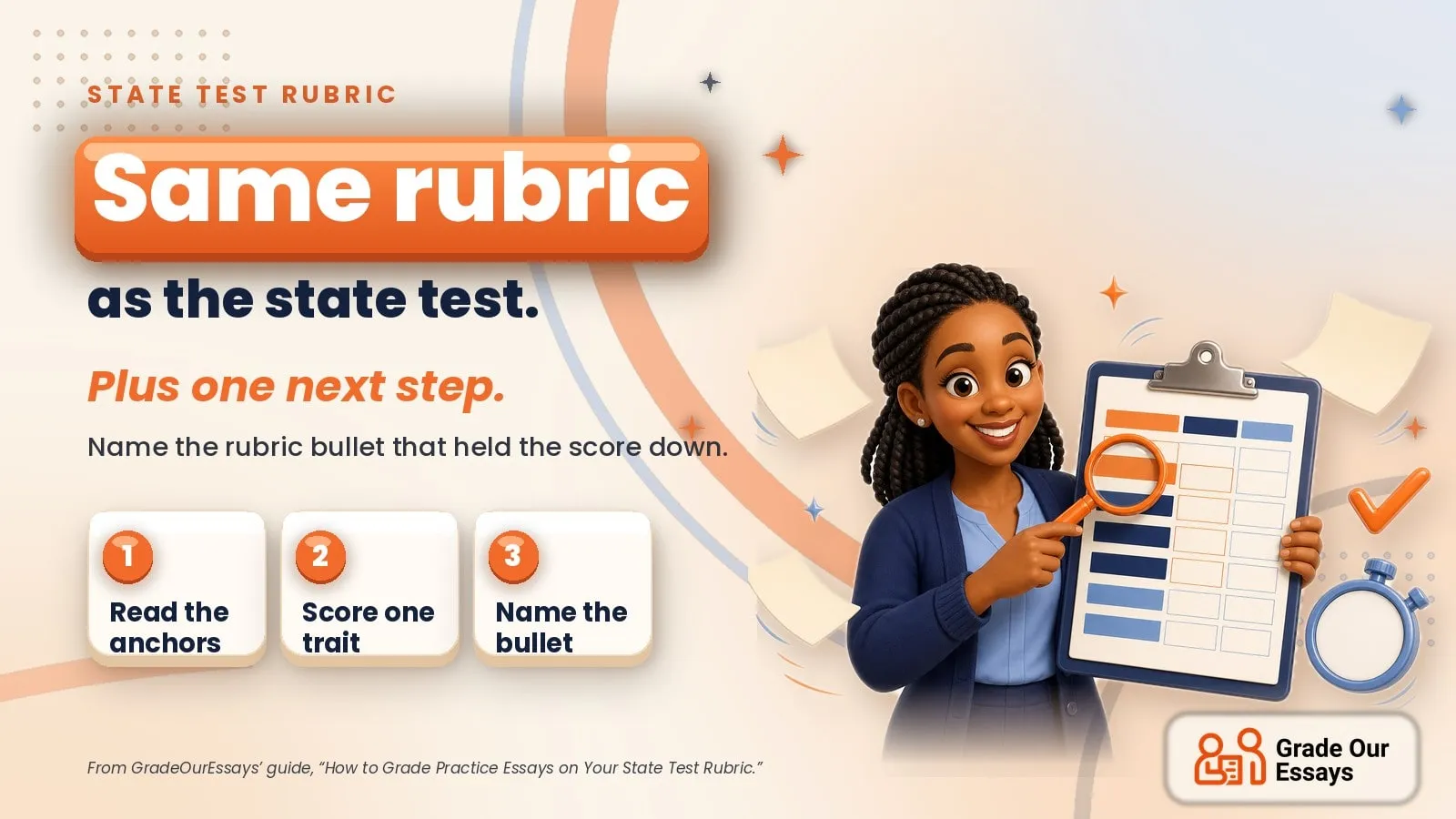
Yes, grade practice essays on your state test rubric when the practice matches the test: same genre, same kind of prompt, and a draft written in one sitting. Score it trait by trait, then add one note naming the part of the rubric row that held the score down, because a bare 2 out of 3 tells a student almost nothing. For skill lessons, early drafts, and genres your state doesn’t test, use a shorter rubric built around what you taught.
Why does the state rubric feel useless on a Tuesday essay?
Because it was built to sort thousands of on-demand responses, not to teach one. State scoring is holistic. The Texas Education Agency’s explanation of how STAAR constructed responses are scored describes responses being judged as a whole against preset criteria, with scorers trained on anchor papers at every score point.
That design is right for a test. It’s awkward in a classroom. Look at the STAAR extended constructed response rubric: one trait, development and organization of ideas, is worth up to 3 points, and conventions is worth up to 2. That single ideas row bundles four separate things: the thesis, the organization, the evidence, and the expression of ideas. A student who gets a 2 can’t tell which of the four pulled them down.
So teachers drift into one of two habits. Some never touch the state rubric, and the spring score surprises everybody. Others score every essay on it, hand back a 3 out of 5, and watch students shrug.
When should you use the state rubric, and when shouldn’t you?
Here’s where I land. Use the state rubric when the practice essay could plausibly sit on the test. Skip it when the assignment is teaching one skill.
| Assignment | Use the state rubric? | Why |
|---|---|---|
| Timed practice essay in the tested genre | Yes | Students should see how the test reads this kind of draft |
| Benchmark or midyear writing check | Yes | You want a score you can compare across the year |
| Short constructed response practice | Yes, the SCR rubric | Use the short rubric, not the essay rubric |
| A paragraph practicing one skill | No | Score the skill you taught, using two or three rows |
| A first draft headed for revision | Not yet | Score the final draft, coach the first one |
| Personal narrative your state doesn’t test | No | The test rubric doesn’t fit the task |
The middle ground matters. If your district rubric has more rows than students can hold in their heads, our post on how to cut your writing rubric to three criteria covers the everyday essays. Save the full state rubric for the drafts that are meant to look like the test.
Two more cautions. Make sure you’re using the current version from your state’s assessment page, since states revise rubrics and post new ones. And match the rubric to the task. An essay rubric used on a two sentence answer will make every response look weak.
How do you score a practice essay on the state rubric?
Five steps. The first one takes a few minutes per unit, not per essay.
- Read the released scoring guide before you grade. Many testing states release scoring guides with annotated anchor papers; Texas posts them for STAAR reading language arts, for example. Read two or three at the score points you’re likely to see, and pay attention to the annotations explaining why a paper earned its score.
- Score one trait at a time across the set. Read every essay for ideas first, then go back for conventions. Mixing them lets strong spelling inflate a weak argument.
- Write down the bullet that decided the score. For a bundled row like STAAR’s, name which of the four parts held the paper down. That’s the note the student actually needs.
- Pick one next step per student. One trait, one place in their essay, one move. Not a list.
- Convert carefully if it goes in the gradebook. A 3 out of 5 is not a 60 percent. Our guide to turning rubric scores into fair grades shows how to build a level chart, including for state scales.
Step 3 is where the teaching happens. The score says where the student is. The bullet says what to do about it.
A worked example on the STAAR rubric
The essay below is a sample written for this post. It isn’t a real student’s work, and the scores are my own read using the rubric’s wording, not an official STAAR score.
Picture a 9th grade English I class doing a timed informational practice essay. The prompt: Explain how the town’s decision to close Main Street to cars on weekends affected local businesses. Use evidence from the article.
Sample essay (written for this post)
Closing Main Street to cars on weekends was good for some businesses and bad for others. The article explains both sides.
First, restaurants did better. The article says “outdoor seating tripled on the first weekend.” Restaurants had more space for customers. People like eating outside when the weather is nice.
Second, some stores did worse. The hardware store owner said “my customers can’t carry lumber three blocks.” This shows that not every business benefits from fewer cars.
Overall, closing Main Street helped restaurants but hurt stores that sell heavy things. The town should think about this.
Now run it through the four bullets of the ideas row on the 2026 English I informational rubric.
| Rubric bullet | What the sample does | Where it sits |
|---|---|---|
| Controlling idea | Clear: helped some, hurt others | Strong |
| Organization | Intro, two body paragraphs, conclusion | Adequate, but the links are “First” and “Second” |
| Evidence | Two relevant quotes, only one explained, and the first is followed by an opinion | Limited, insufficiently explained |
| Expression of ideas | Plain and general (“bad for others,” “heavy things”) | Basic |
On my read, that’s a 2 for ideas. The rubric’s 2 level describes evidence that is “insufficiently explained,” and that’s this paper. Conventions look solid, so a 2 there, for a total of 4 out of 5 on one reader’s scale. Remember that STAAR sums two scorers, so the state reports essays out of 10.
If the student only sees “4/5,” they’ll assume they’re fine. If they see “Ideas 2: your evidence is quoted but not explained,” they know what to fix. The restaurant paragraph is the place: “People like eating outside when the weather is nice” is an opinion, not an explanation of the quote.
How does Grade Our Essays handle state rubric scoring?
This section describes how the product works according to GOE’s own pages, checked on November 24, 2026. It’s a walkthrough, not a hands-on review.
Grade Our Essays is built for exactly this job: a class set of essays on one prompt, scored on an official state writing rubric, grades 3 to 12.
- Create the assignment and pick the rubric. You write the prompt, let AI draft one, or upload your own, then choose your state’s rubric. The state rubric library is organized by state and grade, covers all 50 states, and splits essay (ECR) rubrics from short constructed response (SCR) rubrics, so a short answer gets the short rubric.
- Run it like a practice test. The pricing page lists timed assessments with extension requests on every plan. Students join with a class code, don’t create accounts, and type in the browser, with text-to-speech, speech-to-text, and graphic organizers built in. It scores typed writing only, not handwriting.
- Each essay is scored trait by trait. Every score quotes the student’s own sentences, so you can see what drove the call and check it without rereading the whole essay. Scores flagged for review are marked so you check those first.
- Each student gets revision steps. Each one names what needs work by rubric trait, quotes where to look in the essay, gives the revision move, and ends with a self-check.
- You review, adjust, and release. You can change any score or comment, and you choose when students see their feedback. After review, you can see which skills the class needs to work on next.
- Keep the record. The pricing page lists class score averages and CSV export of assignments and scores on every plan, which is handy when you want to line up a fall practice essay against a winter one.
Here’s an illustration I wrote by hand for the sample essay above. It follows the four-part pattern GOE describes, but it is not real product output.
- What needs work: Development of ideas, evidence. Your quotes are good, but the first one isn’t explained.
- Where to look: “People like eating outside when the weather is nice.”
- The move: Replace that sentence with one that starts “This shows…” and connect outdoor seating to how much money restaurants made.
- Self-check: Does every quote in your essay have a sentence after it that explains what it proves?
For teachers, that means practice essays scored on the state’s criteria, evidence attached to every score, and the final say on each one. For students, it means plain-language feedback while they still remember the essay, tied to the rubric they’ll see in spring.
One caution I’d hold onto. Don’t trust any first read, human or AI, until you’ve checked it. Calibrate on a few released anchor papers, then spot check the highest, lowest, and flagged scores before you release. Our post on checking AI essay scores walks through that routine. If you want to try it on your next practice essay, there’s a free 14-day trial with no credit card required.
When does state rubric scoring backfire?
When it becomes the only feedback students ever get. A steady diet of 2s and 3s on a bundled row teaches students that writing is a number. Pair every state score with one specific next step, and keep using shorter skill rubrics between practice essays.
It also backfires when the practice doesn’t match the test. A take-home essay revised over three days will usually look stronger than the same student’s timed draft. Label which essays are test-style and which aren’t.
And it backfires when you skip calibration. Score a point high all fall and spring results will be a shock. Reading the released anchors once per unit is the cheapest fix.
Try This Tomorrow
- Download your state’s current scoring guide for your grade and read the annotations on two anchor papers at the middle score point.
- Sort your next four assignments into “state rubric” and “skill rubric” using the table above.
- On your next practice essay, add one line per paper naming the rubric bullet that held the score down.
- Make a level chart before any rubric score goes into the gradebook.
- Tell students which essays are test-style practice, so they know what the score means.
Frequently Asked Questions
Should I use the state test rubric for every essay?
No. Use it for practice essays that match the test’s genre and conditions, and for benchmarks you want to compare over time. For skill lessons and early drafts, a two or three row rubric built around what you taught gives students clearer feedback.
Why do students ignore state rubric scores?
Because a bundled score like “Ideas 2” doesn’t say what to fix. Add one note naming the part of the row that held the score down and one place in the essay to revise.
How do I make my practice scores match the state’s?
Read the released scoring guide and anchor papers for your grade, score a few anchors yourself before checking the official scores, and adjust if you’re consistently a point off on one trait.
Can Grade Our Essays score on my state’s rubric?
Its rubric library covers official state writing rubrics for all 50 states, grades 3 to 12, including SCR rubrics. You pick the rubric when you create the assignment, and you approve every score before students see it.
Should a state rubric score go straight into the gradebook?
Not as a raw percentage. A 3 out of 5 isn’t a 60 percent in rubric terms, so convert with a level chart first.