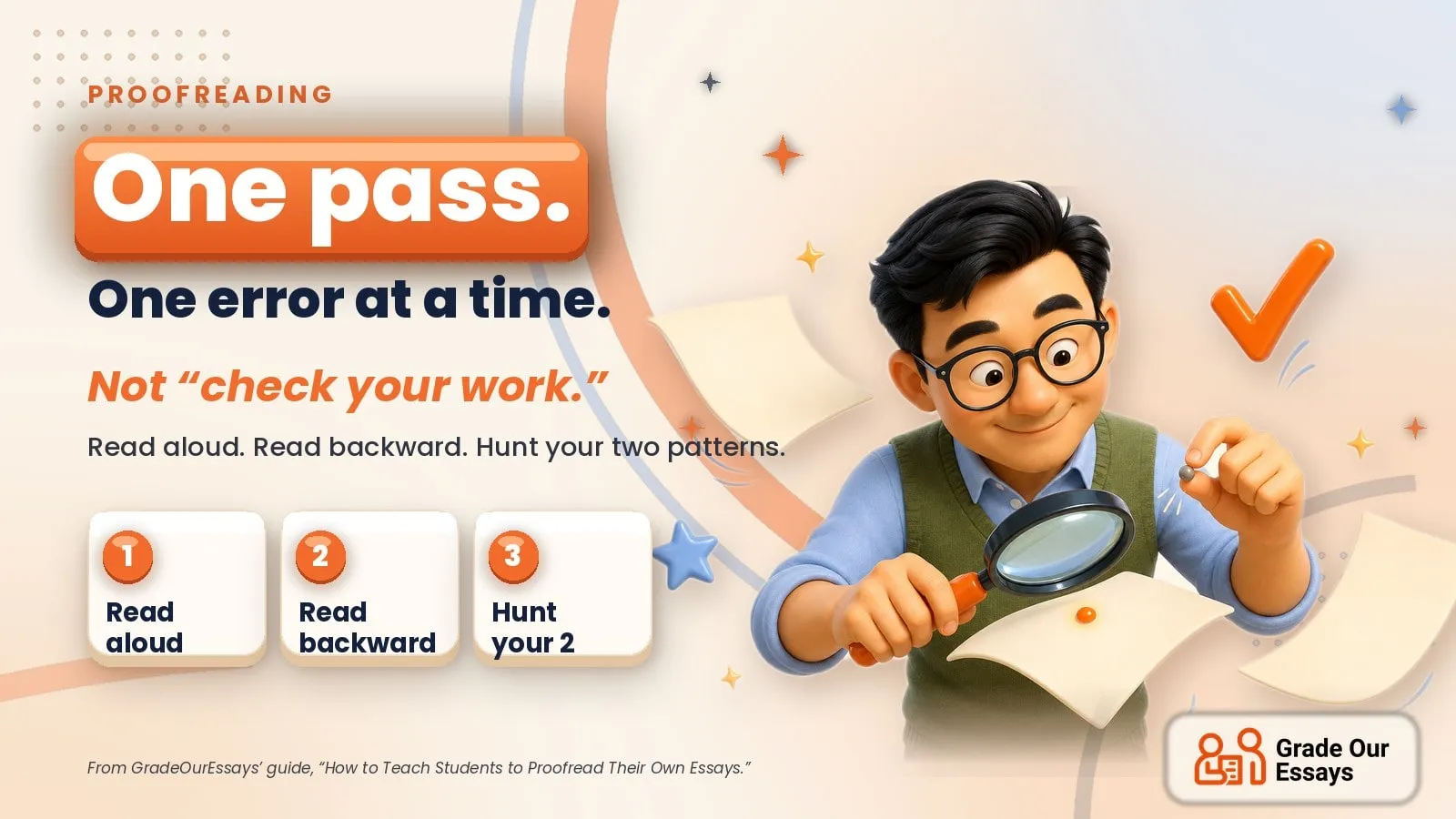
To teach proofreading, stop saying “check your work” and teach it as a short routine of separate passes: one kind of error per pass, read aloud or backward so the brain stops filling gaps, and a personal search for the two errors each student makes most. Students miss their own mistakes because they read what they meant to write, not what’s on the page. A five-minute routine that hunts one error at a time catches more than a 20-item checklist ever will.
Why don’t students catch their own mistakes?
Picture an 8th-grade class turning in argumentative essays on Friday. You told them to proofread. Most of them say they did. Then you open the stack and find “their” for “there,” three sentences fused into one in paragraph 2, and “alot” four times in the same essay.
Most of those students aren’t lying. They reread the essay, but they read it for meaning, and their brain quietly fixed every error on the way through. They know what the sentence was supposed to say, so that’s what they see. An educational psychologist writing for schools this fall made the same point: while a writer’s attention is still on the idea, the error stays invisible. “Check your work” is an instruction with no steps in it.
Three habits make it worse:
- Revising and proofreading feel like the same job. Ask students what revising means and many will say “fixing mistakes.” So they do neither well.
- The checklist becomes a ritual. A 15-box editing checklist gets ticked top to bottom in 40 seconds, and the student’s eyes never leave the checklist.
- Spell check feels like proof. No red underline means “done,” even though spell check happily accepts “form” for “from” and “their” for “there.”
Revising, editing, proofreading: what’s the difference?
Name the three jobs out loud and keep them apart. When students try to strengthen an argument and catch comma splices in the same read, they mostly do whichever is easier.
| Job | Question it answers | When | Example fix |
|---|---|---|---|
| Revising | Does the essay say what I mean, with enough support? | First, after the draft | Add a reason, move a paragraph, rewrite the claim |
| Editing | Are my sentences clear? | Second | Split a 60-word sentence, fix an unclear “it” |
| Proofreading | Is the surface correct? | Last, right before submitting | Spelling, end punctuation, capitals, homophones |
Proofreading goes last for a practical reason. There’s no point fixing the spelling in a paragraph that’s about to be cut. If your students still treat revision as fixing errors, start there; our guide on teaching revision for constructed responses covers that side.
The Common Core writing standards bundle these skills together. From 4th grade on, Writing standard 5 asks students to strengthen writing “by planning, revising, editing, rewriting, or trying a new approach,” and the elementary and middle grade versions add that editing for conventions should show command of that grade’s Language standards (CCSS ELA standards). The standard names the skill. It doesn’t tell you how to get a 13-year-old to actually do it. That’s what the routine below is for.
The five-minute proofreading routine
Run this as a timed block on the day essays are due, before anyone submits. Students do one pass at a time, and nobody moves on until you call the next pass.
- Pass 1: Sentence endings (90 seconds). Read the essay aloud in a whisper voice, or listen to it with text-to-speech. Wherever your voice stops, there should be a period. Wherever a “sentence” runs past one breath, look for two sentences hiding in it.
- Pass 2: Spelling, backward (90 seconds). Start at the last word and read backward, word by word. This breaks the meaning, so the eye has to look at each word instead of predicting it. Circle anything that looks off.
- Pass 3: Your two patterns (60 seconds). Each student searches only for their own two most common errors (more on that list below). Use Ctrl+F on a laptop. On paper, scan with a finger.
- Pass 4: Capitals (30 seconds). Sentence starts, names, and the title of the text they’re writing about.
- Dot the margin. Students put a small dot in the margin next to every fix they made. Count the dots. Students like seeing the number, and you’ll see who skipped the routine.
Why so short, and why split? A reader hunting for everything at once finds very little. A reader hunting only for missing periods finds most of them. Every proofreading guide we read while researching this post landed on some version of that point: model a single check first, and add a second only once the first one works.
For grades 3 to 5, cut it to two passes: sentence endings and capitals. Add spelling once those stick. An acronym like CUPS or COPS works fine at this age, as long as students run it one letter at a time instead of all four in one read. The Institute of Education Sciences has a free sample lesson plan for the COPS editing strategy for grades 2 to 4 if you want a model lesson.
A worked example on a sample paragraph
Here’s a paragraph we wrote for this post. It’s a sample, not real student work, written to look like a typical 8th-grade body paragraph answering “Should school start later?”
Sample paragraph (written for this post, grade 8, before proofreading): Starting school later would help students do better in class. Alot of teenagers dont get enough sleep their bodys are on a diffrent schedule then adults. When students are tired they cant focus, they fall asleep in first period and miss important information. If school started at 9:00 instead of 7:30 there grades would improve.
Run the passes in order. This writer’s two patterns are apostrophes in contractions and then/than.
| Pass | What the student finds | Fix |
|---|---|---|
| 1. Sentence endings | Sentence 2 keeps going after “sleep.” Sentence 3 joins two complete thoughts with a comma | Period after “sleep.” Period after “focus.” Comma after “tired” and after “7:30” |
| 2. Spelling, backward | “diffrent,” “bodys,” “Alot” | different, bodies, A lot |
| 3. Personal patterns | “dont,” “cant,” “then adults” | don’t, can’t, than adults |
| 4. Capitals | “Their” now starts a new sentence | Capital T |
Notice what the passes didn’t catch: “there grades” in the last sentence. Spell check won’t flag it, and backward reading won’t either, because “there” is a real word. That’s the gap a personal pattern search fills. Once there/their/they’re goes on this student’s card, Ctrl+F for “there” finds it in seconds. Until then, it’s the error you mark.
After proofreading (with “their” fixed): Starting school later would help students do better in class. A lot of teenagers don’t get enough sleep. Their bodies are on a different schedule than adults. When students are tired, they can’t focus. They fall asleep in first period and miss important information. If school started at 9:00 instead of 7:30, their grades would improve.
The argument isn’t any better. That’s revision’s job (the claim needs evidence, and “grades would improve” needs a reason). But now you can read it for the argument without tripping on every line, and so can the student.
How do students find their two error patterns?
This is the step that makes proofreading personal, and it’s the one most checklists skip. A 4th grader and an 11th grader shouldn’t be hunting for the same things. One needs capitals and end marks. The other may already know commas are where they get into trouble.
Here’s how to build each student’s list without adding a pile of work:
- Pull from your last round of feedback. Hand back the previous essay and have students tally the convention marks you made. The two biggest tallies go on an index card or the inside of their writing folder.
- Keep it to two. Five patterns turns back into a checklist. Two is a search they’ll actually run.
- Swap a pattern out when it’s fixed. When a pattern disappears for two essays in a row, it comes off the card and the next one moves up.
| If this keeps showing up | The search to run |
|---|---|
| Run-on sentences | Read aloud, and put a period at every stop |
| there/their/they’re | Ctrl+F each spelling and check every hit |
| Missing apostrophes in contractions | Ctrl+F “dont,” “cant,” “wont,” “isnt” |
| “alot,” “should of” | Ctrl+F the exact phrase |
| Lowercase “i” | Ctrl+F ” i ” with spaces |
| Punctuation around quotations | Find every quotation mark and check where the comma or period sits |
If a student’s card is mostly punctuation, our post on what to do when students don’t use punctuation goes deeper on teaching the rule itself. Proofreading only catches what a student already knows is wrong. When an error stays invisible after the routine, that’s a reteach, not a proofreading problem.
How Grade Our Essays helps with the pattern list
The hard part of the pattern list is the first step: knowing which errors each student repeats. With five sections of essays, you can’t track that by hand for every kid.
Grade Our Essays scores each essay trait by trait on your state’s writing rubric, and conventions is one of the traits its feedback is built around. For each trait it drafts a revision step that names the trait, points to a specific place in the essay, and gives one move the student can make now. The example GOE uses on its own feedback page: instead of “Watch your grammar,” the note says three sentences in paragraph 2 run together, so read it aloud and add a period wherever you pause. Every score shows the sentences it was based on, and nothing reaches a student until you review and release it.
On the sample paragraph above, that kind of note would point to the run-together sentences in the middle of the paragraph and give the read-aloud move. The student gets their first card pattern in their own sentences, and you can check the call against the quoted sentences before it goes out.
For teachers, the benefit is consistent trait-level scoring on the same rubric across the whole stack, with you approving every score. For students, it’s feedback they can act on: a place and a move instead of a red circle with “sp” next to it. GOE is FERPA and COPPA compliant, students join with a class code, and there’s a free 14-day trial with no credit card required.
The routine works with or without it. GOE just takes the tallying off your plate.
What doesn’t work (and when proofreading isn’t the problem)
A few things look like proofreading instruction and don’t do much:
- Long checklists handed out with no modeling. Students tick boxes. Model one item with a think-aloud on a sample paragraph first.
- Peer editing with no focus. A partner looking for “anything wrong” finds one misspelling and stops. If you use peers, give each one a single job, the way our guide on peer review for student essays describes.
- Proofreading on the same screen they drafted on. The essay looks too familiar. A printout, a bigger font, a different background color, or text-to-speech all make it look new enough to see.
- Correcting every error yourself. If you fix all 40, the student copies your fixes and learns nothing about finding them. Mark the first instance of a pattern, or put a dot in the margin of the line, and let them find it.
And sometimes the errors aren’t careless at all. A student who never puts a comma after an introductory clause may not know the rule. A multilingual learner may hear the sentence as correct. More proofreading time won’t help either one. Teach the convention, then put it on the card.
Try This Tomorrow
- Write “Revise, Edit, Proofread” on the board with one question under each, and ask students which one they usually skip.
- Before the next essay is submitted, run only Pass 1 (sentence endings, read aloud) for 90 seconds. Have students dot the margin for every fix and count the dots.
- Hand back last week’s essay and have each student tally your convention marks and write their top two on an index card.
- On your next stack, mark only the first instance of each error with a margin dot instead of correcting every one.
- Project the sample paragraph above and run the passes together as a class before students try it alone.
Frequently Asked Questions
What’s the difference between editing and proofreading?
Editing improves how sentences read: clarity, length, unclear words. Proofreading is the final surface check for spelling, punctuation, capitals, and homophones, done right before submitting.
Should students use spell check and grammar tools?
Yes, as one pass, not the whole job. Spell check misses real words used wrong, like “there” for “their” or “form” for “from,” so students still need their personal pattern search.
How long should proofreading take?
For a typical middle school essay, about five minutes if it’s done in separate timed passes. Much longer than that and students start skimming.
Why do students find errors in a classmate’s essay but not their own?
They know what their own essay is supposed to say, so they read the meaning instead of the words. Reading aloud, reading backward, or changing the font helps break that.
What if a student keeps making the same error after proofreading?
Then they probably don’t know the rule yet. Reteach that convention with a few examples, then add it to their two-pattern card so they search for it every time.