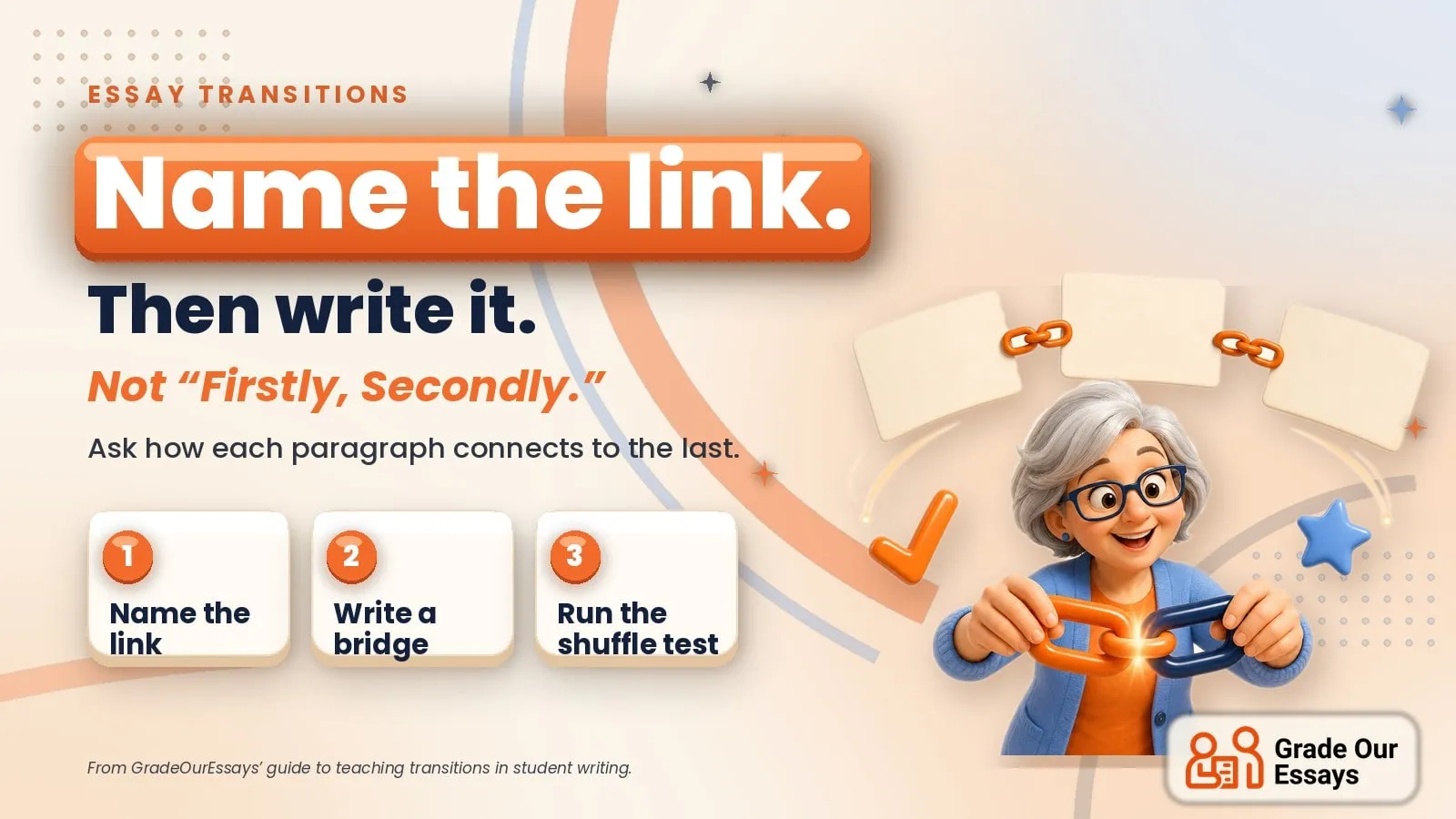
Teach transitions as the relationship between two ideas, not as words from a list. Before students pick a connector, have them name how the new paragraph relates to the last one (it adds, contrasts, causes, gives an example, or answers an objection), then write a bridge sentence that names both ideas. The transition word comes last, and sometimes it isn’t needed at all.
Why do essays still read “First… Second… In conclusion”?
Picture a 7th grade argument essay on whether the school day should start later. The body paragraphs open like this:
Sample student essay (written for this post): body paragraph openers, first draft First, school should start later because students are tired. Second, students would do better in class. Another reason is that students would be late less. In conclusion, school should start later.
Every sentence has a transition. The essay still reads like four notes stapled together, and the comment most of us reach for (“choppy,” “work on flow”) doesn’t tell the student what to change.
Teachers writing about this fall describe the same loop. Instruction stops at a word list sorted by category, students drop “furthermore” into drafts without knowing what it signals, and essays get longer without getting more connected. Students can often explain out loud how two ideas connect, but the link never reaches the page. They know why paragraph 3 follows paragraph 2. The reader doesn’t.
A transition word signals a connection. If the connection isn’t in the writing, no word can fake it. As the UNC Writing Center’s handout on transitions explains, transitions aren’t just decoration. They tell readers how to think about the idea that comes next.
What do the standards actually expect at each grade?
The expectation grows a lot between elementary and high school, which is one reason the “First, Second, Third” habit sticks. It was the right answer in 3rd grade. Here’s how the Common Core writing standards describe it for argument and opinion writing (your state’s wording may differ, so check the rubric your students are scored on).
| Grade | What the standard asks (opinion/argument, standard 1c) | What it looks like in a student essay |
|---|---|---|
| 3 | Use linking words and phrases (because, therefore, since, for example) to connect opinion and reasons | “I think recess should be longer because we need to move. For example, …” |
| 6 | Use words, phrases, and clauses to clarify the relationships among claims and reasons | Transitions start doing logical work, not just counting |
| 7 to 8 | Also create cohesion and clarify the relationships among claims, reasons, and evidence (grade 8 adds counterclaims) | Topic sentences that point back to the claim |
| 9 to 10 | Link the major sections of the text, create cohesion, and clarify relationships between claims, reasons, evidence, and counterclaims | Paragraph openers that connect the last section to the next |
| 11 to 12 | All of the above, plus varied syntax | The connection is built into the sentence itself |
Notice what disappears in the upper grades: any list of words. “Firstly” links nothing.
Four kinds of transition trouble (and what each one needs)
Before you reteach transitions, sort a stack of drafts by the kind of problem. It keeps you from teaching a word list to students whose real issue is a missing idea.
| What you see | What’s going on | What to teach |
|---|---|---|
| “First… Second… Another reason… In conclusion” | Counting, not connecting. The paragraphs could be shuffled and nothing would change | Bridge sentences that name the old idea and the new one |
| “However” where nothing contrasts, “Therefore” where nothing follows | The student knows transitions are expected but not what each signals | The five relationships (below), one at a time |
| Two sentences side by side with a jump between them | A missing step in the reasoning. The link is in the student’s head | Add the missing sentence, not a connector |
| “Furthermore” or “Moreover” opening every other sentence | Stacking connectors to sound formal | Cut half of them and read it aloud |
Watch the third row. When a paragraph feels choppy, the fix is often a missing sentence of explanation, the same gap you see when students restate a quote instead of analyzing it. Adding “Moreover” makes it sound smoother and say nothing more.
How do I teach transitions as relationships instead of words?
This routine fits in one or two class periods and holds up all year.
- Teach five relationships, not fifty words. Post them where students can see them: adds to (also, in addition), contrasts (however, but, while), causes or results (because, so, as a result), gives an example (for example, for instance), and answers an objection (even so, still, although). Five is enough for grades 4 to 10.
- Name the relationship first. For each pair of body paragraphs, students write in the margin how paragraph B relates to paragraph A, using one of the five. If they can’t, either the paragraphs are out of order or one doesn’t belong.
- Write a bridge sentence. It names the idea just finished and the idea coming next, in the student’s own words: “Being tired doesn’t just make mornings miserable; it shows up in grades.” No list word needed.
- Decide whether a connector still helps. Sometimes the bridge needs “as a result” to be clear. Often it doesn’t.
- Run the shuffle test. Cut a draft into paragraphs, swap two body paragraphs, and have a partner read it. If no one notices the swap, the transitions are labels, not links.
The shuffle test is the part students remember, and it gives partners something concrete to check during peer review. If students plan with an organizer, add a small box between reasons for “how this connects to the last one.” Most graphic organizers for essays have a box for every reason and none for the connections, so students never plan them.
A worked example: revising the sample essay
Here’s the sample essay after one round of the routine, with the relationship the writer named in the middle column.
| First draft opener | Relationship named | Revised opener |
|---|---|---|
| First, school should start later because students are tired. | (opens the argument) | When a teenager is up past 11 doing homework, a 7:30 bell means starting the day short on sleep. |
| Second, students would do better in class. | causes or results | That missing sleep doesn’t stay at home; it follows students into first period, where tired students remember less of what they hear. |
| Another reason is that students would be late less. | adds to | A later bell would also help with a problem the office deals with every morning: students who miss the bus and walk in late. |
| In conclusion, school should start later. | (closes the argument) | Thirty extra minutes would give students more sleep, sharper mornings, and fewer late passes, which makes it worth the change to the bus schedule. |
Sample student essay (written for this post): revised body paragraph 2 That missing sleep doesn’t stay at home; it follows students into first period. A tired student can copy notes but has trouble remembering them the next day, so a sleep problem quietly turns into a grades problem.
Look at what changed. The revised openers don’t use fancier transition words; most use none. Each one points back to the idea before it (“That missing sleep,” “also help”) and forward to the new point. The conclusion stopped announcing itself and started answering the question. For students who need a stem, “That ___ doesn’t just ___; it also ___” is a good one. (In a real assignment, the revised paragraphs would still need evidence from the sources students were given.)
When to let students keep “First” and “Second”
Don’t ban list words for everyone. In grades 3 to 5, linking words inside a paragraph are the actual goal; a 3rd grader who writes “because” and “for example” in the right places is doing the work. “First” and “Next” are fine at any grade when sequence really is the relationship, as in a procedure. On a timed state test, a clear “First… Next” essay beats a half finished one with elegant bridges.
Push harder from about 7th grade on, in argument and literary analysis. By 9th grade, aim for openers that connect one section to the next, since that’s what the standard describes.
How should I give feedback and score transitions?
Score transitions by one question: can the reader tell why this paragraph comes next? Don’t count transition words. A checklist that rewards “uses at least three transitions” is how the “Furthermore” stacking starts. Comments work better when they name the place and the move:
- Counting: “Paragraph 3 starts ‘Another reason is.’ How is this reason connected to the sleep problem in paragraph 2? Write one sentence that names both.”
- Wrong signal: “You wrote ‘However’ in paragraph 2, but the next sentence agrees with the last one. Pick a word that means ‘adds to’ or cut it.”
- Missing link: “I can’t tell how being late connects to grades. Add the sentence that explains it.”
- Stacking: “Cut every ‘Moreover’ in this paragraph and read it aloud. Put one back only if the paragraph needs it.”
How Grade Our Essays helps with transition feedback
The hard part is volume. Each student needs to hear which kind of transition trouble they have and where, and writing that 30 times is where the evening goes.
Grade Our Essays scores each essay trait by trait on the state writing rubric you pick, for grades 3 to 12 and for informational, opinion, argumentative, and narrative writing. Transitions usually live under an organization or development trait, depending on your state’s rubric. Each score quotes the student’s own sentences as evidence, so you can check the call quickly, and each student gets drafted revision steps in plain language: what needs work by rubric trait, where to look in the essay, the revision move to make, and a self-check. Nothing reaches students until you review it, and you can change any score or comment first.
Take the first draft of the sample essay above. A note in that same shape, on the organization trait, might read: “Organization: your body paragraphs start with ‘First,’ ‘Second,’ and ‘Another reason is.’ Look at ‘Another reason is that students would be late less.’ Write one sentence at the start of that paragraph that connects being late to the sleep problem you explained earlier. Self-check: if someone swapped paragraphs 2 and 3, would a reader notice?” You read the drafted feedback, decide whether it fits that student, adjust it if not, and release it when you’re ready.
For you, that means a class set scored consistently on the same state rubric language, with trait level feedback already drafted, so your time goes to the students missing a step instead of to writing “choppy” thirty times. You can also see which skills the class needs next, which tells you whether the five relationships lesson is for everyone or a small group. For students, it means a specific move tied to their own sentence while the essay is still fresh. Students join with a class code and don’t create accounts, essays need to be typed (it doesn’t read handwriting), and the tool is FERPA and COPPA compliant. There’s a free 14 day trial with no credit card required if you want to try it on your current essay.
Try This Tomorrow
- Put the five relationships (adds to, contrasts, causes, gives an example, answers an objection) on the board and leave them up.
- Project one anonymous “First… Second… Another reason” draft and run the shuffle test as a class.
- Have students write the relationship in the margin between each pair of body paragraphs before they revise anything.
- Ask for one bridge sentence per paragraph break, then let students decide whether a connector still helps.
- Retire “choppy” from your comments for a week. Replace it with “how is this connected to ___?”
Frequently Asked Questions
What are transitions in writing?
Transitions are words, phrases, or whole sentences that show how one idea relates to the next. The word is only the signal; the connection has to be in the ideas themselves.
Should I ban “firstly” and “in conclusion”?
Not outright. They’re fine for young writers and for sequence, but by middle school argument writing, ask students to replace them with openers that name the actual connection.
How many transition words should an essay have?
There’s no right number. Score whether the reader can follow why each paragraph comes next, not how many transitions appear.
What’s the difference between a transition word and a transition sentence?
A transition word (“however”) signals one relationship. A transition sentence names the idea just finished and the idea coming next, so it does the connecting itself.
What grade should students start using transitions?
In the Common Core standards, simple linking words like “because” and “also” appear in the early grades, grade 3 adds words like “therefore” and “for example,” and by grades 9 and 10 students are expected to link the major sections of an argument. Check your state’s standards, since wording varies.