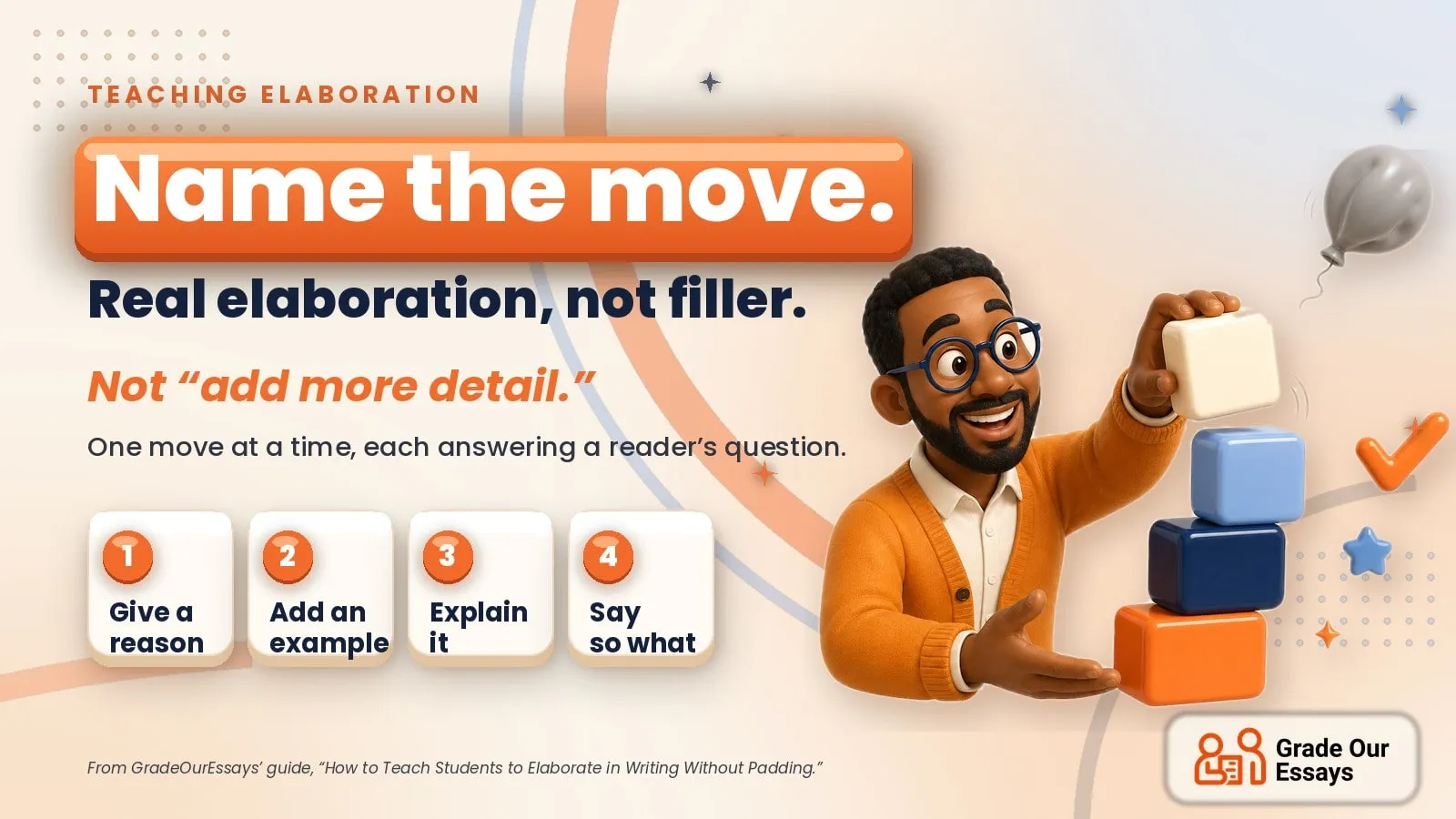
To teach students to elaborate, stop asking for “more” and name the kind of detail the sentence is missing. Most thin student writing is missing one of four things: a reason (why is it true?), an example (what does it look like?), an explanation (how does that prove the point?), or a consequence (so what?). Teach those four as separate moves, model each one on a single sample paragraph, and write feedback that names the move instead of the length.
That last part matters more than it sounds. When “add more detail” comes back as the same paragraph with two extra adjectives, the student usually did what you asked. You asked for more. You got more.
Why does “add more detail” get you longer writing, not better writing?
Teachers keep describing the same cycle this fall. You write “add more detail” or “elaborate” in the margin. The revision comes back with a stronger adjective, the claim restated in new words, or a second example dropped in with no explanation. Students aren’t being lazy, most of the time. They don’t know which detail you mean, and many of them think the paragraph is finished because it technically answers the question.
There’s a real gap between a correct answer and a developed one, and kids can’t see it from the inside. They know what they meant, so the paragraph feels complete to them.
State rubrics make the stakes clear. The Smarter Balanced argumentative rubric used for California’s CAASPP writing task scores a whole trait called Evidence/Elaboration. A 2 on that trait describes “uneven, cursory elaboration,” and notes that development may consist primarily of source summary. Length doesn’t earn the point. A response can run long and still sit at a 2 if the extra sentences only repeat or summarize.
So the fix isn’t a word count. It’s teaching students what a reader needs next.
What does elaboration actually mean in student writing?
Elaboration is any sentence that answers a question a reader would ask about the sentence before it. That’s the whole idea. If you can name the reader’s question, you can name the move.
For argument, opinion, and informational writing, four moves cover almost everything students need in grades 4 through 10:
| Move | The reader’s question | A stem students can borrow | What it adds |
|---|---|---|---|
| Reason | Why is that true? | “…because…” | The logic behind a claim |
| Example | What does that look like? | “For example,…” / “In the article,…” | A specific case, fact, or detail |
| Explanation | How does that prove your point? | “This shows… because…” | The link between the example and the claim |
| Consequence | So what? What happens because of it? | “As a result,…” / “This matters because…” | Why the point is worth making |
Narrative writing is different, and it’s worth saying so out loud. In a story, elaboration means slowing down one moment with an action, a thought, dialogue, or a sensory detail. The four moves above don’t map neatly onto that, so teach narrative elaboration as its own lesson instead of forcing the chart.
In source-based writing (a text-dependent analysis, an SCR, a state performance task), the example has to come from the text. Students who reach for a personal anecdote on a source-based prompt are elaborating, technically, but they’re elaborating on the wrong evidence.
A sample paragraph: thin, padded, and elaborated
Here is a sample I wrote for this article, not real student work. Picture a 6th grade opinion prompt: “Should our school let students use phones during lunch?”
Sample, first draft (thin):
Students should be able to use phones at lunch. Phones are fun. Also it would make lunch better.
Now the version you often get back after writing “add more detail”:
Sample, revised after “add more detail” (padded):
Students should definitely be allowed to use their phones at lunch. Phones are really, really fun and everyone likes them a lot. Also, it would make lunch so much better for everyone. That is why I think students should be able to use phones at lunch.
It’s longer. It isn’t better. Every new word is an intensifier (“definitely,” “really, really,” “so much”) or a repeat of the claim.
Sample, revised one move at a time (elaborated):
Students should be able to use phones at lunch because it is the only free time some of us have to check in with family. For example, a student whose parent works nights might only be able to text them around noon. If that message waits until after school, the parent is already asleep, so the student goes all day without talking to them. Letting phones out for one lunch period would keep that connection open without taking any time from class.
Here’s how those sentences break down:
| Sentence | Move | Reader question it answers |
|---|---|---|
| “…because it is the only free time some of us have to check in with family.” | Reason | Why should they? |
| “For example, a student whose parent works nights…” | Example | What would that look like? |
| “If that message waits until after school…” | Explanation | Why does lunch matter for that? |
| “…without taking any time from class.” | Consequence | So what? Why is this worth it? |
Notice that “Phones are fun” disappeared. The elaborated version is better partly because the writer cut a weak reason to make room for a strong one. That’s a judgment students rarely make on their own, and it’s worth modeling: sometimes elaboration means swapping a reason, not stretching it.
How can I tell padding from elaboration when I’m grading?
Use the cover test. Put your finger over a sentence and reread the paragraph. If the reader loses information, the sentence is doing work. If nothing is lost, it’s padding.
Padding usually looks like this:
- The claim restated with synonyms (“That is why I think…”)
- Stacked intensifiers (“really, really,” “so much,” “a lot”)
- A second or third example with no explanation attached
- A summary of the source instead of a point about it
My recommendation: don’t set sentence minimums for graded work. A minimum tells students that length is the target, and padding is the fastest way to hit it. There’s one fair exception. For very reluctant writers, especially in grades 3 and 4, a minimum during drafting can get words on the page. Just don’t grade against it.
The other direction matters too. More elaboration isn’t always the goal. A short constructed response often needs one strong explanation sentence, not four. If a student nails the explanation in one sentence, pushing for three teaches them that more is better, which is the opposite of what you want. If students tend to quote and then repeat the quote instead of explaining it, that’s a narrower problem with its own fix; I’d start with asking a smaller question about the quote.
Teach one move at a time
Students can’t absorb four moves in one lesson. Spread them across a week or two, one move per mini-lesson, about 15 minutes each.
- Show a thin sample paragraph. Project something like the phone paragraph. Ask the class: “What question would a reader ask after the second sentence?”
- Name the move that answers it. Write the move and its question on the board (“Explanation: How does that prove your point?”).
- Students find one spot in their own draft. They mark the sentence a reader would question most.
- They add one sentence using that move. Then they highlight it, so you can see it at a glance.
- Partners run the cover test. Does the new sentence add information, or could you cover it and lose nothing?
Keep a three-level ladder on the wall for each prompt: a thin version, a padded version, and an elaborated version of the same paragraph. Students compare their draft to the ladder and pick one change. The padded rung is the important one. Most anchor charts only show weak and strong, and students never see that longer can still be weak.
If you’re already running a revision day, this slots right in. The routine in our guide to teaching revision for constructed responses works well with a single elaboration move as the focus.
What should I write in the margin instead of “add more detail”?
Name the move and point to the place. That’s it. Here are swaps based on the sample paragraph:
| Instead of | Write |
|---|---|
| Add more detail. | “Phones are fun” is your reason. Why would fun matter to the principal? Add a “because.” |
| Elaborate. | Sentence 2: give one example of a student who’d need their phone at lunch. |
| Explain more. | You have an example. Add a sentence that starts “This shows…” and connect it back to lunch. |
| Develop your ideas. | End the paragraph by answering “So what?” What changes if the school says yes? |
Once students know the four moves, you can shorten margin notes to a code and a location: R for reason, EX for example, EXP for explanation, SW for “so what.” “EXP, sentence 3” takes two seconds to write, and a student who learned the move knows exactly what to do. For more comment swaps across other traits, see these feedback examples by writing trait.
How Grade Our Essays helps with elaboration feedback
The hard part of elaboration feedback isn’t knowing the moves. It’s writing a specific note for every paragraph in a class set when 25 of them need a different move. That’s where Grade Our Essays fits.
Here’s how the workflow runs. You create an assignment, write the prompt (or have AI draft one, or upload your own), and pick the state writing rubric you’re teaching to. Students join with a class code and write in the browser. Each essay is then scored trait by trait on that rubric, and each score quotes the student’s own sentences so you can check the call without rereading the whole essay. Students also get drafted revision steps: what needs work, named by rubric trait; where to look, quoting their own sentences; the revision move to make; and a self-check so they know when they’re done. You can change any score or comment, and nothing reaches students until you release it.
That revision step pattern lines up with the four moves. Applied to the thin phone paragraph, a step in that shape would name the elaboration or development trait on your rubric, quote “Phones are fun. Also it would make lunch better,” ask the student to replace “fun” with a reason a principal would care about and add one example, and end with a self-check like “Can someone who disagrees see why lunch is the right time?” That’s an illustration I wrote by hand for the sample, not a captured output. Your job in review is to make sure the move it asks for is the one you’d pick.
Where it helps most: the first read of a full class set, when you need specific notes on every paper and also want to see which skills the class needs to work on next. If most of the set is missing explanation sentences, that’s tomorrow’s mini-lesson. Where it doesn’t help: handwritten drafts (it scores typed writing, not handwriting) and narrative quick writes you’d rather respond to in conversation. Teachers can try it with a free 14-day trial, and no credit card is required.
Try This Tomorrow
- Pick one move (start with Explanation) and teach it with a sample paragraph you wrote yourself.
- Have every student highlight the one sentence they added with that move, so you can scan a set in minutes.
- Put a thin, padded, and elaborated version of the same paragraph on the wall for your current prompt.
- Retire “add more detail” for one week. Every margin note names a move and a place.
- Run the cover test on one padded paragraph as a whole class before students revise.
Frequently Asked Questions
What is elaboration in writing for students?
Elaboration is any sentence that answers a question a reader would ask about the sentence before it. In argument and informational writing, that usually means adding a reason, an example, an explanation, or a consequence.
How do I get students to elaborate without just making their writing longer?
Name the move instead of asking for more. Feedback like “Sentence 2: add an example” gets a targeted sentence, while “add more detail” tends to get adjectives and repeated claims.
Should I give students a minimum number of sentences?
For graded work, no, because minimums reward padding. For very reluctant writers, a drafting minimum can help get ideas down, as long as you grade the quality of the moves, not the count.
How is elaboration scored on state writing tests?
Many state rubrics give elaboration its own trait. The Smarter Balanced rubric, for example, scores Evidence/Elaboration on a 4 point scale, and the lower scores describe cursory elaboration or development that mostly summarizes the source.
Does elaboration look the same in narrative writing?
No. In a narrative, elaboration means slowing down a moment with action, thoughts, dialogue, or sensory detail, so it’s best taught as its own lesson.