Teach students to revise a constructed response by assigning one content move, a 10 minute timer, and a letter that names the change. They check the claim against the prompt, then the evidence and the explanation, and they edit spelling only at the end. If the only job is a cleaner sentence, students proofread, and the response still misses the question.
Picture a 9th grade English class, 28 students, on a Thursday. They draft one paragraph on a one page article about a town that closed its public pool. The prompt asks why the town closed it and asks for evidence from the article. You say, “Revise your response,” and set 10 minutes. Three papers have spelling fixes, one has swapped “old” for “outdated,” and the claims still answer a question the prompt never asked.
Why “Revise Your Response” Doesn’t Work
“Revise” does not name a job. On a short response, spelling is the easy job, because a misspelled word is visible and a weak claim is not. A fancier synonym feels like work. It does not change what the paragraph says.
Longer essays teach a later cleanup, after the ideas have moved. An SCR often has one paragraph and a bell, so students do the step they can finish, which is editing. Say the job instead: “Make one move on the claim, the evidence, or the explanation. Star the sentence. Spelling starts in the last two minutes.”
Writing Next (Graham and Perin, 2007) is a Carnegie Corporation report on writing in grades 4 through 12. It lists explicit strategy instruction for planning, revising, and editing as one of 11 practices with research support. A single cue is not that instruction.
The What Works Clearinghouse practice guide on teaching secondary students to write effectively tells teachers to teach strategies for planning, drafting, evaluating, revising, and editing, then let students practice a strategy they have seen. The guide rates that recommendation as having strong evidence for grades 6 through 12. You model one move, they use it on their paragraph, and they can point to the sentence that changed.
We also say “revise” when we mean “deal with the comment.” If students are already skipping notes, start with getting them to use essay feedback. This routine is the skill those notes ask for, including on a day with no comment yet.
What Is the Difference Between Revising and Editing in a Constructed Response?
Revision changes what the response says, or the order of the ideas. Editing changes how the sentences look. A clear rubric usually puts prompt match, evidence, and explanation ahead of conventions. A clean paragraph that answers the wrong question still misses the rows that carry the score.
| Revising | Editing | |
|---|---|---|
| Question the student asks | Does this answer the prompt with a claim, evidence, and a reason? | Can a reader get through the sentences? |
| SCR or ECR example | Replace “the pool was old” with the budget reason, or add why that fact matters | Fix “their” and “there,” or add the period after the claim |
| Time in a 10 minute block | About 8 minutes, in two passes | The last 2 minutes, skipped if content ran long |
| Rubric row it can change | Prompt match, evidence, or explanation | Conventions, when that row is on today’s score |
Ask which column last week’s revision lived in. Most hands land on editing, so one word has been covering two jobs. Keep editing in the block, and keep it last. Drop it when the timer runs out. A comma fix cannot rescue a claim that missed the prompt.
How Can Students Revise an SCR in 10 Minutes?
Teach four moves, and require one. ARMS means Add, Remove, Move, and Substitute. Each letter does a content job.
- Add. A missing claim, one detail from the passage, or a sentence on why the detail fits.
- Remove. A sentence that answers a different question, or a second detail that crowds the paragraph.
- Move. The claim into the first sentence, or the explanation to the spot right after the evidence. On an ECR, one paragraph moves next to the evidence it explains.
- Substitute. A vague claim becomes one that does the prompt’s job, or a repeated fact becomes a reason.
When the move is Add, students still have to choose a detail that answers the prompt. The first line of the article is not automatically evidence.
Run three passes, in this order.
- Minutes 0 to 3, claim and prompt. Underline the task word (why, how, which cause). Read only the first sentence. Substitute if it answers a different task. Add a claim if none is there. Leave spelling alone.
- Minutes 3 to 8, evidence and explanation. Highlight the evidence. Add a detail if none of it comes from the text. Remove a detail that answers a different question. If the next sentence repeats the detail, Substitute a reason. If it only restates a quote, use a smaller question about the quote another day. This pass is not that lesson.
- Minutes 8 to 10, editing. Spelling, capitals, end punctuation. Skip the pass if time is gone. A tidy miss is still a miss.
Model pass 1 before the timer. Read a claim you wrote, name the task word, and Substitute out loud. Then stop.
Students need to see one move. They do not need a performance of all four letters.
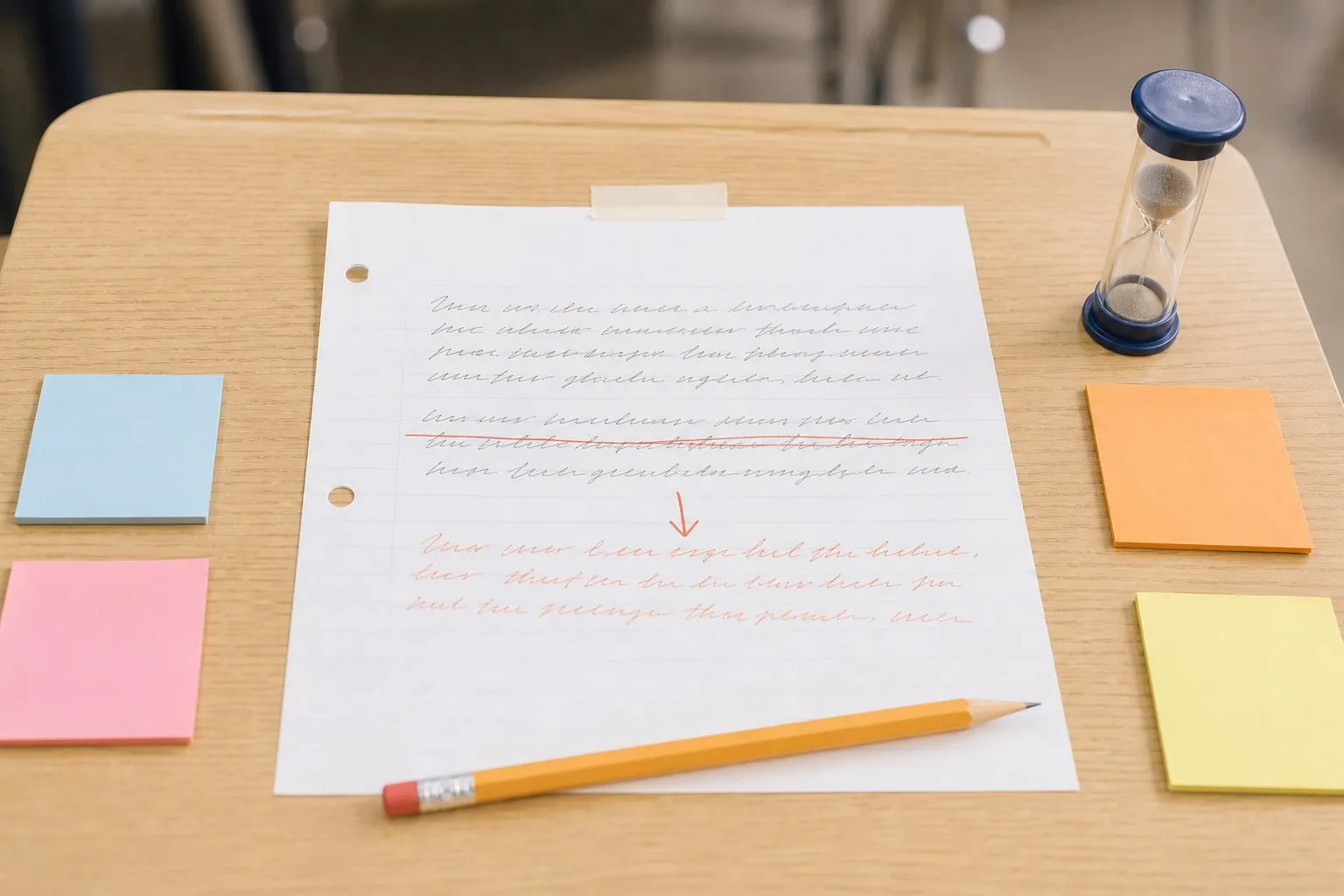
They write A, R, M, or S in the margin and star the changed sentence. The model may show several letters. Their paper gets one. For an ECR, assign one paragraph: “Revise paragraph 2 only.” Revising the whole essay will not fit in 10 minutes.
Worked Example: A Weak SCR Before and After
Project a sample you wrote, and say it is made up. Put three facts on the board: the pool was busy all summer, the repair estimate was larger than the year’s parks budget, and the building opened decades ago. The prompt is, “Why did the town close the public pool? Use evidence from the article.”
The weak response:
The town closed the pool because it was old. This shows the pool was old and they had to close it. The article says the pool opened decades ago.
The claim answers how old the pool was. The middle sentence repeats it and sits before the evidence. “Busy all summer” is a trap: a busy pool is a reason to keep it open.
The revised response:
The town closed the pool because the repair would cost more than the parks department could spend in a year. The article says the repair estimate was larger than the parks budget for the whole year. The town could not pay for that repair from the year’s budget, so the closing was a money decision.
A scorer now has a reason and a detail that match.
| Spot in the weak response | Move | What changed |
|---|---|---|
| “Because it was old” | Substitute | The claim names the budget, which is what the prompt asked |
| “This shows the pool was old,” before the evidence | Move, then Substitute | The reason follows the evidence and states the money gap |
| “Opened decades ago” | Remove | Age does not answer why the pool closed |
| No budget fact | Add | The evidence is the comparison from the article |
Substitute on the claim does the most work. Cut the age detail and leave “because it was old,” and the response is shorter and still wrong. Mark the letters on a copy for four minutes, then start the 10 minute block on their own draft.
How Do You Grade Revision Without Doubling Your Workload?
Score the change, and leave the rest of the response alone.
- Read the prompt, not the whole article.
- Read the starred sentence and any crossed out words still on the page.
- Mark done, or not yet. The new sentence has to do the job that letter promised. A detail about the wrong question is not yet. “Outdated” for “old” is not yet, because the claim did not change.
- One line: “Substitute landed. The claim now answers why.” Or, “Not yet. It still says the pool was old. Use the budget fact.”
At about 30 to 40 seconds a paper, a class of 30 takes about 15 to 20 minutes. That is a timer you choose, not a result from a study. Start on the commas and you have opened a second grading session.
If the star is missing, hand the paper back in class. Searching for a silent change teaches students the label was optional.
This is a different job from scoring a draft in a short pass. That pass scores the draft. This check asks whether one revision happened, and you can skip the score while students learn the letters.
A pen is enough. When you want a first look at which trait is weak, Grade Our Essays can draft that feedback. It uses AI to help grade essays, it is aligned to 500+ state rubrics across all 50 states, and you review and approve every score before students see it. A free 14 day trial does not require a credit card. You still name one move, and the student still makes the change.
Try This Tomorrow
- Put the four letters on the board with one example of each before anyone drafts. That keeps “revise” from becoming a spelling pass.
- On a 25 minute SCR, write for 15 and revise for 10. Stop the draft while time remains.
- No letter means it is not turned in. A draft that already works still needs a line: “S considered, no change, because the claim answers why and the evidence is the budget fact.”
- During pass 2, ask, “Which rubric row does this letter change?” If they say spelling, send them back to the claim or the evidence.
- Tonight, read the starred sentence and write one line. Save commas for a day when editing is the assignment.
Frequently Asked Questions
Should students revise before or after peer review?
Have them make one solo pass first, so a partner has a change to check. The partner asks whether the starred sentence answers the prompt, and a two minute second pass can use that note. If peer review comes first, the talk slides to spelling, because a typo is easier to see than a missed claim.
What about students who change nothing?
Hand it back in class when the letter is missing. If the draft already fits the prompt, the student names the move they considered and why they kept the sentence. A blank margin means the work is not finished.
Can AI tools help with revision?
A tool can flag a missing explanation or a sentence that ignores the prompt. The student still writes the new sentence, labels the move, and stays inside the timer. A tool that rewrites the paragraph is practice in pasting, and you still judge the change against the rubric.
How often should students revise?
Use the 10 minute block two or three times a week on responses you already assign. You do not need a separate revision unit. The short version, repeated, is how students learn that revising and editing are different jobs.
Does this routine work for an ECR?
Yes, on one paragraph. Run the three passes on the body paragraph that is losing points. A full ECR needs more than 10 minutes if every paragraph is in play, so one labeled change on the weak paragraph is the version that fits the period.