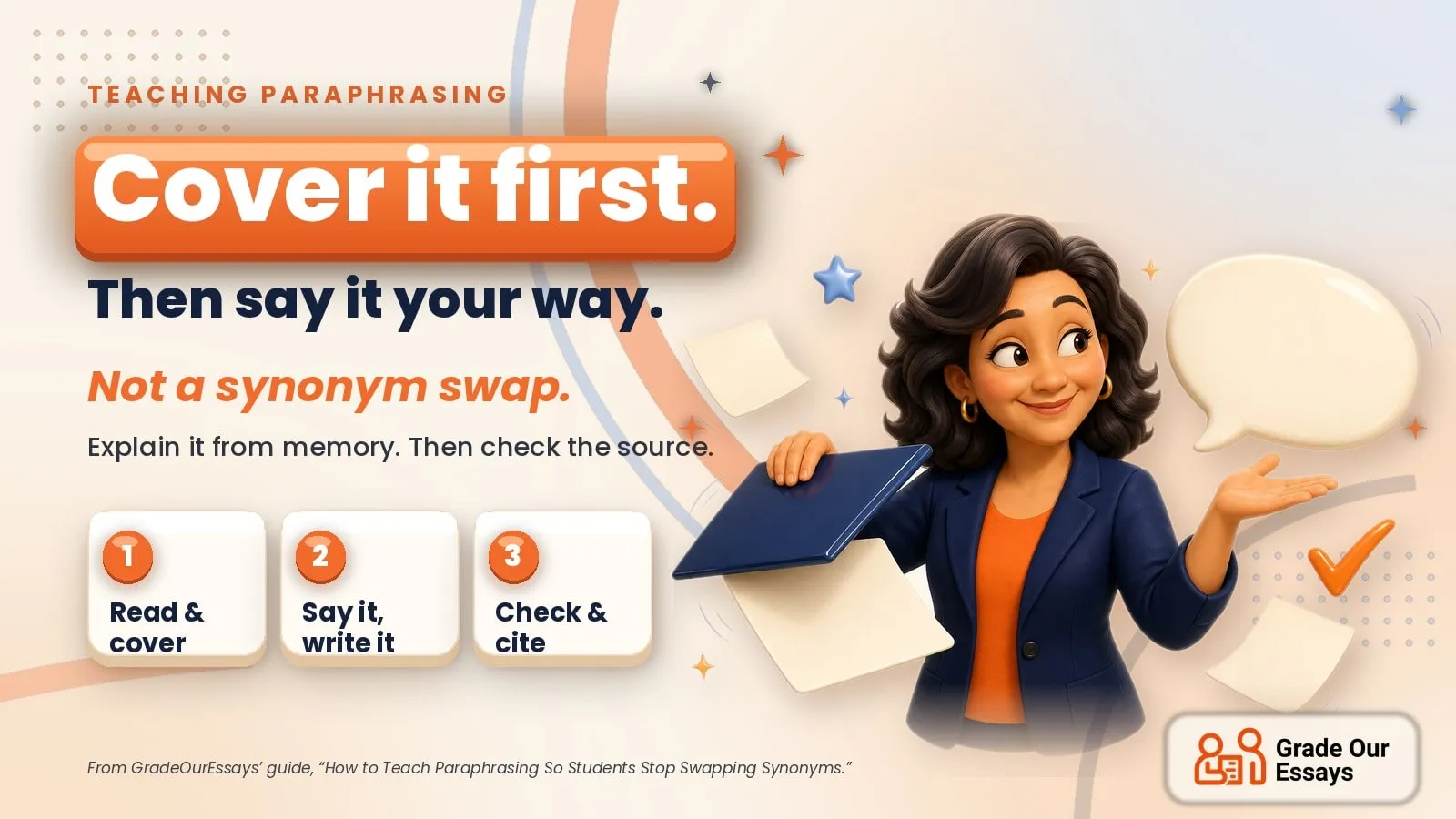
To teach paraphrasing so students stop swapping synonyms, take the source away before they write. Have students read a short passage, cover it, explain the idea out loud from memory, write that explanation down, and then uncover the source to check meaning, borrowed phrases, and the citation. Synonym swapping happens when the original sentence is still in front of the student, so the fix is a routine that makes them work from understanding instead of from the page.
Why do students think swapping synonyms is paraphrasing?
Because it looks like what we asked for. “Put it in your own words” sounds like a word problem, so students solve it at the word level. They keep the author’s sentence, trade “shows” for “indicates” and “length” for “duration,” and hand it in feeling like they followed directions. Teachers writing about this fall have described exactly that pattern, along with a newer one: students copying the answer that appears at the top of a search page, or pasting a source into a rewrite tool and turning in what comes back.
Most of those students aren’t trying to cheat. Nobody has shown them that a paraphrase starts with an idea, not a sentence. Writing guides call the synonym swap “patchwriting.” It’s a normal stage for developing writers, but it isn’t acceptable in finished work, and a rewrite tool just does it faster.
The standards expect more. The Common Core writing standards ask fourth graders to summarize or paraphrase information in notes and finished work, and by grades 6 through 8 students are expected to “quote or paraphrase the data and conclusions of others while avoiding plagiarism” (CCSS ELA, Writing standard 8).
What does a real paraphrase look like?
Show students the difference before you ask them to produce it. Here’s a sample I wrote for this post. Use it as is or swap in a passage from your current unit.
Sample source passage (written for this post): Honeybees tell each other where to find food with a movement called the waggle dance. The angle of the dance shows the other bees which direction to fly, and the length of the waggle tells them how far away the flowers are.
Version A, the synonym swap: Honeybees inform one another where to locate food using a motion named the waggle dance. The angle of the dance indicates to other bees what direction to travel, and the duration of the waggle shows them how distant the flowers are.
Version B, a real paraphrase: When a honeybee finds flowers, it goes back to the hive and dances to share the news. The direction of the dance points the other bees the right way, and the longer it waggles, the farther they have to fly (Source 2).
Version A swapped about a dozen words and changed nothing else. Same sentence count, same order, same structure, same “the angle of the dance.” Version B starts where a reader’s understanding starts (a bee finds food), uses a cause and effect structure the original doesn’t have, and keeps “waggle” because there’s no better word for it. That last point matters. Students should keep technical terms like “waggle dance,” “photosynthesis,” or “Bill of Rights.” Hunting for synonyms for those words is how paraphrases end up wrong.
| Synonym swap | Real paraphrase | Direct quote | |
|---|---|---|---|
| What changes | Individual words | Words, structure, and order | Nothing |
| Shows understanding? | Rarely | Yes | Not by itself |
| Needs a citation? | Yes, and it’s still too close | Yes | Yes, plus quotation marks |
| When to use it | Never in final work | Most of the time | When the exact wording matters |
The cover test: a five step routine students can repeat
This routine is built on the same advice the Purdue OWL gives on paraphrasing: understand the passage, set it aside, write, then check your version against the original. What makes it work in a classroom is doing every step every time until it’s a habit.
- Read it twice. Start with one to three sentences, never a full article.
- Cover it. Flip the paper, close the tab, or put a sticky note over it. This is the step students skip, so make it physical.
- Say it. Students tell a partner what they learned, starting with “Basically, this says…” If they can’t, they don’t understand the passage yet, and no amount of rewording will fix that. Send them back to step 1.
- Write it. They write what they just said, in the order they said it. It will sound like them, which is the point.
- Uncover and check. Students compare their version with the source and ask three questions: Is the meaning still accurate? Did I copy any phrase of three or more words? Did I say where it came from?
If a student finds a borrowed phrase in step 5, they have two honest options: put it in quotation marks or rewrite that part. Both are fine. Leaving it as is isn’t.
Expect step 3 to take the longest the first week. When a student stalls with the source covered, comprehension, not wording, is the real gap, and that often lines up with the students who restate a quote instead of explaining it.
A classroom scenario: the research paragraph that sounds too polished
Picture a seventh grade science research project on pollinators. A student who usually writes short, plain sentences turns in a paragraph full of words like “facilitate” and “subsequently,” with the exact sentence order of the first website on the search page.
The productive move is a two minute conference. Ask, “Forget the paragraph for a second. What did you learn about how bees find flowers?” Most students can tell you something true in plain words. Write down what they say, hand it back, and say, “That’s your paraphrase. Add where you learned it.” The student leaves having paraphrased from understanding once, which is the habit you want.
If the paragraph turns out to be pasted from a chatbot or rewrite tool, that’s a different conversation, and our guide on what to do when you think a student used AI walks through it without turning it into an argument. Either way, set your rule for rewrite tools before the project starts.
What should I write instead of “use your own words”?
“Use your own words” is the comment that created the synonym swap in the first place. Students read it as “change the words.” Name the step they skipped instead.
| Instead of | Try |
|---|---|
| Use your own words. | Cover the source and tell me what this paragraph taught you. Then write that. |
| Too close to the source. | Your second sentence follows the source sentence word for word in the same order. Start with the cause instead. |
| Cite your sources. | You learned this from Source 2. Add “(Source 2)” at the end of the sentence. |
| Don’t plagiarize. | “Located in the northern region” is the source’s phrase. Quote it or say it your way. |
| Explain this better. | You kept the facts but not the point. Add one sentence on why this matters for your claim. |
Each one names a place and one thing to do.
How paraphrasing shows up on source-based essays
Many state writing tests hand students a set of sources and ask for an essay that uses them. Those rubrics usually reward evidence that is accurate, relevant, and explained, and quoting long chunks of the passage doesn’t earn much on its own. A student who can paraphrase has more control: they can shrink a long paragraph of source material into one accurate sentence, save quotation marks for the phrase that matters, and spend their writing time on explanation.
On a timed test students won’t flip the passage over, but the habit transfers: read the chunk, look away, say it in their head, then write. Pair it with the selection and analysis routines in our guide to using evidence in SCR and ECR responses, and students have a plan for every source they cite.
How Grade Our Essays helps with source-based writing feedback
Teaching the routine is the easy part. The hard part is the class set: 28 research paragraphs or source-based essays, and every one needs a specific note about where the evidence works and where it doesn’t. That’s where Grade Our Essays fits.
Here’s the workflow. You create an assignment with your prompt (or let AI draft one, or upload your own) and pick the state writing rubric you teach to; the library covers all 50 states for grades 3 through 12. Students join with a class code and type their response in the browser, with no student accounts to manage. Each essay is scored trait by trait, and every score quotes the student’s own sentences, so you can see which lines the evidence score rests on without rereading the whole paper. Students also get drafted revision steps: what needs work, named by rubric trait; where to look in their essay; the revision move to make; and a self-check. You can change any score or comment, and nothing reaches students until you release it.
On the sample above, picture Version A sitting in a student’s informational essay. A useful revision step in that shape would name the evidence trait, point to the waggle dance sentence, ask the student to cover the source and rewrite the idea starting with what the bee does first, and end with a self-check like “Could I explain this sentence to a friend without looking?” That’s an illustration I wrote for this post, not captured output. Your job in review is to make sure the move it asks for is the one you’d pick.
Two honest limits. It scores typed writing, not handwriting. And its job is rubric scoring and feedback, not matching sentences against a source, so the uncover and check step stays with you and your students. What it gives teachers is time back on the first read and consistent, trait level scores across the set; what it gives students is faster, clearer feedback they can act on while the essay is still fresh. Teachers can try it with a free 14-day trial, no credit card required.
Try This Tomorrow
- Put the bee sample (or one from your unit) on the board with Versions A and B. Ask students which one the writer understood, and why.
- Run the cover test on one three sentence chunk as a whole class. Model step 3 out loud yourself first.
- Hand out sticky notes for the next research or source-based task. The note goes over the source during step 4, every time.
- Retire “use your own words” for a week. Every comment names the step the student skipped.
- Tell students your rule for rewrite tools before the next project starts, in writing.
Frequently Asked Questions
What is the easiest way to teach paraphrasing?
Read a short passage, cover it, have students explain it out loud from memory, then write what they said. Uncovering the source afterward to check meaning and borrowed phrases is what turns this into a routine they can use alone.
Is changing a few words in a sentence plagiarism?
Yes, if it’s turned in as the student’s own sentence. Swapping synonyms while keeping the author’s structure is patchwriting. It needs to be either quoted or rewritten from understanding, and it still needs a citation either way.
Do students need to cite a paraphrase?
Yes. The words are theirs, but the idea came from the source. A simple check is to ask “Whose words are these?” and then “Whose idea is this?” If the second answer is the source, it gets a citation.
What grade should students learn to paraphrase?
The Common Core writing standards introduce paraphrasing in notes and finished work in fourth grade and expect students to quote or paraphrase while avoiding plagiarism in grades 6 through 8. Younger students can start with oral retelling, which is the same skill without the pencil.