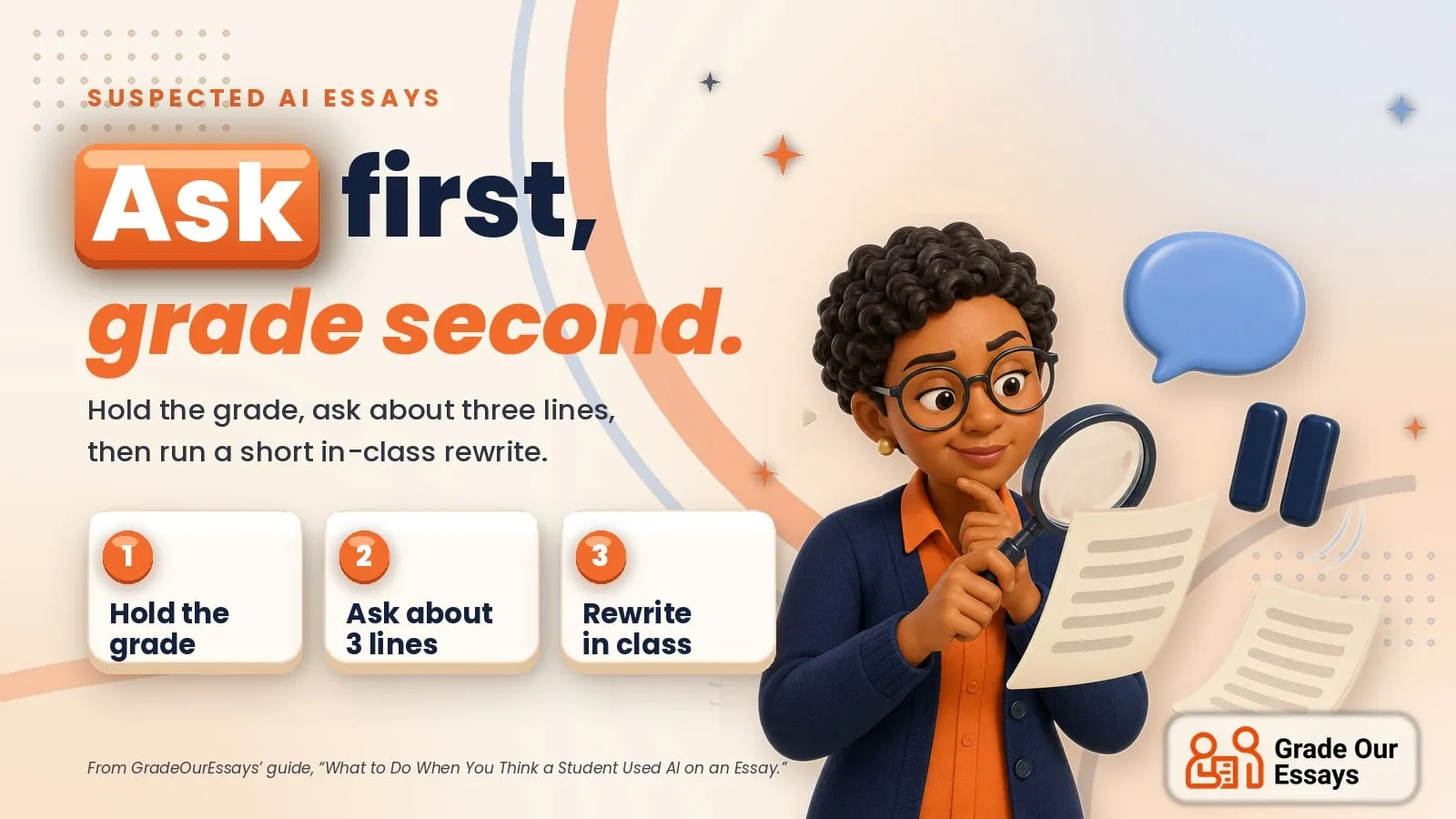
When you think a student used AI on an essay, don’t open with an accusation or a detector score. Hold the grade, pick two or three specific lines, and ask the student to walk you through how they wrote the piece. Then decide from what you heard and saw: a short in-class rewrite of one paragraph usually settles it, and your school’s integrity policy decides the consequence, not your gut.
The hard part isn’t spotting the essay. Most of us can feel it by the second paragraph. The hard part is the five minutes after, when a 14-year-old looks at you and says “I wrote that,” and you have nothing you could show a parent.
Why does this keep going so badly?
Teachers have been describing the same scene all fall. A high school science teacher on Reddit wrote in October that 15 of the 22 essays turned in for a quarter project were AI-written, even after a warning and a second chance to rewrite for partial credit. In another thread, a teacher asked whether students everywhere storm up to the desk to argue a zero for AI use they clearly committed, then go quiet only once the teacher shows the evidence. And an ELA teacher described a quieter version of the problem: autocomplete, sentence suggestions, and pasted search summaries make a whole class sound alike, so it’s hard to tell what any one student understands.
Put those together and the pattern is clear. The suspicion comes fast. The plan for what to do next doesn’t exist, so each conversation turns into an argument about the essay instead of a check on the student’s thinking.
Three things usually make it worse:
- The detector score goes first. Once you say “this came back 90 percent AI,” the meeting is about the software. The student argues with a number neither of you can explain.
- The grade goes in before the conversation. A zero in the gradebook tells the family the verdict came before the hearing, and you spend the next week defending it.
- “It doesn’t sound like you” is the whole case. Students do improve. A parent will say exactly that, and they won’t be wrong to.
Is an AI detector enough proof?
No. Use it as a reason to look closer, never as the evidence. Researchers at Stanford tested several popular detectors on essays by non-native English writers and found the tools consistently misclassified that writing as AI-generated, while also showing that simple prompting got AI text past the same tools. If you teach multilingual learners, that should stop you cold. Their careful, plain sentences are exactly the kind of writing that gets flagged. (We cover how to read their drafts fairly in feedback for multilingual learners.)
What counts as evidence is something you can point to and the student can answer:
- Lines in the essay the student can’t explain or define when asked about them
- Ideas or details that never came up in class and don’t appear in the assigned text
- A document history that shows the essay arriving in one or two big pastes
- A gap between this essay and writing you watched the student do in the room
One of these is a reason to talk. Two or three that line up is a pattern you can describe calmly to a student, a parent, or an administrator.
Before the conversation: a four minute prep
Do this before you call the student over. It keeps the meeting short and keeps you out of an argument.
- Hold the grade. Put “pending” or leave the cell blank. Don’t enter a zero yet.
- Pick two or three lines. Choose sentences with a word choice, claim, or piece of evidence you’d expect the student to explain easily if they wrote it.
- Pull one piece of in-class writing. A quick write, an exit ticket, a timed paragraph. Anything you saw them produce.
- Check your school’s policy. Know whether a conversation like this has to be reported, who decides the consequence, and whether a redo is allowed. If you don’t know, ask before the meeting, not after.
What do I actually say to the student?
Keep the opening neutral and about the work. One high school English teacher writing in Edutopia describes starting with a version of “Tell me what happened here” and then mostly listening, and reports that many students explain on their own once they’re asked an open question. You don’t need a script that clever. You need a few questions only the writer can answer.
Here’s a worked example. The paragraph below is a sample written for this post, the kind of 8th grade body paragraph on The Outsiders that makes you stop.
Sample paragraph: Ponyboy’s relationship with Johnny serves as a profound catalyst for his evolving understanding of loyalty. Through the juxtaposition of the church scene and the rumble, Hinton illustrates that true allegiance transcends the superficial boundaries of social class, ultimately revealing a nuanced portrait of adolescent identity.
Nothing in it is wrong. That’s the problem. Here’s how the questions line up with what you’d want to learn:
| Line in the sample | Question to ask | What a writer usually does | What a non-writer usually does |
|---|---|---|---|
| “profound catalyst” | “What do you mean by catalyst here? Say it another way.” | Fumbles, then gives a plain version (“it’s what makes him change”) | Can’t explain, or repeats the phrase |
| “the church scene and the rumble” | “Which part of the church scene were you thinking of?” | Names a moment, even roughly | Stays general (“the part where they’re there”) |
| “transcends the superficial boundaries” | “Who in the book crosses those boundaries?” | Mentions a character, maybe Cherry | Talks about loyalty in general |
| The whole paragraph | “What did you write first? What did you cut?” | Describes a messy order, a part that was hard | “I just wrote it” |
A few rules that keep this fair:
- Ask about decisions, not definitions you’d fail yourself. A student who used a thesaurus may not define a big word cleanly. Ask what they meant, in their words.
- Don’t make them rewrite under pressure on the spot. Anxious students and multilingual students perform worst in exactly that moment. Offer the in-class rewrite as a next step with notice.
- Invite evidence. “If you have notes, a draft, or document history, bring them tomorrow.” Many students don’t know their process counts.
- Don’t bargain for a confession. “Admit it and we’ll keep it between us” puts you outside your school’s process and can pressure an honest student into a deal.
How do I decide the grade?
Decide after the conversation, using what you heard and what you can show. This table is the decision we’d recommend for most grade 6 to 12 classrooms. Adjust the consequence column to your school’s policy, which always wins.
| What happened | What you do next | Grade |
|---|---|---|
| Student explains the lines and the process clearly | Thank them, say so, and enter the grade | Score the essay as written |
| Student explains some of it, is nervous, has no drafts | Schedule a 15 minute in-class rewrite of one paragraph on the same prompt | Score after the rewrite |
| Student admits using AI | Talk through what got in the way (time, confusion, avoidance) and follow policy | Per policy; a supervised redo if your school allows one |
| Student can’t explain any of it and has no process | Document the questions and answers, then refer it through your school’s process | Pending until the process finishes |
The in-class rewrite does most of the work. Give the same prompt, the same text, and 15 minutes on paper. You’re not looking for an identical paragraph. You’re looking for the same ideas in the student’s own sentences. When the rewrite holds up, you’ve saved yourself a wrong accusation. When it doesn’t, you have something concrete to show a family.
Our recommendation: make the paragraph rewrite your default second step every time, for every student. Using the same move with everyone is what makes it defensible. The moment it depends on who the student is, it isn’t fair anymore.
What do I tell parents?
Tell them what you saw, what you asked, and what happens next. Skip the detector percentage and skip adjectives like “obviously.”
A short version that works:
“I had questions about a few lines in Jordan’s essay, so I asked him about them. He wasn’t able to explain them yet, so he’ll write one paragraph on the same prompt in class on Thursday. I’ll grade the essay after that.”
That message describes the process, not the verdict, and it gives the family a date. (Jordan is a sample name for the example.) If the case goes to an administrator, your notes from the conversation and the rewrite are the record.
How do I stop doing this every week?
You won’t stop every pasted paragraph. You can make fewer of these conversations necessary by collecting writing you watched before the essay leaves the room. A paper plan, a claim written in class, and a short check-in give you a baseline before you ever suspect anything. We walked through that full routine in making the writing process visible, and the quick check-ins fit the three minute format in writing conferences for large classes.
Time is the honest cost here. The conversations take time you’d otherwise spend on feedback. If first-pass rubric feedback is what eats your evenings, Grade Our Essays drafts trait-level comments against your state rubric, and you review and adjust every score before students see it (there’s a free 14-day trial, no credit card). The point is to move your time to the parts only you can do, like these five minute talks.
Try This Tomorrow
- Find one essay in your current stack that bothered you, and write down the three lines you’d ask about.
- Pull one piece of in-class writing from that student to compare.
- Change the gradebook cell to “pending” instead of entering a zero.
- Write your own opening line, something like “Walk me through how you wrote this,” and use it word for word every time.
- Add one sentence to your next assignment sheet: “Keep your notes and drafts. I may ask you to walk me through your writing.”
Frequently Asked Questions
Can I give a zero if I’m sure a student used AI?
Only if your school’s policy allows it and you can show more than a feeling or a detector score. Hold the grade, have the conversation, and use the in-class rewrite before you decide.
Should I tell the student the detector flagged their essay?
Not as your opening, and never as your only evidence. If it comes up, say it’s one reason you looked closer and that you don’t treat it as proof.
What if the student says a parent or tutor helped?
Ask what kind of help. Talking through ideas is different from someone else writing the sentences. Your assignment sheet should say which kinds of help are allowed, and the rewrite still shows you what the student can do alone.
What about students with accommodations?
Keep the same steps and keep the accommodation. If a student dictates or uses a device to write, run the rewrite the same way they normally write. You’re checking whose ideas they are, not testing handwriting.
How long should the conversation take?
About five minutes. If it’s running past ten, you’re arguing. Stop, set up the rewrite, and let that answer the question.