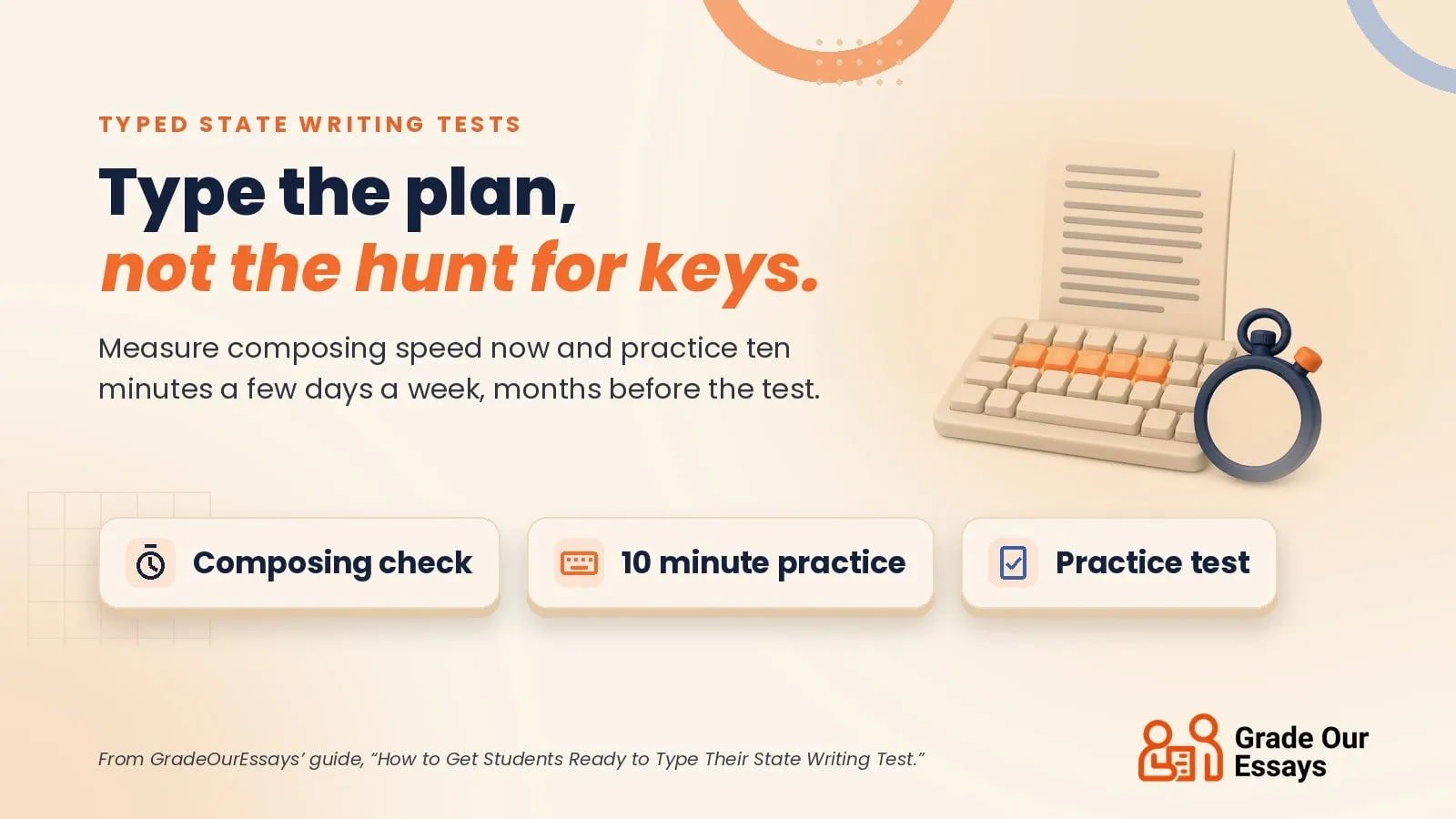
To get students ready to type their state writing test, treat typing as part of writing instruction, not a separate tech skill. Check how fast each student can compose (not copy) on a keyboard using a real prompt, run short typing practice inside ELA a few days a week, and move more of your regular drafting onto the keyboard months before the test. Then let students rehearse in your state’s own practice test so the tools on test day are familiar.
The goal isn’t speed for its own sake. It’s making sure the keyboard stops eating the thinking time a student needs for evidence, explanation, and organization.
Why does typing matter on a writing test?
Picture a 4th-grade class in March. The prompt asks students to read two short articles and write an informational essay. One student has a clear plan on scratch paper: a main idea, three pieces of evidence, a conclusion. Twenty minutes later she has typed four sentences, because she’s still hunting for the shift key and deleting letter by letter with the backspace. Her plan was a 3. What she typed scores a 1.
Teachers keep describing some version of this. A special education teacher in New York City wrote this fall about third graders taking computer state tests for a second year without any formal typing instruction and no clear plan from the state, district, or school to provide it. At a Maryland school board meeting in November, a teacher asked the board to look at how typing is taught, because third graders type their answers on the state ELA test with little practice. A middle school teacher’s spouse described her taking time out of math and history to teach basic typing because there’s no computer class. The same concern is showing up outside the U.S., where an Australian literacy researcher warned this month that many students reach secondary school fluent in neither handwriting nor typing.
There’s research behind the worry. A New South Wales study of online writing tests found that students in Years 2 to 5 scored lower on computer writing tests than on paper ones, and the gap shrank as typing speed went up. The median typing speed for Year 3 students in that study was 9 words per minute, which the report notes is likely slower than children that age handwrite.
If your state’s writing test is typed, typing fluency is part of what the test measures, whether anyone planned it that way or not. (Our state writing tests reference page lists how each state delivers and scores its writing task.)
How fast do students actually need to type?
There’s no single official speed, and you should be suspicious of anyone who gives you one. What the standards do describe is stamina and technique.
The Wisconsin DPI keyboarding page quotes the writing standards: by grade 4, students should have enough keyboarding skill to type a minimum of one page in a single sitting, and by grade 5, two pages. New York’s keyboarding guidance lays out a progression across the grades.
| Grade | What the standards expect | What that means in your room |
|---|---|---|
| 2 | Introduced to keyboarding (NY) | Finding letters, spaces, capitals. No timed work. |
| 3 and 4 | Instruction with a focus on technique over speed (NY); one page in a sitting by grade 4 (WI) | Home row, both hands, short typed paragraphs every week |
| 5 and 6 | Two pages in a sitting by grade 5 (WI); speed and accuracy (NY) | Full typed paragraphs and short essays as routine work |
| 7 and up | Keep improving speed and accuracy (NY) | Typed drafts are the default, not the exception |
The more useful question is local: can this student get their plan onto the screen in the time your test allows? That’s a composing speed, not a copying speed, and you can measure it yourself.
Run a composing check on a real prompt
Typing games measure copying. Copying a sentence you can see is much faster than composing one in your head. For test readiness, you want to know the second number.
Here’s a check that takes one class period and doubles as a baseline writing sample.
- Give a short prompt students can answer without reading anything, like “Should students have homework on weekends? Explain your answer.”
- Set a timer for 10 minutes. Students type in whatever program they’ll use most this year. Spell check off if your test doesn’t have it.
- When time is up, check the word count and divide by 10. That’s their composing rate in words per minute.
- Watch while they type. Note who looks at the keys, who uses one finger, and who stops to fix every typo.
Write the rate on your class list. You’ll use it to group practice and to see who needs more than practice.
| What you see | What it usually means | What to try |
|---|---|---|
| Very few words, eyes on the keyboard the whole time | Letter hunting. Typing is the bottleneck. | Daily technique practice, short typed responses, recheck in four weeks |
| Steady typing, but the response is thin or off topic | Typing is fine. The writing plan is the issue. | Planning and elaboration instruction, not typing drills |
| Lots of words, then deletes half of them | Stops to fix every error | Teach “type through it, fix it after.” Save editing for the last two minutes |
| Faster on paper than on the keyboard, by a lot | May need an accommodation conversation | Talk with the IEP or 504 team. Don’t switch modes on your own |
That second row matters. A slow response isn’t always a typing problem. If a student types fluently and still writes three sentences, more keyboard drills won’t help. Planning will.
A ten minute routine that fits inside ELA
Most of us don’t have a keyboarding class and aren’t getting one before spring. Wisconsin’s guidance suggests a regular block of 15 to 30 minutes a day for five or six weeks when you can get it. If you can’t, short and frequent beats long and rare. Here’s a version that fits inside an ELA block.
| Day | About 10 minutes | Why |
|---|---|---|
| Monday | Technique practice in whatever free typing program your school already uses | Home row and both hands. Accuracy over speed. |
| Tuesday | Type a response to yesterday’s reading in three to five sentences | Composing, not copying |
| Wednesday | Retype a short paragraph from a handwritten draft, adding one detail | Builds speed on words they already chose |
| Thursday | Timed quick write on a simple prompt, then count words | Students track their own composing rate |
| Friday | Use the tools: highlight, cut and paste a sentence, fix a mistake with the arrow keys | The moves they’ll need on test day |
Thursday’s quick write is the one students start caring about. Let them keep a simple chart of their words per minute. Most kids like watching a number go up, and it gives you an easy check every week.
The bigger change is quieter. Move more of your regular drafting onto the keyboard. If students type every short constructed response in November, January, and February, they’ll get more real practice than any drill gives them. Hold on to some handwritten work too, though, especially for planning and for the in class essays many of us now use (here’s how to build stamina for in class essay writing).
Practice the test, not just the keys
Students can type fine and still lose minutes to an unfamiliar screen. Check your state’s testing portal for a practice or training test, and have students use it at least twice before test season, once early and once close to the test.
What to look for while they practice:
- Where the passages live. Can they scroll the article and the answer box at the same time, or do they have to switch tabs?
- Whether spell check exists. Many test word processors don’t have it. If yours doesn’t, turn it off in your practice too, so students aren’t relying on red underlines in March.
- Copy and paste. Some tests let students copy text from a passage into their answer. Teach them to use it for short quotes, then explain in their own words.
- Highlighter and notes tools. Students who annotate on paper all year need to try the digital version before test day.
- Saving and time limits. Know whether the test is timed, whether answers save automatically, and what happens if a student logs out.
If your state’s test is scored by a machine first, how students use evidence on screen matters even more. We covered what the scoring rewards in how to prepare students for a machine scored writing test.
What about students who write better by hand?
Some students will always be faster with a pencil. For most, the answer is still more keyboard practice, started early, because the test format isn’t changing for them.
For students with a disability that affects writing, the answer belongs to the IEP or 504 team, not a single teacher on test day. Accommodations such as a scribe or speech to text are governed by your state’s testing rules, and those rules are specific. If your composing check shows a big gap between paper and keyboard for a student with a plan, bring that data to the team now, not in April.
The worst outcome is a student who learns, in the middle of the test, that the way they normally work isn’t allowed. Decide early and practice the real mode all year.
Make typed practice worth grading
Here’s the catch. Once students type every short response, you have a lot more writing to read. That’s good for them and hard on you.
Two things help. First, score typed practice against just one or two rubric traits at a time (evidence this week, organization next week) instead of the whole rubric. Second, keep feedback to one next step. If a stack of typed responses is still more than you can turn around in a few days, Grade Our Essays drafts trait level feedback aligned to your state rubric, and you review and approve every score before students see it (there’s a free 14 day trial, no credit card required). The routine above works the same either way.
Try This Tomorrow
- Run the 10 minute composing check. One simple prompt, word count divided by 10. Write each rate on your class list.
- Find your state’s practice test. Bookmark it and put a first practice session on the calendar before winter break.
- Pick one weekly typed response. Make Tuesday’s reading response typed, every week, starting now.
- Turn off spell check in practice if your test doesn’t have it.
- Flag the big gaps. List students who are much faster on paper and share it with case managers this month.
Frequently Asked Questions
How many words per minute should students type for state testing?
No state sets an official typing speed for its writing test. A better target is whether a student can compose a full response in the time your test allows. Measure their composing rate on a real prompt and compare it to the length of a strong response.
When should students start practicing typing for the writing test?
Start now if the test is in spring. New York’s guidance puts keyboarding instruction in grades 3 and 4 with a focus on technique, and skills build over weeks of short, frequent practice, not a cram session in March.
Should I let students handwrite their practice essays?
Some, yes, especially for planning and in class writing. But if the test is typed, most practice responses in the months before it should be typed too, so students build speed on composing, not just copying.
Is typing practice a waste of ELA time?
Not when it’s composing practice. A typed response to a reading is writing instruction and typing practice at once. Pure drills should stay short, around 10 minutes, and give way to real writing quickly.
What if a student types much slower than they write?
Recheck after four weeks of practice. If the gap is still large and the student has an IEP or 504 plan, share the data with the team so they can decide on accommodations under your state’s testing rules.