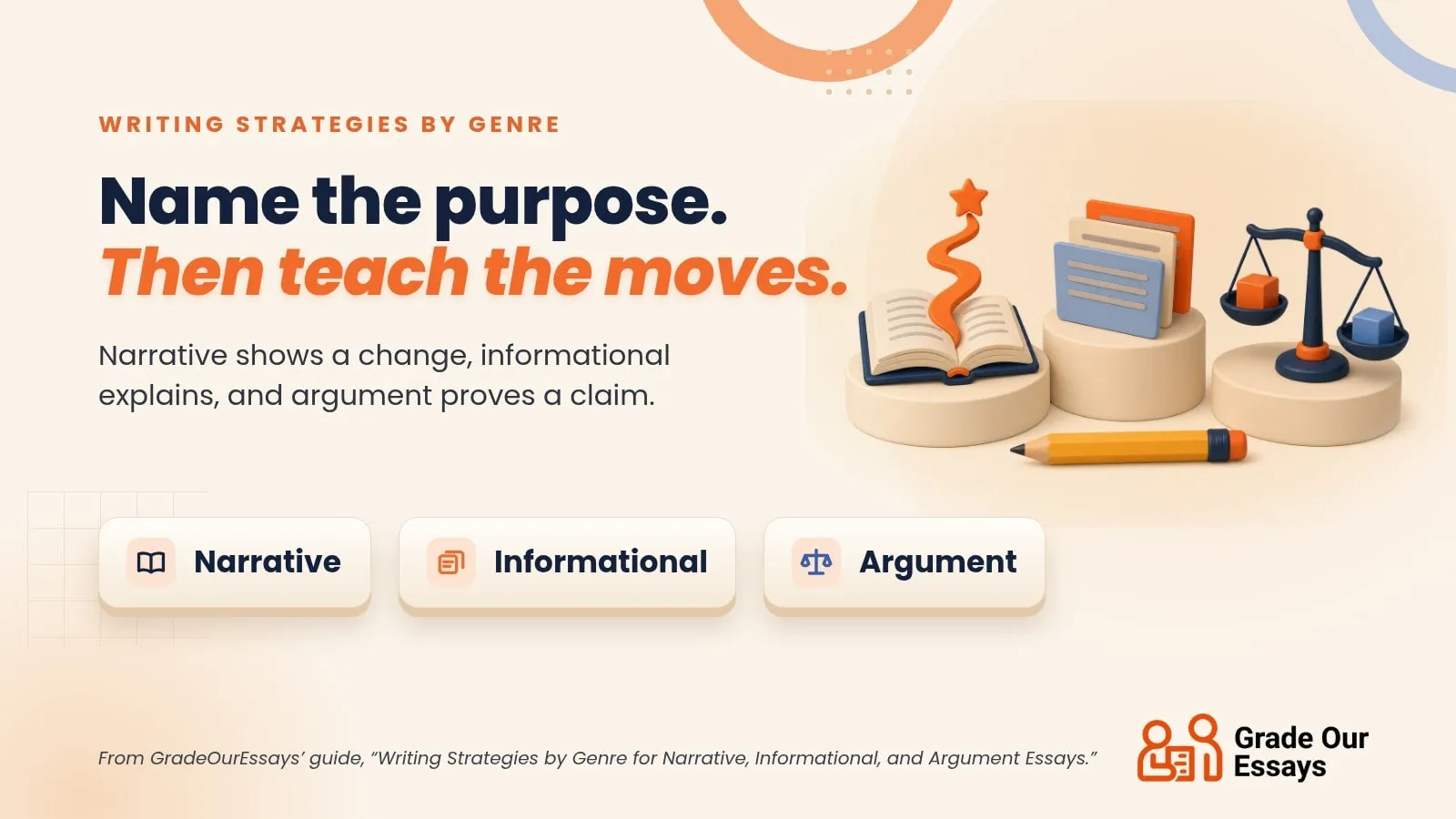
The best writing strategies by genre start with one question students answer before they plan: what is this piece supposed to do to the reader? Narrative moves through time toward a change, informational explains a topic in organized chunks, and argument proves a claim with reasons, evidence, and a fair answer to the other side. Teach one small, named strategy for each genre, show it in a mentor text, and grade for that genre’s moves instead of using one generic essay checklist for everything.
Why does one essay formula fail across genres?
Most students arrive with one structure they trust. Usually it’s an intro with three points, three body paragraphs, and a conclusion that restates the intro. That shape can carry a short informational piece. It falls apart on a personal narrative, where “three reasons why my summer was fun” isn’t a story, and it weakens an argument, where three parallel reasons with no counterclaim read like a list of opinions.
Teachers describe this in their own words all fall. An ELA teacher on Reddit wanted to fold narrative writing into a short story unit instead of teaching plot notes and narrative writing separately, and wasn’t sure how to do both at once. An 8th grade teacher on X said the argument models in their textbook were heavily opinionated, with weak counterclaims, so students had no good example of what a fair argument looks like. And literacy accounts keep sharing anchor charts for one stubborn basic: giving informational writing a structure students can plan with.
The fix isn’t three separate formulas. It’s teaching students that genre is a decision about purpose, and that each purpose comes with a few moves that make it work. The federal What Works Clearinghouse guide for elementary writing recommends teaching the writing process for a variety of purposes, and the secondary guide recommends explicitly teaching writing strategies with a model, practice, and reflect cycle. That’s the backbone of everything below.
The genre moves at a glance
Before the unit starts, put this chart on the wall or in the front of writing notebooks. It answers the question students rarely ask out loud: what am I actually supposed to do here?
| Genre | Purpose | Structure students plan with | The move most students skip | A strategy to name and teach |
|---|---|---|---|---|
| Narrative | Show a change over time | Beginning, problem, turning point, ending | Slowing down the key moment | Zoom in: one moment, told in real time |
| Informational | Help a reader understand a topic | Topic, subtopics, details, wrap up | Explaining why a fact matters | Fact plus “this means” sentence |
| Argument | Convince a reader a claim is right | Claim, reasons, evidence, counterclaim, rebuttal | Answering the strongest objection | Steelman the other side first |
| Literary analysis | Explain how an author creates meaning | Claim about the text, evidence, analysis | Analysis instead of summary | Quote, then “the word ___ shows ___” |
Narrative writing strategies that work
The most common narrative problem is scope. Ask for a personal narrative and you get the whole week at the beach, the entire tournament, or a summary of a year. Nothing gets the space to come alive.
Shrink the story to one moment
Have students list people who matter to them, attach an emotion to each, and then pick one moment, roughly 30 minutes to an hour long, that captures that feeling. “My grandma’s house” becomes “the night the power went out and she taught me to play dominoes by flashlight.” That one change fixes pacing before a single sentence is drafted.
Plan with a story arc, not a list
Students plan on a four box arc: beginning, problem, turning point, ending. Test each link with “because” and “so.” If the boxes read “I went to tryouts. I ate lunch. I made the team,” the events don’t connect. “Because I froze on the first drill, I almost walked out, so my sister texted me one line that changed my mind” does.
Zoom in on the turning point
Teach students to slow the most important moment down to real time using action, dialogue, thought, and sensory detail. A useful rule: the turning point should take up more lines than the whole beginning. A 6th grader who writes “I was nervous and then I scored” can revise to show the sweaty grip on the ball, the coach’s one word of advice, and the half second before the shot.
What to look for when you grade: a single focused event, a clear change in the narrator, pacing that slows at the key moment, and dialogue that does work (reveals character or moves the plot). Dialogue punctuation matters, but grade it lightly the first time so students don’t strip out dialogue to stay safe.
Informational writing strategies that work
Informational writing tends to fail in two ways. Either it becomes a pile of facts in no order, or the student’s opinion leaks in and the piece quietly turns into an argument.
Sort before you draft
Give students their notes on index cards or sticky notes and have them physically sort facts into two to four subtopic piles. Each pile becomes a section with its own heading or topic sentence. For a 4th grade report on sea turtles, the piles might be “body,” “habitat,” “life cycle,” and “threats.” For a 10th grade explanatory essay on the causes of the Dust Bowl, they might be “farming practices,” “drought,” and “economic pressure.”
Teach the “this means” sentence
Students list facts and stop. Require every fact to be followed by a sentence that explains it: “Sea turtles can hold their breath for hours. This means they can rest underwater instead of returning to the surface constantly.” That one move turns a fact list into explanation, and it’s easy to spot when you grade.
Keep it neutral
Have students highlight any sentence that tells the reader what to think (“Everyone should…”, “This is the worst…”). In informational writing, those sentences either get cut or rewritten as facts. A Venn diagram comparing an informational paragraph and an argument paragraph on the same topic makes the difference concrete.
What to look for when you grade: clear subtopics, accurate and relevant facts, explanation after the facts, precise vocabulary for the subject, and a neutral voice.
Argument writing strategies that work
The weak spot in student arguments is almost always the counterclaim. Students either skip it, or they invent an opponent so flimsy (“Some people think homework is fun”) that rebutting it proves nothing.
Investigate both sides before choosing a claim
Instead of asking students to pick a side on day one, give them two short sources that disagree. They list the best reasons on each side first, then decide where they stand. A claim built after looking at both sides is usually more precise. “Schools should start later” turns into “High schools should start no earlier than 8:30 because…” and the counterclaim is already written in their notes.
Steelman, then rebut
Teach students to state the opposing view the way someone who believes it would say it, then answer it with evidence. A simple frame helps: “Some argue that ___ because ___. That concern makes sense, but ___ shows that ___.” If your textbook’s models have weak counterclaims, rewrite one as a class so students see the difference.
Color code the parts
After drafting, students highlight claim, reasons, evidence, and reasoning in four colors. A body paragraph with lots of evidence color and almost no reasoning color tells them exactly what to revise. If students restate a quote instead of explaining it, use the strategies in getting students to analyze instead of restating quotes.
What to look for when you grade: a precise, arguable claim, reasons that are distinct from each other, relevant evidence that is explained, a real counterclaim with a rebuttal, and a conclusion that does more than repeat the intro.
What does this look like in a real unit?
Picture an 8th grade class moving from a narrative unit into argument in November. Students have just written strong personal narratives, and now the first argument drafts come in reading like stories: a page about the time a student was late to school, followed by one sentence saying school should start later.
The teacher spends one class on a “same topic, three genres” lesson. Students take the topic “school start times” and write three short pieces in 10 minutes each: a narrative moment (the morning they were late), an informational paragraph (what the school schedule is and how buses run), and a claim with one reason. Then partners read all three and name what changed. Students start to see that the late morning story can still appear in the argument, but as a short hook or a piece of evidence, not as the whole essay.
That narrative skill isn’t wasted. It becomes a tool inside the argument. The difference is that now the student is choosing it on purpose.
How should rubrics change by genre?
You don’t need a brand new rubric for every unit, but the language inside your rows should match the genre. A single “Organization” row that says “logical order with transitions” means one thing for a story and something different for an argument.
| Rubric row | Narrative look for | Informational look for | Argument look for |
|---|---|---|---|
| Focus | One moment, a clear change | A clear topic and controlling idea | A precise, arguable claim |
| Organization | Time order, pacing that slows at the turning point | Subtopics grouped logically | Reasons in a deliberate order, counterclaim placed well |
| Development | Action, dialogue, sensory detail | Facts explained with “this means” | Evidence plus reasoning that ties it to the claim |
| Language | Vivid verbs, voice | Precise subject vocabulary, neutral tone | Formal tone, clear transitions between reasons |
If your rubric has grown to eight rows, it’s worth trimming it first. A shorter rubric with three clear criteria is easier to adapt by genre than a long one.
State tests make this matter more. State writing prompts often name the genre the student must write in, and students lose points when they answer an argument prompt with an explanation or a narrative. Practice reading prompts and labeling the expected genre before planning, every time.
When a stack of essays from three genres lands on your desk, Grade Our Essays drafts trait level feedback against the state rubric you choose, and you review and approve every score before students see it. You can try it free for 14 days with no credit card.
Try This Tomorrow
- Post the genre chart above and have students copy the “purpose” column into their notebooks.
- Run a 30 minute “same topic, three genres” lesson using one shared topic from your current unit.
- Before the next draft, have students write the genre and its purpose at the top of their planning page.
- Pick one named strategy for your current genre (zoom in, “this means,” or steelman) and model it live with a think aloud.
- Rewrite one rubric row in genre specific language before you grade the next set.
Frequently Asked Questions
What are the main genres of student writing?
Most K-12 standards group school writing into narrative, informational or explanatory, and argument (opinion in the early grades). Many secondary teachers add literary analysis as a fourth unit because it combines argument with close reading.
In what order should I teach writing genres?
There’s no single right order. Many teachers start with narrative because students can write about themselves, then move to informational and argument, and schedule the genres their state test emphasizes closest to test season.
How do I stop students from turning every essay into five paragraphs?
Teach structure as a choice that follows purpose. Show two mentor texts in different genres side by side and have students map each one’s structure, then let them plan with the genre’s own pattern instead of a fixed paragraph count.
What’s the difference between informational and argument writing?
Informational writing explains a topic so the reader understands it, without taking a side. Argument writing takes a position and tries to convince the reader, using reasons, evidence, and a response to the opposing view.
How can I grade different genres fairly with one rubric?
Keep the same rows (focus, organization, development, language) so scores stay comparable, but rewrite the descriptors inside each row for the genre. That way students know what the row means for this assignment.