To score a whole class set of essays consistently, put every paper on one rubric, judge one trait at a time, and check your hardest calls against the evidence in the student’s own sentences. Grade Our Essays is built around that routine. It scores each essay on a state writing rubric, quotes the sentences behind each score, and holds everything until you review it. This post walks through how that works for a grades 3 to 12 class set, including a short sample essay you can use to test your own rubric habits.
Why does the 30th essay get a different read than the first?
You already know the feeling. By the fourth paper in a row that restates the quote instead of explaining it, your patience has changed, and so has your bar. Research on rater fatigue backs this up. A published study on rating order effects describes how scores can depend on where a paper falls in a sequence, because judgment fatigue wears down rating quality over a long scoring session (Applied Psychological Measurement).
Teachers have built their own fixes for years: notes on how they treat certain mistakes, a rule to stop after five papers, regrading a few from the top of the pile at the end. Those habits work. They also cost time, and they fall apart at 10 PM on the night before grades close.
The goal isn’t a perfect machine score. The goal is that a student’s paper gets read against the same rubric no matter where it sat in the stack. That is the job a rubric-based first read can take off your plate, as long as you stay the person who decides.
What does Grade Our Essays actually do with a class set?
Here is the workflow as the product describes it on its AI essay grader page. I haven’t graded a class with it, so this is a description of how it works, not a review.
- Create an assignment. You write a prompt, let AI draft one, or upload your own. Then you pick a state rubric.
- Students write. They join with a class code and type in the browser. They don’t create accounts. Text-to-speech, speech-to-text and graphic organizers are built into the writing space.
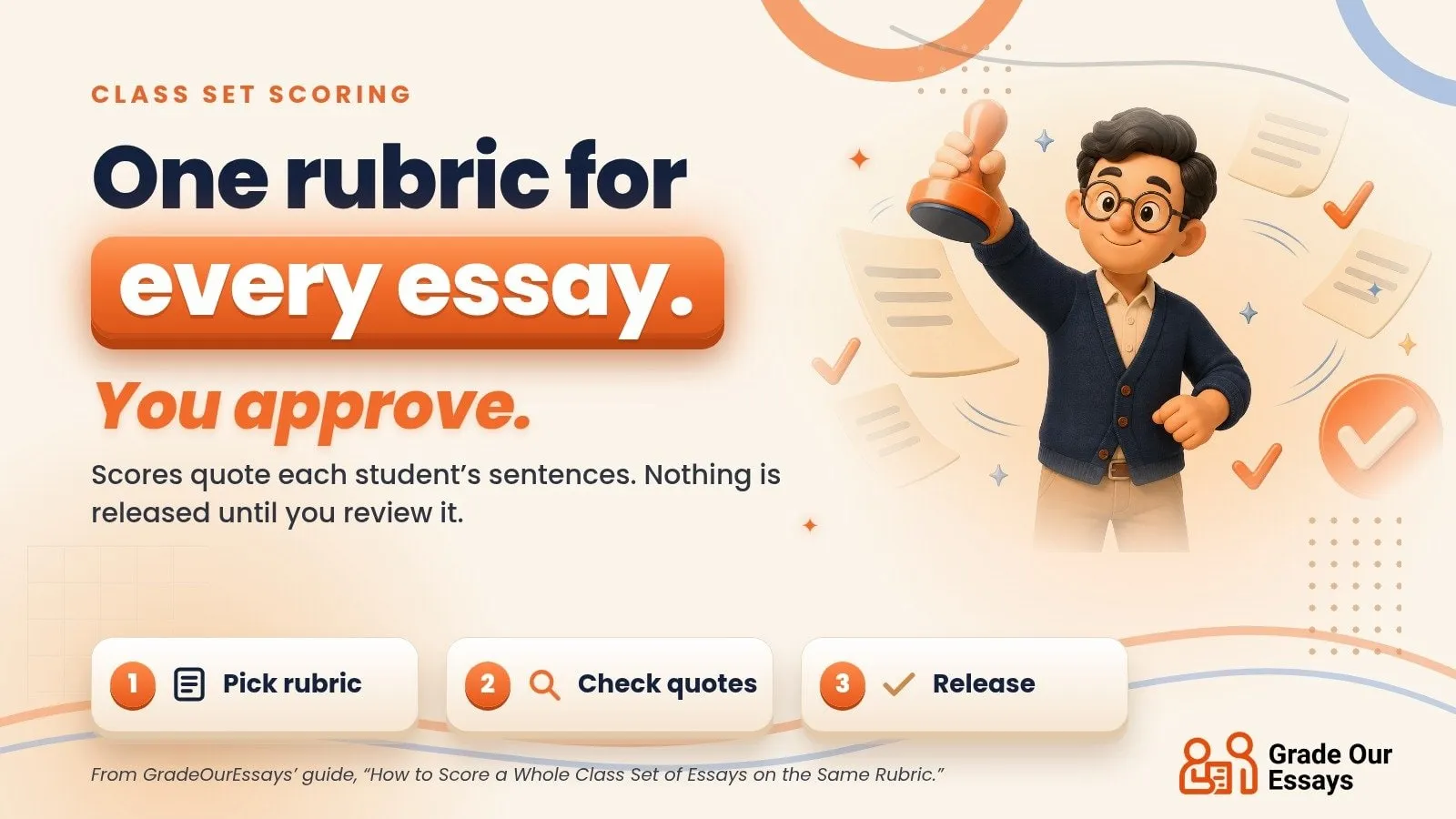
- AI drafts the scores. Each essay is scored trait by trait on the rubric you chose. Every score quotes the student’s own sentences, and scores flagged for review are marked so you can check those first.
- You review and release. You can change any score or comment. You choose when students see their feedback.
Two things matter for consistency here. Every essay in the set meets the same criteria, and the evidence is attached to each score, so a call you disagree with takes seconds to spot instead of a full reread.
The rubric library is large. The state writing rubrics page lists 500+ official rubrics across all 50 states for grades 3 to 12, split into extended constructed response (ECR) and short constructed response (SCR). If your district uses its own rubric language, the closest state rubric is your starting point, and your edits finish the job.
What does the scoring look like on a sample essay?
Here is a short sample written for this post. It is not a real student’s work. Imagine a 6th grade class read two short articles about later school start times and wrote an argumentative response. The rubric is the one Texas uses for STAAR ECR, which GOE documents on its STAAR ECR rubric page: Development and Organization of Ideas (0 to 3) and Conventions (0 to 2).
Schools should start later in the morning. Teenagers are tired when they wake up early and they cannot focus in first period. If school started at nine, students would be more awake and would learn more. Some people say a later start would make the day end too late, but sleep matters more than sports practice. Students also behave better when they are rested. For all these reasons, schools should start later.
Read it the way a rubric would. The sentences are clean. Capitalization and punctuation are nearly perfect. The claim is clear, and there is a counterargument. Now look for evidence from the articles. There isn’t any. No fact, no quote, no detail the students read.
| Trait | What a careful read finds | Likely point range |
|---|---|---|
| Development and Organization | Clear claim and a simple structure, but no text evidence at all. Reasons are opinions. | Low end of the scale |
| Conventions | Mostly correct at grade level | Would be high if scored alone |
Here’s the catch. On the STAAR rubric, an essay that earns 0 for Development and Organization also earns 0 for Conventions, however clean the writing is. According to GOE’s rubric page, the tool applies that zero rule automatically on STAAR rubrics, so a practice score never looks rosier than the real test would allow. If this essay lands at a 0 for development, a teacher doing this by hand at 9 PM might still hand out two points for those tidy sentences. That is exactly the kind of inconsistency a built-in rule prevents.
Notice what you do next, though. You decide whether this response is a 0 or a low 1. The quoted sentences make that call quick. And the teacher is the one who approves it.
What do students get back?
Faster feedback matters most for students while the essay is still fresh in their minds. GOE’s AI writing feedback page says students see a score for each rubric trait, the teacher’s comments, and next revision steps in plain language.
The revision steps follow a four part pattern: what needs work, where to look in the essay, the revision move to make, and a self-check. For the sample above, a useful version might read:
- What needs work: Development and Organization. Your reasons are your opinions, not facts from the articles.
- Where to look: Your third sentence, “students would be more awake and would learn more.”
- The move: Find one fact in Article 2 about sleep and school start times. Quote it right after that sentence, then explain why it supports your claim.
- Self-check: Can a reader point to a sentence that came from the articles?
That is far more usable than “add evidence.” It’s also the pattern from our post on feedback examples: name the trait, point to a place, give one move.
How do I know the AI scored it fairly?
You don’t, until you check. The product’s own FAQ says to treat it like a first draft from a careful colleague. I’d add a routine on top of that.
- Open the flagged scores first.
- Spot check three papers: the highest, the lowest, and one in the middle. Read the quoted evidence, then the paper.
- Look at a borderline essay, one point from a cutoff, and make the call yourself.
- Adjust the score or comment, then release.
If you disagree with more than a stray score or two, the likely culprit is the rubric choice, not the essay. Pick the rubric that actually matches the task. A short constructed response graded on an ECR rubric will look wrong every time.
This approach has limits. It only reads typed writing, and it does not read handwriting. The scores are suggestions, not final grades, and a rubric can’t see effort, growth, or what you know about a kid. If you want help turning rubric points into a gradebook number, our post on turning rubric scores into grades covers it.
Is it worth it for a class set, or just for state test prep?
My recommendation: use it where you grade the same prompt on the same rubric for many students. That is a 120 paper constructed response cycle, a benchmark essay, or STAAR style practice before test day. Skip it for a three sentence exit ticket, or for a piece where your own conference notes are the whole point.
For privacy, the product states that it is FERPA and COPPA compliant and that student writing is never used to train AI models. Check your district’s policy anyway before you assign anything.
One more benefit that gets overlooked is the class view. GOE says you can see which skills the whole class needs to work on next. If 22 of 28 papers lose points on explaining evidence, that is Monday’s mini lesson, no spreadsheet needed.
If you want to try this on your own prompt, GOE offers a free 14 day trial with no credit card required.
Try This Tomorrow
- Choose one trait, such as evidence, and read only that trait across ten papers before moving to the next.
- Write down how you treat one common error (for example, restating a quote) and apply it the same way all session.
- Regrade two early papers when you finish. If the scores move, you have found drift.
- Read the opening of our framework for grading ECRs faster and pick one step to try.
- If you use an AI first read, check the flagged scores before anything else.
Frequently Asked Questions
Can an AI grader score essays on my state rubric?
Grade Our Essays offers 500+ official state writing rubrics across all 50 states for grades 3 to 12, including STAAR. You pick one when you create the assignment.
Does the teacher still approve the scores?
Yes. Scores are suggestions. You can change any score or comment, and you choose when students see their feedback.
Do students need accounts?
No. Students join an assignment with a class code and write in the browser.
Can it grade handwritten essays?
No. It scores typed writing only, so students need to write in the browser.
Is a practice score the same as a real STAAR score?
No. GOE describes it as practice scoring on the same rubric structure, so students see where they stand before test day.