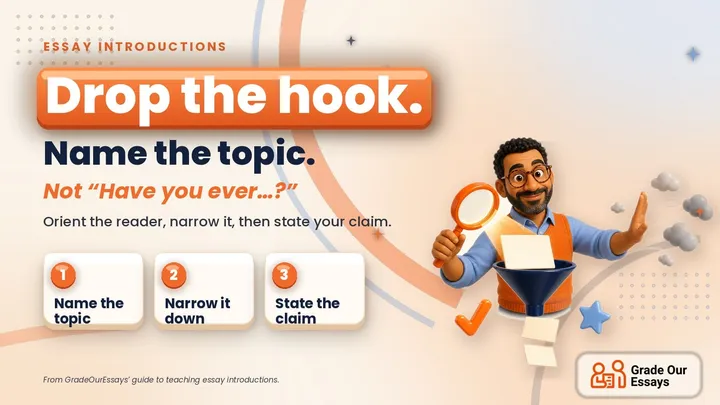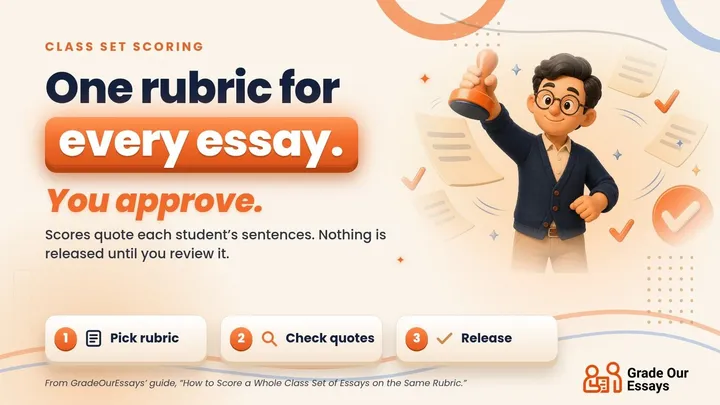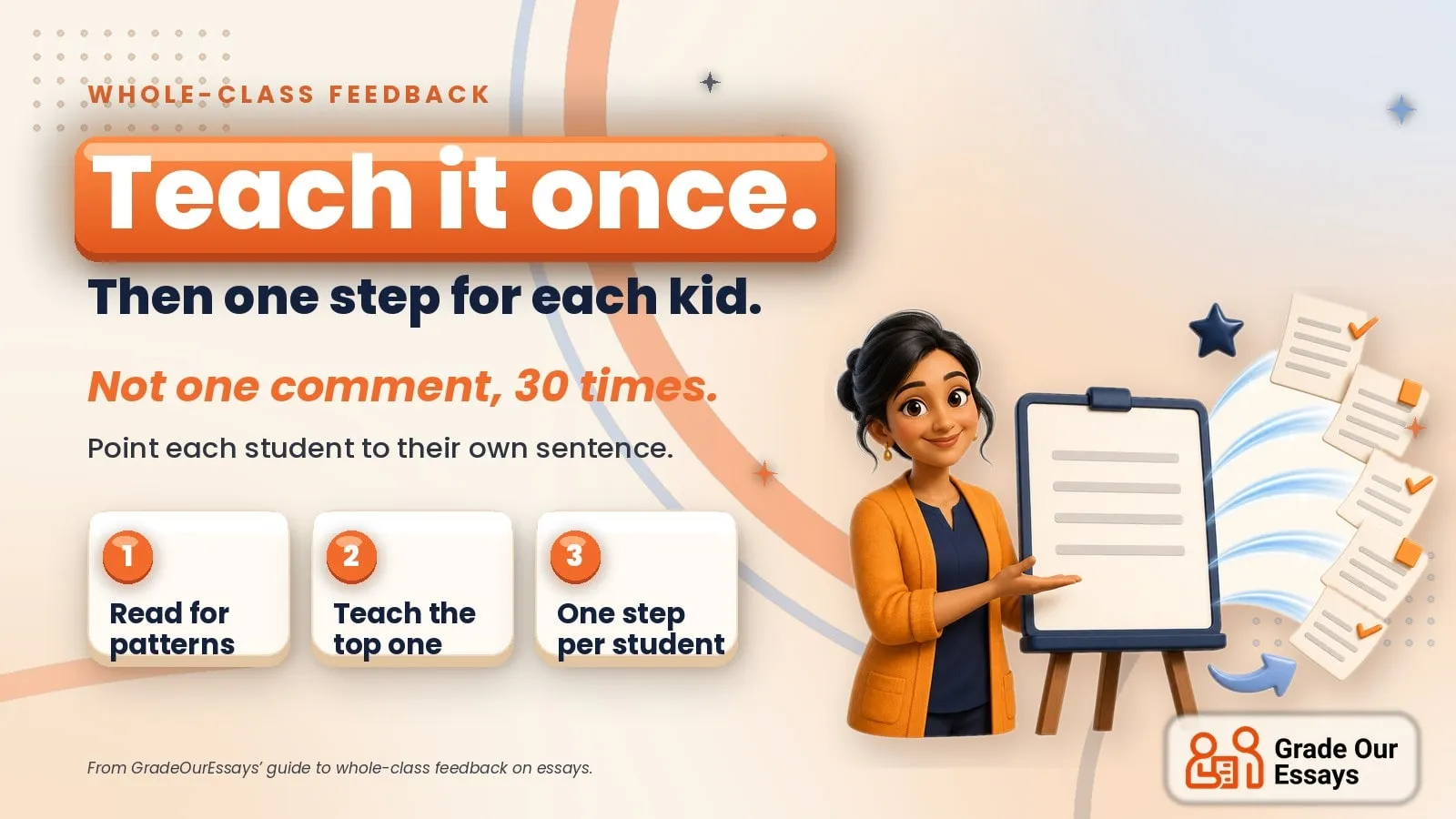
To give whole-class feedback on essays without losing the individual student, split the job into two layers. Read the set once for patterns and teach the one or two biggest ones in a short feedback lesson, then hand every student one personal next step on one rubric trait and give them class time to act on it. Grade Our Essays is built to draft both layers for a grades 3 to 12 class set: it shows which skills the class needs to work on next, drafts trait-level revision steps for each student, and holds everything until you review and release it.
Why does the same comment end up on 30 essays?
Because most essay problems aren’t individual. When a class writes to one prompt, the same few gaps repeat: a quote dropped in with no explanation, a claim that’s really a topic, a conclusion that copies the intro. So you write “explain how this evidence supports your claim” on paper after paper.
Teachers have been saying this out loud this fall. One teacher posting on X described sitting in front of 100 essays on a Sunday evening, wanting to respond to each kid’s needs and slipping into autopilot because the same mistakes kept coming back. Another said they want to use whole-class feedback more, but writing the same comments in 30 books is wearing them down, and they’ve been criticized for a lack of red pen anyway. An education writer’s post in November named the trade-off: many teachers believe in whole-class feedback and still worry it leaves a student’s work unacknowledged.
That tension is the real problem. Individual comments on every paper eat your weekend. Pure whole-class feedback can leave the kid with the unusual problem, or the kid who did something great, feeling unseen.
What does whole-class feedback miss?
Whole-class feedback works when many students share the same misconception. You read the set, note the common strengths and errors, and spend part of the next lesson teaching into them. A review from Evidence Based Education describes it this way and adds two limits worth taking seriously. It’s a weaker fit when the problems are highly individual, and a student who hears feedback aimed at the whole room may assume it doesn’t apply to them.
Both limits show up in essay work. The student who wrote a strong argument with no paragraph breaks needs something different from the student whose paragraphs are perfect and whose claim is a fact. And the student who needs “explain your evidence” most is often the one who hears it in the mini lesson and thinks, “That’s for other people.”
Feedback also isn’t free. The Education Endowment Foundation’s guidance report on teacher feedback points out that large amounts of time go into feedback, not always productively. So the goal isn’t more comments. It’s the right comment, at the right size, landing on the right student.
The routine: one read, two layers
Here’s the routine I’d recommend for a class set of typed essays on one prompt and one rubric.
- Read for patterns first. Before you write a single comment, skim the set with a tally sheet that lists your rubric traits. Make a mark every time a trait is the biggest weakness in a paper.
- Pick one or two class patterns. The trait with the most marks becomes your feedback lesson. Ignore the rest for now. Two patterns is the ceiling.
- Find one model and one fixable example. Pull a strong sentence or paragraph from the set and one weak example you can rewrite together. Remove names, or write your own version.
- Write one personal next step per student. One trait, one place in the essay, one move. If a student’s biggest need matches the class pattern, the personal note just points them to where it shows up in their own essay.
- Teach, then revise in class. Run a 10 to 15 minute feedback lesson, hand back the essays, and give students time to make the move before they leave.
| Whole-class layer | Individual layer | |
|---|---|---|
| What it covers | The 1 or 2 traits most of the class missed | The one trait this student should work on next |
| Where it lives | A slide or sheet you teach from | A short note on each essay |
| What students do | Watch the model, fix a shared example | Find the spot in their own essay and revise it |
| What it costs you | One read for patterns, one short lesson | One specific sentence per paper |
The individual layer is short on purpose. Our post on feedback examples for student writing shows the pattern: name the trait, point to a place, give one move. If students tend to skim past your notes, why students ignore essay feedback covers how to build in the time to act on them.
How does Grade Our Essays handle both layers?
This section describes the workflow as GOE’s own pages explain it (checked November 20, 2026). It’s a walkthrough of how the product works, not a hands-on review.
- Create the assignment. You write a prompt, let AI draft one, or upload your own, then pick your state’s writing rubric. The library covers official state writing rubrics for all 50 states, grades 3 to 12, including short constructed response rubrics.
- Students write in the browser. They join with a class code and don’t create accounts. The tool scores typed writing only; it does not read handwriting.
- Each essay gets scored trait by trait. Every score quotes the student’s own sentences, and scores flagged for review are marked so you check those first.
- Each student gets revision steps. According to the AI writing feedback page, each step names what needs work by rubric trait, quotes where to look in the essay, gives the revision move, and ends with a self-check so the student knows when they’re done.
- You see the class picture. The home page says that after you review, you can see which skills the class needs next. The pricing page lists class score averages and basic analytics, a presentation view for class review and discussion, and a rubric-guided revision workflow on every plan, and it lists Class Focus Suggestions on the free trial and paid plans.
- You review and release. You can change any score or comment, and you choose exactly when students see their feedback.
Map that onto the routine. Steps 3 and 5 handle the tallying, step 4 drafts the individual layer, and step 6 keeps you deciding what each student reads.
What does this look like on a sample essay?
Here’s a sample paragraph written for this post. It isn’t a real student’s work. Imagine a 7th grade class of 28 that read an article about a town replacing its library’s late fees with a reading program and wrote an argument about whether their own town should do the same.
Our town should get rid of library late fees. Late fees stop kids from using the library. The article says “after the fees ended, card sign ups went up by a lot.” Also, libraries are supposed to be for everyone. That is why the fees should end.
Now picture the class view after you review the scores. As an example, say explaining evidence is the weakest trait across the set, with most papers quoting the article and moving straight on, while a handful of students have organization problems the rest don’t share.
That gives you a clean split:
| Layer | What goes in it | Example for this set |
|---|---|---|
| Whole class | The shared pattern | A 12 minute lesson on the “This shows…” sentence after a quote |
| Small group | The handful with organization problems | Five minutes with you while others revise |
| Individual | One next step per student | A revision step that quotes their own sentence |
For the sample paragraph, a revision step in GOE’s four-part pattern might read:
- What needs work: Evidence and explanation. You quote the article, then move on without saying why it matters.
- Where to look: “The article says ‘after the fees ended, card sign ups went up by a lot.’”
- The move: Right after the quote, add a sentence that starts “This shows…” and connect the sign ups to your claim that fees stop kids from using the library.
- Self-check: Could a reader explain why your quote proves your point, using only your words?
Notice what that does for the student who would have tuned out the mini lesson. The whole-class lesson teaches the “This shows…” move. The personal step puts it on their sentence. They can’t decide it’s for someone else.
Before you release anything, read a few papers yourself: the highest, the lowest, and a couple flagged for review. If a revision step points to the wrong sentence or asks for the wrong move, change it. You’re the one who approves every score and comment.
When does this help, and when doesn’t it?
My recommendation: use this two-layer setup for any typed essay or constructed response where a whole class writes to one prompt on one rubric. Benchmark essays, unit arguments, and state test practice fit well. That’s where patterns are real and a class view earns its keep.
It helps less in a few places:
- Handwritten in-class essays. GOE scores typed writing only, so you’re back to a paper tally sheet.
- Very short exit tickets. You can see the pattern by flipping through them. You don’t need software.
- Personal narratives you’re conferencing on. When the conversation is the feedback, writing conferences for a large class are a better use of your time.
- A class with no shared pattern. It happens. Skip the whole-class lesson and lean on the individual layer.
On privacy, GOE states that it is FERPA and COPPA compliant and that student writing is never used to train AI models. Check your district’s rules before you assign anything with any tool.
If you want to run this on your next essay, Grade Our Essays offers a free 14-day trial with no credit card required.
Try This Tomorrow
- Make a tally sheet with one column per rubric trait and skim your current stack before writing any comments.
- Circle the trait with the most marks. That’s your whole feedback lesson. Leave everything else for next time.
- Write one model sentence and one fixable example for that trait, with names removed.
- Give every student one personal next step that points to a sentence in their own essay.
- Save the last 15 minutes of the feedback lesson for revision, and collect the revised paragraph before students leave.
Frequently Asked Questions
What is whole-class feedback on essays?
It’s feedback you give the whole class at once, based on patterns you saw across the set, instead of writing the same comment on every paper. You read for common strengths and errors, then teach into them in the next lesson and give students time to revise.
Does whole-class feedback replace individual comments?
It shouldn’t. Pair it with one short personal next step per student, so each student knows which part of the lesson applies to their essay.
How many class patterns should I teach at once?
One, two at most. More than that and students won’t know which change to make first.
Can Grade Our Essays show what the whole class needs?
Yes. GOE says you can see which skills the class needs next after you review the scores, and its pricing page lists class analytics and a presentation view for class review on every plan.
Do I still approve the feedback?
Yes. You can change any score or comment, and nothing reaches students until you release it.