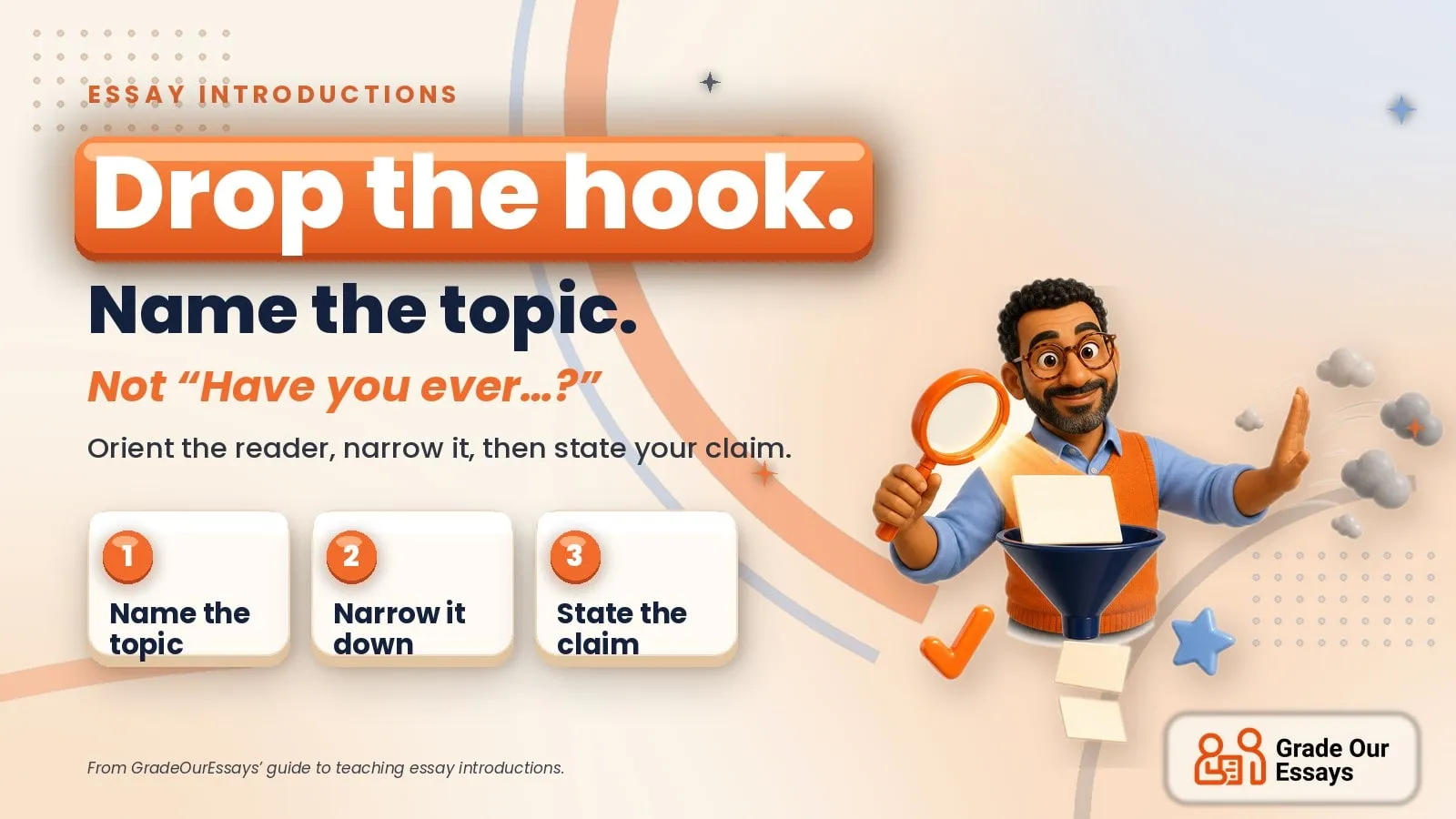
To teach essay introductions that work, stop treating the hook as a required sentence and give the introduction three plain jobs instead: name the specific topic or text, narrow it to the question the essay answers, and end on the claim. Students write it after a working thesis, and every opening sentence has to pass one test: could it start an essay on a different topic? If it could, it goes. That one rule retires “Have you ever…?” and “Since the beginning of time” faster than any list of banned openers.
Why do my students start every essay with “Have you ever”?
Because it’s the only move most of them were taught. Teacher blogs this fall keep describing the same stack of papers: openings that ask a yes or no question, sweep across all of human history, quote a dictionary, or announce “In this essay I will…” before the student has said anything. One post on grading literary essays describes introductions so broad they could sit in front of any essay on any story. Another notes that students can write a hook, a context sentence, and a thesis in isolation but can’t make the three sound like one paragraph.
The usual margin note, “stronger hook,” makes it worse. Students hear that the first sentence should be clever, so they reach for the template they know or stall on line one. Picture a 7th grade class drafting an argument essay on a proposed full day phone ban. Half the class opens with “Have you ever been on your phone in class?” and the other half with “Technology has been around for a long time.” Neither tells the reader anything about this school, this rule, or what the writer thinks.
What should an essay introduction actually do?
An introduction has one purpose: get the reader from “I don’t know what this is about” to “I know exactly what this writer is arguing” in as few sentences as the topic allows. The UNC Writing Center’s guide to introductions makes the same point about openings that are too broad: even a big picture first sentence has to be clearly about the topic.
The standards describe the job, not the decoration. The Common Core writing standards for argument ask 6th graders to “introduce claim(s)” and 9th and 10th graders to “introduce precise claim(s).” Nothing in that language asks for a rhetorical question. (Your state’s standards and rubric may be worded differently, so read the organization or purpose row of the rubric your students are actually scored on.)
Here’s the framing to give students:
| Job | What the sentence does | Question the student asks |
|---|---|---|
| Orient | Names the specific topic, text, or situation | Would a stranger know what this essay is about? |
| Narrow | Gives the one piece of context the reader needs before the claim | What does my reader need to know before my claim makes sense? |
| Claim | States the position or controlling idea | Could someone disagree with this, or ask “why”? |
That’s the whole introduction for most school essays: two to four sentences. A “hook,” when there is one, is just an orient sentence that happens to be interesting.
The specificity test: a routine you can teach in one class period
This works in grades 5 through 12, and it takes about one class period the first time.
- Write the working thesis first. Students draft the claim before they touch the opening. If they don’t have a claim yet, they aren’t ready to write an introduction, and pretending otherwise is where the “In this essay I will” sentences come from. (If the claim is the problem, teaching thesis statements comes first.)
- Draft the orient sentence. It must name the specific thing: the school, the rule, the text and author, the event. No “people,” no “society,” no “throughout history.”
- Run the specificity test. Students cover the rest of the essay and read the first sentence to a partner. Could it open an essay on a different topic? If yes, rewrite it until it couldn’t.
- Write the bridge. One sentence answering “what does my reader need to know before my claim?” This is usually a fact from the source, the situation that’s changing, or the tension in the text.
- Read the three sentences aloud as one paragraph. If the claim feels like it came out of nowhere, the bridge is missing something.
Step 3 is the one that sticks. Students can run it on each other, and unlike “write a better hook,” it doesn’t depend on taste or creativity.
A worked example on a sample essay
Here’s a sample introduction written for this post (not a real student’s work), from a 7th grade argument essay on the prompt “Should our school ban phones for the whole school day?”
Sample student introduction (written for this post): first draft Have you ever been on your phone in class? Phones are a big part of life today. Since the beginning of time, people have used new technology. In this essay I will talk about whether phones should be banned at school.
Run the specificity test. “Have you ever been on your phone in class?” could open almost any essay about phones. “Since the beginning of time” could open an essay about anything. The last sentence names the topic but never takes a side, so the reader finishes the paragraph without a claim.
Now the same writer after one round of orient, narrow, claim:
Sample student introduction (written for this post): revision At our school, phones are allowed at lunch and in the hallways but are supposed to stay in backpacks during class. The school board is now considering a ban for the whole school day, from the first bell to the last. A full day ban would help students focus, but only if the school gives families a clear way to reach their kids in an emergency.
Sentence one orients (this school, this rule). Sentence two narrows to what’s changing. Sentence three is a claim someone could argue with, and it hands the essay its structure: a body paragraph on focus, one on emergencies, and a counterclaim waiting to happen. There’s no question and no quote, and it’s still more interesting than the first draft, because specifics are.
Weak openers and what to try instead
Students need a replacement for each habit more than a list of banned phrases. This table works as an anchor chart.
| Opener habit | Sample (written for this post) | Why it falls flat | Try instead |
|---|---|---|---|
| Yes or no question | “Have you ever felt left out?” | The reader answers and stops | Name the situation: “In Wonder, Auggie starts 5th grade at a school where…” |
| Sweeping history | “Since the beginning of time, people have…” | True of everything, so it says nothing | Start in the specific time and place of the topic |
| Dictionary definition | “Webster’s defines courage as…” | Delays the point and borrows someone else’s words | Say what courage looks like in this text |
| Announcement | “In this essay I will explain…” | Tells instead of doing | Delete it and let the claim do the announcing |
| Prompt restatement | “Should schools ban phones? There are many opinions.” | Repeats the question without answering it | Answer it in the last sentence of the paragraph |
Questions aren’t banned, by the way. A question the essay actually answers can be a fine opening for a strong writer. The trouble is the yes or no question that exists only because the student was told to hook the reader.
When does a hook actually help?
Some honest limits. In personal narrative and memoir, an opening scene or line of dialogue does real work, and that’s where creative openings belong. Strong writers in grades 9 to 12 should learn a few deliberate opening moves (a striking detail from the text, a short scene, a counterintuitive claim) once the basic three jobs are automatic. Teacher bloggers who teach hook types, like a startling fact, a quotation, or a brief anecdote, have a point for those students.
Where hooks hurt is timed writing. On an on demand state writing test or an in class ECR, a student who spends eight minutes on a clever first sentence has eight fewer minutes for evidence and explanation. For timed work, I’d teach a two sentence introduction: one orient sentence that names the text or issue, then the claim. (If stamina is the bigger issue, see building in-class essay writing stamina.) For literary analysis, the best opening is usually the author, the title, and one concrete detail from the text in the first two sentences.
Grades 3 and 4 are their own case. Young writers are still learning that an opinion piece needs to state the opinion at the start at all. A plain “I think recess should be longer because…” is a success there, not a weak hook.
How should I give feedback on introductions?
Grade the introduction on whether the reader knows the topic and the claim by the end of it. Don’t score cleverness, and don’t count hook types. Comments work when they name the place and the move:
- Too broad: “Your first sentence could start an essay about anything. Rewrite it so it names our school’s phone rule.”
- Announcement: “Cross out ‘In this essay I will talk about.’ What do you think about the ban? Write that sentence instead.”
- No bridge: “I go straight from the rule to your claim. Add one sentence about what the school board is considering.”
- No claim: “By the end of paragraph 1, I still don’t know your side. Finish the paragraph with your position.”
If your students tend to write a conclusion that just repeats this paragraph, pair this lesson with teaching conclusions that don’t repeat the intro, since the two problems usually show up in the same essays.
How Grade Our Essays handles introduction feedback
Writing “your first sentence could start any essay” 30 times is the slow part. Grade Our Essays scores each essay trait by trait on the state writing rubric you pick, for grades 3 to 12 and for informational, opinion, argumentative, and narrative writing. Depending on your state’s rubric, the introduction usually falls under an organization, purpose, or focus trait. Each score quotes the student’s own sentences as evidence, so you can check the call without rereading the whole essay, and each student gets drafted revision steps in plain language: what needs work by rubric trait, where to look in the essay, the revision move to make, and a self-check.
On the first draft sample above, a note in that shape might read: “Organization: your introduction doesn’t state your position. Look at ‘In this essay I will talk about whether phones should be banned at school.’ Replace it with one sentence that says whether you agree with the ban and why. Self-check: could a classmate disagree with your last sentence?” You read the drafted feedback, decide whether it fits that student, change any score or comment, and release it when you’re ready. Nothing reaches students before you approve it.
For you, that means a class set scored consistently on the same state rubric language, with trait level feedback already drafted, so your time goes to conferring with the students who still can’t find a claim. Seeing which skills the class needs next also tells you whether the specificity test is a whole class lesson or a small group. For students, feedback is faster and clearer: a specific move tied to their own sentence while the essay is still fresh. Students join with a class code and don’t create accounts, essays need to be typed (it doesn’t read handwriting), and it’s FERPA and COPPA compliant. There’s a free 14 day trial with no credit card required.
Try This Tomorrow
- Project five sample openers (written by you, not pulled from student papers) and have students run the specificity test on each: could this start an essay on a different topic?
- Before the next draft, require a working thesis on a sticky note before anyone writes the first sentence.
- Give timed writers the two sentence introduction: orient sentence, then claim. Practice it on two prompts in ten minutes.
- Swap “stronger hook” in your comment bank for “name the specific topic in your first sentence.”
- Have partners read only paragraph one aloud and say the writer’s claim back. If they can’t, the introduction isn’t done.
Frequently Asked Questions
How long should an essay introduction be?
For most school essays, two to four sentences: one to orient, one to narrow, one for the claim. On a timed test, two sentences is enough.
Should students start an essay with a question?
Only if the essay answers it and the answer isn’t yes or no. Most “Have you ever” questions fail that test, so teach a specific orient sentence as the default and save questions for writers who use them on purpose.
Should students write the introduction first or last?
Write a working thesis first, then draft the introduction around it, and revise the opening after the body is done. Many students find their first opening no longer fits the essay they actually wrote.
Do state writing tests reward a creative hook?
Read the organization or purpose row of your state’s rubric to be sure. What scorers need to see is a clear claim or controlling idea early, and time spent polishing a clever first line is time not spent on evidence.