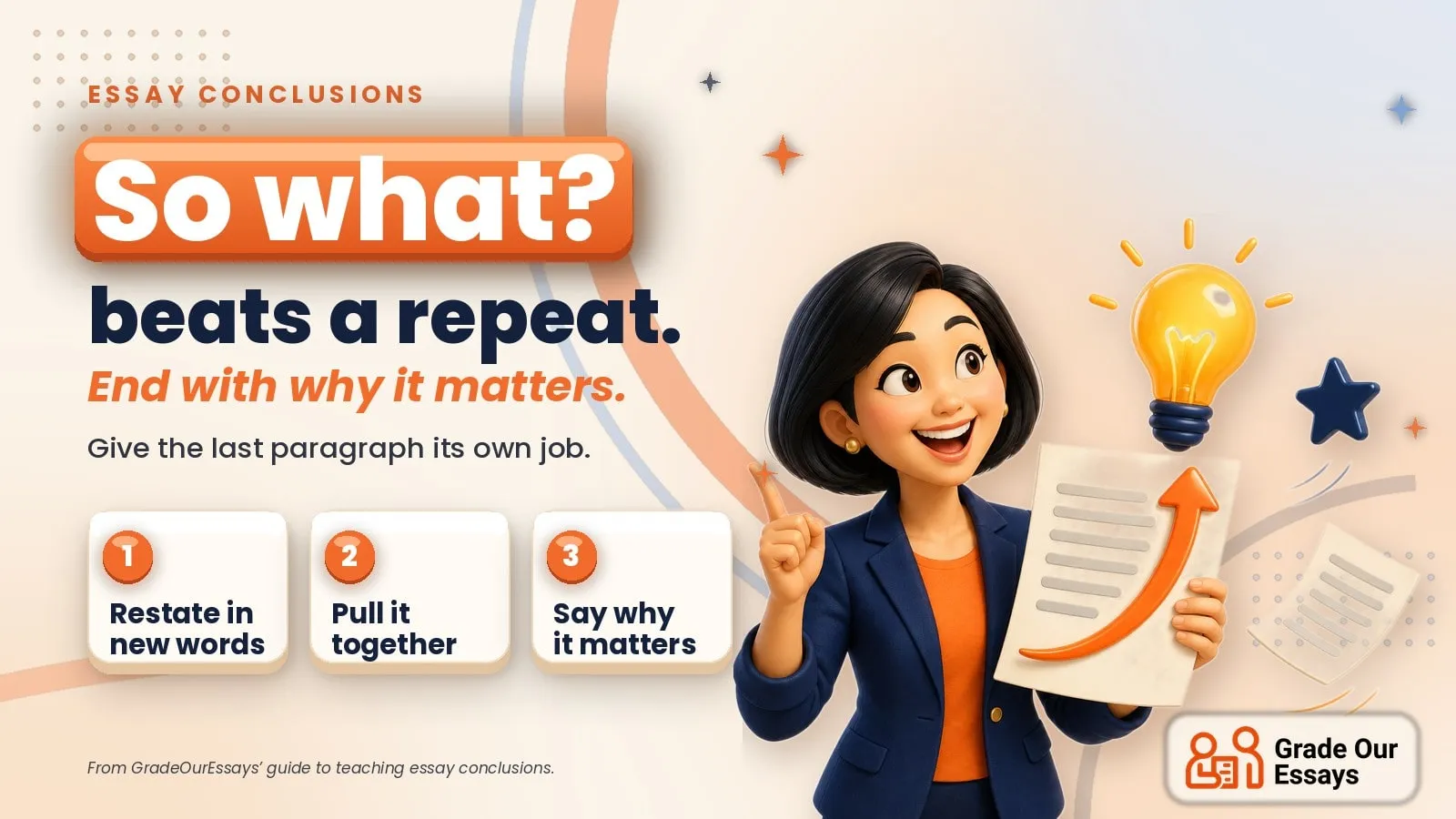
To teach students to write a conclusion that doesn’t just repeat the introduction, give the last paragraph a different job: restate the claim in new words, pull the body paragraphs together into one bigger point, and answer “so what?” for the reader. Then test it with a swap. If the first and last paragraphs could trade places and nobody would notice, the conclusion isn’t done yet.
Why do student conclusions sound like the introduction?
Because we taught them to. For years the standard advice for grades 3 to 8 has been “restate your thesis and summarize your main points.” Students follow that to the letter. They copy the thesis, change two words, list their three reasons again, and stop.
Teachers keep bringing this up. In a recent r/ELATeachers thread asking grades 3 to 8 teachers about their students’ biggest writing struggles this year, conclusions came up next to organization and summarizing. Teacher-facing blogs this fall describe the same stack of papers: an introduction and a conclusion that are nearly identical, with a few words moved around. And the fix most of us write in the margin, “develop your conclusion,” doesn’t tell a 12-year-old what to do.
There’s a second cause. By the last paragraph, students are tired and out of time, especially on a timed essay. A copied thesis feels safe because they already know it’s “right.”
So the problem isn’t laziness, and it isn’t usually a lack of ideas. Students don’t know what a conclusion is for.
What should a conclusion actually do?
A strong conclusion makes three moves. The UNC Writing Center puts it as “synthesize, don’t summarize,” and lists ending on a rephrased thesis with no real change as a strategy to avoid (UNC Writing Center). Here’s how that looks as something you can teach.
| Move | What it means | What students usually write instead |
|---|---|---|
| 1. Restate the claim | Say the main point again in new words, now that the reader has seen the evidence | The thesis, copied |
| 2. Pull it together | Show what the reasons add up to, in one or two sentences | Reason 1, reason 2, reason 3, listed again |
| 3. Answer “so what?” | Why it matters: an implication, a recommendation, a question, or a return to the opening image | A generic line like “this is why it is important” |
The third move is the one that changes the paper. It’s also the one students skip, because nobody has shown them it exists.
For a short paragraph response or a test SCR, this shrinks to one or two sentences. A sentence that names the bigger point is usually enough. For a full ECR or a five paragraph essay, three to five sentences is plenty in grades 4 to 8. High school writers can stretch it further.
A before and after on a sample essay
Here’s a short example written for this post, not a real student’s work. Picture a 7th grade argument essay on whether schools should replace paper textbooks with tablets.
Sample introduction:
Many schools are thinking about switching from paper textbooks to tablets. Tablets are lighter, cheaper over time, and easier to update. Schools should replace paper textbooks with tablets.
Sample conclusion, first draft:
To sum up, schools should replace paper textbooks with tablets. Tablets are lighter, they are cheaper over time, and they are easier to update. That is why schools should switch to tablets.
Run the swap test. The two paragraphs say the same thing. A reader learns nothing new from the ending.
Sample conclusion, revised with the three moves:
A backpack full of outdated books is a bad deal for students and for school budgets. Every reason in this essay points to the same idea: a textbook should change as fast as the information inside it does. If our district keeps buying paper, students will keep carrying last decade’s facts in their backpacks.
Notice what changed. The claim is still there, in new words. The three reasons got folded into one idea (books should keep up with information). The last sentence answers “so what?” with a consequence for the reader’s own school. And no new evidence showed up, because a brand new reason in the conclusion is its own problem.
How do I teach the “so what?” move?
Most students can restate. The “so what?” is where they stall, so give them a few concrete ways in. I’d teach these four and let students pick.
- Name a consequence. “If this doesn’t change, then…”
- Make a recommendation. “Our school should…” or “Next time you…”
- Zoom out. Connect the point to a bigger group, a later time, or the reader’s own life.
- Return to the opening. If the essay starts with a scene, a question, or a surprising fact, close the loop on it.
Avoid giving students a single sentence frame for this move. A frame like “This is important because…” gets you thirty identical endings. Give them the four options, model each one on the same sample essay, and have them try two before choosing.
A routine that works in one class period:
- Put a weak and a strong conclusion on the board side by side, both written on a topic your class isn’t using. Ask what the strong one does that the weak one doesn’t.
- Teach the three moves with the table above.
- Have students circle their own thesis and their own conclusion, then do the swap test with a partner.
- Students write two new endings using two different “so what?” options.
- Partners pick the stronger one and say why in one sentence.
The partner step matters. Students are much better at hearing a copied ending in someone else’s paper than in their own. If peer feedback in your room tends to come back as “good job,” the routines in our post on peer review for essays help.
How should I grade and give feedback on conclusions?
Many state writing rubrics fold the conclusion into an organization trait rather than scoring it alone. On a STAAR style ECR rubric, for example, it sits inside Development and Organization of Ideas. So a weak conclusion rarely tanks a score by itself, but it’s often the difference between a solid paper and a strong one. That’s worth telling students plainly.
When you comment, skip “weak conclusion.” Name the move that’s missing and point to a place. This follows the same pattern from our feedback examples post: name the trait, point to the place, give one move.
| Instead of | Try |
|---|---|
| “Weak conclusion.” | “Your last paragraph repeats your thesis word for word. Rewrite that first sentence so it says the same claim in new words.” |
| “Don’t just summarize.” | “You list all three reasons again. Replace that list with one sentence about what they add up to.” |
| “End stronger.” | “Your last line could go in any essay. What should our school do because of your argument? Say that instead.” |
| “No new ideas here.” | “Your conclusion brings in a new reason about screen time. Move it into the body as its own paragraph.” |
Because conclusions are short, they’re fast to read in a separate pass. Pull the last paragraph of every paper in a stack, read only those, and you’ll see in minutes whether this is a whole class problem or a handful of students. If it’s most of the class, that’s tomorrow’s mini lesson, and individual comments can wait.
How Grade Our Essays helps with conclusions
Grade Our Essays is built for exactly this kind of feedback at class set scale. Here’s how it works, as described on its product pages.
You create an assignment, pick one of 500+ official state writing rubrics (grades 3 to 12, all 50 states), and students join with a class code and write in the browser. The tool scores each essay trait by trait on that rubric, and each score quotes the student’s own sentences, so you can check a call without rereading the whole essay. It also drafts revision steps for each student that follow a four part pattern: what needs work, named by rubric trait; where to look, quoting the student’s sentences; the revision move to make; and a self-check so students know when they’re done. Nothing reaches a student until you review it, and you can change any score or comment first.
For the tablet essay above, a revision step on the organization trait might look like this (an illustration of the pattern, not real output):
- What needs work: Organization. Your conclusion repeats your introduction.
- Where to look: Your last paragraph, “That is why schools should switch to tablets.”
- The move: Replace your list of reasons with one sentence about what they add up to, then end with what our school should do.
- Self-check: Could your first and last paragraphs trade places? If yes, keep revising.
GOE’s own writing feedback page uses a conclusion example too: when a conclusion brings in a new reason, move it into the body as its own paragraph.
For teachers, that means consistency and a head start: every paper read against the same rubric, evidence attached to each score, and the routine “repeat your thesis” comment drafted for you to approve or rewrite. The product also shows which skills the class needs next, which is how you’d spot a whole class conclusion problem without tallying it yourself.
For students, it means feedback while the essay is still fresh, tied to a specific sentence, with a move they can make today.
The limits are worth knowing. It reads typed writing only, so handwritten in-class essays aren’t a fit. The drafted feedback is a starting point, and you should read the flagged scores and a few borderline papers yourself before releasing anything. GOE states it is FERPA and COPPA compliant and that student writing is never used to train AI models, but check your district’s policy before assigning anything. If you want to try it on your next essay set, there’s a free 14 day trial with no credit card required.
When does a formula conclusion still make sense?
Sometimes “restate and summarize” is fine. For a struggling 3rd or 4th grade writer, a clear restated claim is a real win, and you can add the “so what?” later in the year. On a timed state test, a short conclusion that restates the claim in new words beats no conclusion at all when the clock is running out.
The goal isn’t to ban structure. It’s to stop the copy and paste. If you’re teaching different essay types this year, our guide to writing strategies by genre covers how endings shift for narrative and informational pieces.
Try This Tomorrow
- Have every student highlight their thesis and their last paragraph in two colors. If the colors say the same thing, they rewrite one sentence before turning it in.
- Teach the swap test in five minutes and make it part of your revision checklist.
- Write one weak and one strong conclusion on a topic your class isn’t writing about, and ask students what the strong one does differently.
- Retire “To sum up” and “That is why” as opening and closing words for one assignment and see what students write instead.
- Read only the conclusions in your next stack before anything else, and decide whether you need a whole class lesson.
Frequently Asked Questions
How long should a conclusion be?
For grades 4 to 8, three to five sentences is usually enough. A short constructed response needs one or two closing sentences at most.
Should students restate the thesis in the conclusion?
Yes, but in new words, after the reader has seen the evidence. A copied thesis adds nothing.
Can a conclusion include new evidence?
No. A new reason or quote belongs in a body paragraph. The conclusion pulls together what’s already there.
What does “so what?” mean in a conclusion?
It’s the answer to why the argument matters. Students can name a consequence, make a recommendation, connect to a bigger idea, or return to the opening.