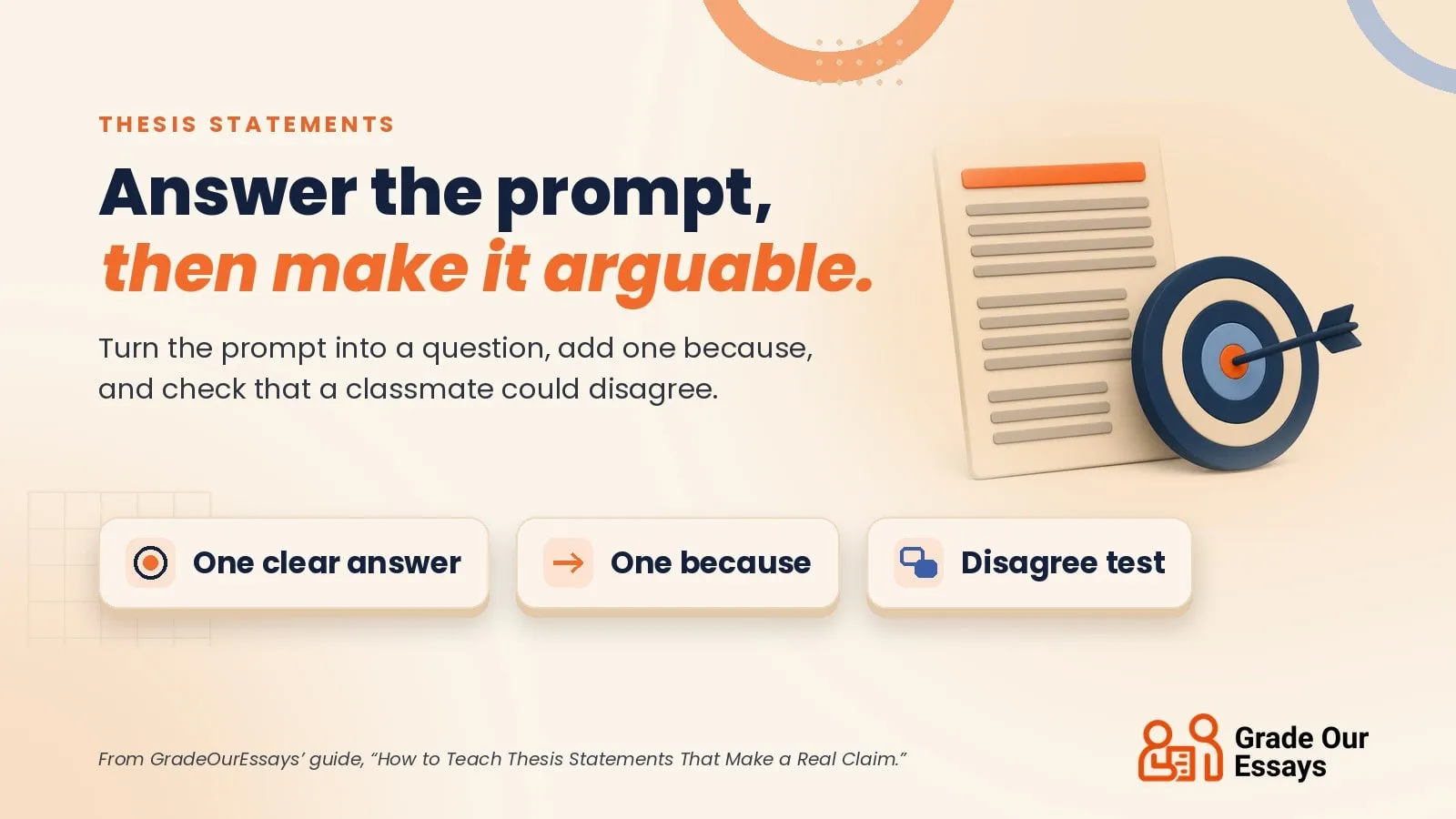
To teach thesis statements that make a real claim, turn the prompt into a question, have students answer it in one sentence someone could argue with, and add one “because” that names their reasoning. Then test every draft with a single check: could a thoughtful classmate disagree? If nobody could, the student has written a topic or a fact, and the fix is a question from you, not another template.
Most thesis trouble isn’t a sentence problem. It’s a thinking problem that happens to show up in one sentence, which is why reteaching the formula rarely fixes it.
Why can’t my students write a thesis statement?
Teachers have been describing this all fall. A 10th-grade teacher on Reddit wrote in September about a body paragraph lesson that went well with middle schoolers and then stalled with sophomores, many of whom couldn’t come up with a main point at all, before evidence or analysis even entered the picture. In October, another teacher asked colleagues for urgent help teaching essay writing, and most of the replies started with thesis templates. An ELA curriculum blog this month described modeling claims, sharing strong examples, and still getting back plot summary and explanations that prove nothing. Its conclusion: the thinking needs practice before the writing does.
Read enough weak theses and the pattern is clear. The student hasn’t decided anything yet. They’ve picked a subject and written it down in sentence form.
There are usually three reasons:
- The prompt invites description. “Describe how Brian changes in Hatchet” asks for a list of changes. Students give you exactly that.
- The formula became the goal. When the three-part thesis is the thing being graded, students fill the three slots with three topics and stop thinking.
- A fact feels safe. Nobody can mark “The story takes place in the wilderness” wrong. A claim can be wrong, and plenty of students would rather be vague than wrong.
All three are fixable, and none of them require a new unit.
What’s the difference between a topic, a fact, and a claim?
Students need to see the difference side by side before they can hear it in your feedback. The examples below are sample sentences written for this post, answering a common middle school prompt: “How does Brian change in Hatchet by Gary Paulsen?”
| Type | Sample thesis | What’s wrong with it | Question to ask the student |
|---|---|---|---|
| Topic | This essay is about how Brian changes in Hatchet. | Names the subject. Says nothing about it. | “What do you want to prove about how he changes?” |
| Fact | In Hatchet, Brian survives alone in the wilderness after a plane crash. | True, so nobody can disagree. Nothing to prove. | “Why does that matter? What does it show?” |
| List | Brian changes because of the hatchet, the tornado, and the moose. | Three events, no idea connecting them. | “What do these three moments have in common?” |
| Vague | Brian’s time in the wilderness is very powerful and changes him a lot. | “Powerful” and “a lot” can’t be tested with evidence. | “Which word could you replace with something specific?” |
| Claim | Brian’s biggest change isn’t learning to survive. It’s learning to stop waiting to be rescued. | Takes a position a classmate could push back on, and points to evidence. | “Which scene proves it best?” |
Put the first four rows on the board without labels and ask students to rank them from weakest to strongest. They usually spot the claim fast. What they can’t do yet is explain why the others fall short, and that explanation is the lesson.
A four-step routine for writing a claim
Here’s the routine we recommend for grades 6 through 10. It works for argument and literary analysis, and it’s short enough to run in ten minutes at the start of any essay.
- Turn the prompt into a question. “Explain whether schools should…” becomes “Should schools…?” If the prompt already is a question, students copy it at the top of their page.
- Answer it in one sentence. No reasons yet. Just the answer, with a stance word: should, shouldn’t, mostly, more than, not really.
- Add one “because.” One line of reasoning, not three. If a student has three reasons, ask which one the other two depend on.
- Run the disagree test. A partner reads it and tries to argue the other side in one sentence. If the partner can’t, the thesis is still a fact.
For 9th and 10th graders, add a fifth step once the first four are routine: start the sentence with “Although” and name the other side. That one word forces students to admit an opposing view exists, which is most of what a counterclaim is.
A worked example
Here’s the routine applied to a sample 8th-grade argument prompt, with sample drafts written for this post: Should our school require students to lock their phones away for the whole school day?
| Step | Sample draft | What changed |
|---|---|---|
| Starting draft | Phones in school are a big issue today. | A topic. No answer to the prompt. |
| 1 and 2: Question and answer | Our school should require phones to be locked away for the whole day. | Now it answers the question. |
| 3: Add one because | Our school should require phones to be locked away for the whole day because students can’t build the habit of focusing for a full class when a notification can interrupt at any minute. | A line of reasoning the body paragraphs can prove. |
| 4: Disagree test | A partner says, “But what about emergencies?” | It passes. Someone can argue with it. |
| Optional: Although | Although families worry about reaching students in an emergency, our school should require phones to be locked away all day because students can’t build the habit of focusing for a full class when a notification can interrupt at any minute. | The other side is named, so the essay has to answer it. |
Notice the final version isn’t fancy. It’s long, a little clunky, and completely clear about what the essay will prove. For a 13-year-old, that’s a strong thesis. Polish can come in revision.
Should students use a three-part thesis?
Use it as training wheels for the first essay or two in grades 5 through 7, then retire it. That’s our recommendation, and here’s why.
The three-part thesis (“X because A, B, and C”) does one job well. It gives a student who has never organized an essay a map for three body paragraphs. The problem is what it does after that. Students learn to hunt for three things instead of one idea, so you get three loosely related points that never build. On a timed state test response, where students may only have time for two solid body paragraphs, the third prong often turns into a paragraph with no evidence.
| The three-part thesis helps when… | It hurts when… |
|---|---|
| Students are writing their first multi-paragraph essay | Students already know how to organize paragraphs |
| The prompt really does have three clear parts | The prompt asks for one interpretation or one position |
| You need a quick check that each body paragraph has a job | Students pick three reasons first and decide their stance last |
| Struggling writers need a visible structure on the page | The essay is timed and three paragraphs won’t fit |
A single “because” keeps the structure without the list. Students can still write three body paragraphs. Each one just proves part of the same reason instead of introducing a new one.
How do you give feedback on a thesis before the essay is written?
Collect the thesis before the draft. This is the cheapest feedback you’ll ever give, and it saves more grading time than anything you do after the essays come in.
Run a thesis checkpoint as an exit ticket: one thesis sentence plus the two pieces of evidence the student plans to use. Then sort the stack into three piles in one pass:
- Claim. It passes the disagree test. Write a check mark and nothing else.
- Not yet. It’s a topic, fact, list, or vague statement. Write the matching question from the table above.
- No answer. The student hasn’t responded to the prompt. Pull these students into a quick conference the next day.
Keep the comments as questions. “What do you want to prove about this?” asks the student to do the thinking. If you rewrite the thesis for them, you’ll get your sentence back in the final draft, and you’ll learn nothing about whether they understood the text.
You can also hand part of this to students. A two-minute partner disagree test works as a quick round of peer review because the job is so narrow: try to argue with the sentence, then tell the writer whether you could.
Does a thesis look different in each genre?
Yes, and students get confused when we use the same word for all of them without saying so.
In an argument essay, the thesis is a position: what should happen, or which side is right. In literary analysis, it’s an interpretation: what a character’s choice or an author’s technique reveals. In informational writing, many teachers and state rubrics call it a controlling idea or central idea, and it doesn’t need to be debatable in the same way. For informational writing, swap the disagree test for a “so what” test: does the sentence tell the reader what’s important about the topic, or just name it? (Our guide to writing strategies by genre breaks down the other moves that change from genre to genre.)
If your students take a state writing test, pull up your state’s rubric and find the row that scores the claim or central idea. Use the rubric’s exact words in your thesis lessons so the language students hear in October is the language they’re scored on in spring. If you’d like a first pass on a full class set, Grade Our Essays drafts trait-level feedback aligned to your state’s rubric, and you review and approve every score before students see it. It has a free 14-day trial with no credit card required. The thesis checkpoint still works best by hand, because it’s quick and it tells you who to talk to tomorrow.
Keep the thesis honest through the body paragraphs
A strong thesis can still go wrong by paragraph three. Students write a good claim, then drift into summary because the evidence they collected was about the plot, not about their point. If that’s the bigger problem in your room, our post on students who restate the quote instead of analyzing it goes deeper.
A quick self-check before students turn in a draft:
- Highlight the thesis in one color.
- Highlight each topic sentence in a second color.
- For each topic sentence, finish this out loud: “This paragraph proves my thesis because…”
When a student can’t finish that sentence, one of two things is true. Either the paragraph wandered, or the thesis was wrong and the student figured out something better while drafting. The second one is good news. Writers change their minds as they write. Let them revise the thesis to match the essay they actually wrote, as long as the new version still passes the disagree test. The UNC Writing Center’s thesis guide makes the same point for older writers: if the thesis and the body don’t go together, one of them has to change, and it’s fine for that to be the thesis.
Try This Tomorrow
- Show the five rows. Put a topic, fact, list, vague statement, and claim on the board for a text your class just read. Have students rank them and explain the bottom two.
- Rewrite one prompt. Change “describe” or “explain how” to a question with two possible answers before you assign your next essay.
- Run the disagree test. Give partners two minutes to argue with each other’s thesis. If they can’t, the writer revises before drafting.
- Collect theses as an exit ticket. Sort them into three piles and respond only with questions.
- Retire the third prong. For your next essay, require one “because” instead of three reasons and see whether the body paragraphs hold together better.
Frequently Asked Questions
What makes a thesis statement arguable?
A thesis is arguable when a thoughtful reader could reasonably disagree with it using the same text or evidence. If every reader would accept it as true, it’s a fact or a summary, and the essay has nothing to prove.
Should a thesis statement be one sentence?
For most middle and early high school essays, yes. One sentence forces a student to commit to a single position. Older students writing longer essays can use two sentences if the second adds a qualification or names the other side.
Where does the thesis go in an essay?
Usually at the end of the introduction, so the reader knows the claim before the evidence starts. The UNC Writing Center guide linked above describes it the same way. What matters more than placement is that every body paragraph connects back to it.
How do I help students who still write a topic instead of a claim?
Ask them the prompt as a question out loud and have them answer it in one sentence before they write anything. Many students can say a claim long before they can write one. Then have them write down exactly what they said.
Can a thesis change after the essay is drafted?
Yes. Drafting is often how students figure out what they actually think. Let them revise the thesis to match the essay, as long as the new version still answers the prompt and passes the disagree test.