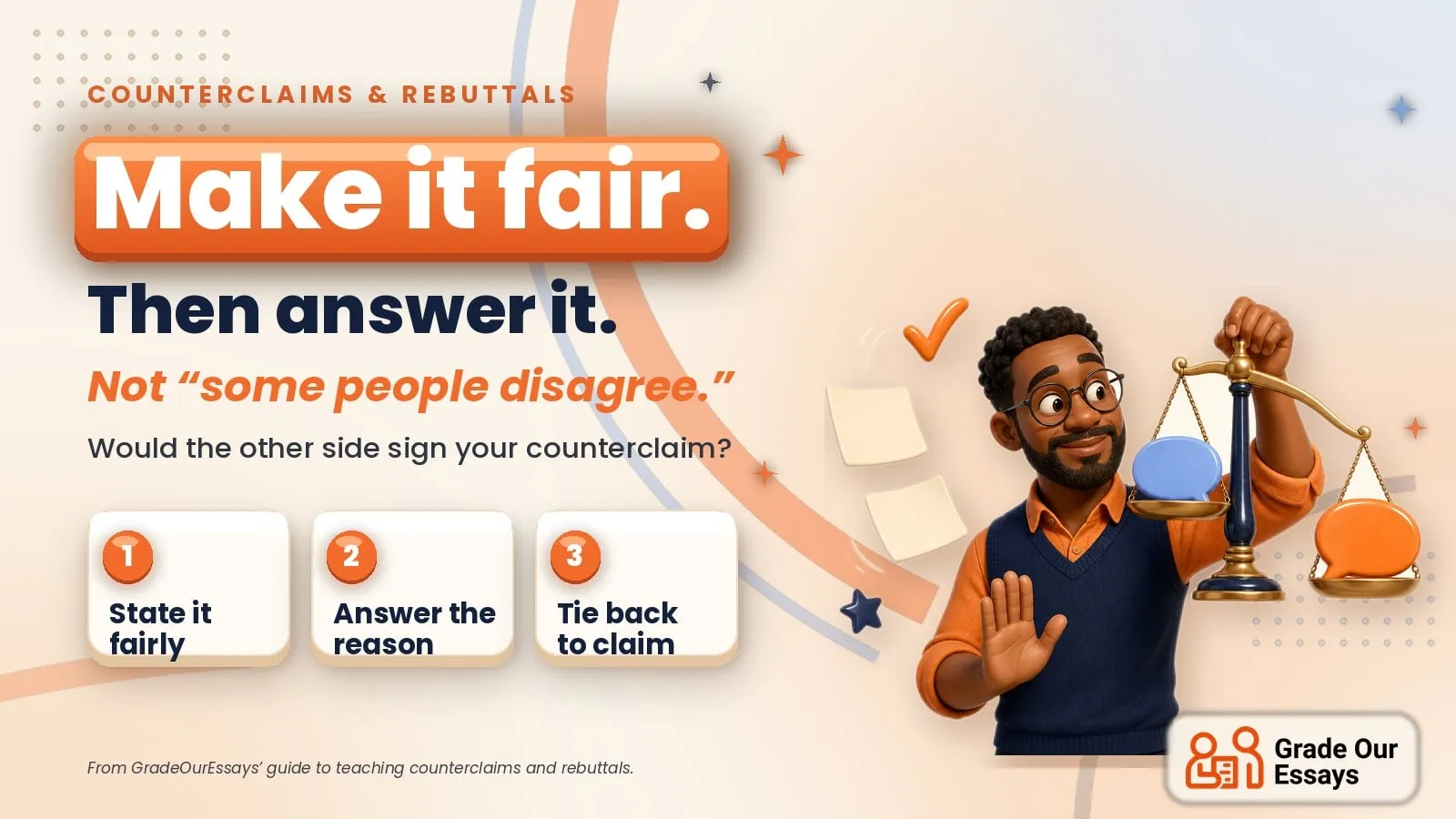
Teach the counterclaim as a fair statement of the strongest reason someone would disagree, followed by a rebuttal that answers that reason directly and ties back to the thesis. Most weak counterclaims fail in one of three predictable ways: a one-line dismissal, a straw man, or a fair objection that never gets answered. Name those three failures for students, give them a “Yes, but” frame, and spend one revision round on the counterclaim paragraph alone.
Why do students write “some people disagree, but they are wrong”?
Picture an 8th grade argument unit. The prompt asks whether the school should require phones to stay in lockers all day. The rubric says “acknowledges and responds to an opposing claim.” Thirty essays come back, and the fourth paragraph in most of them reads something like this:
Sample student paragraph (written for this post): Level 1 Some people think students should keep their phones. But they are wrong because phones are distracting.
It’s not laziness, exactly. Teachers writing about argument units this fall describe the same pattern: students treat the counterclaim as a box on the rubric, pick the weakest version of the other side so it’s easy to knock down, and drop it into the next to last paragraph because that’s where it “goes.” Underneath that is a real thinking problem. To write a good counterclaim, a 13 year old has to set aside their own opinion long enough to argue the other side well, and most of them have never been asked to do that on paper.
The standards make the jump steep, too. In the Common Core writing standards, 7th graders “acknowledge alternate or opposing claims,” 8th graders also “distinguish” their claim from them, and by 9th and 10th grade students are expected to develop claims and counterclaims “fairly,” pointing out strengths and limitations of both. Your state’s wording may differ, so check the argumentative rubric your students are actually scored on.
The three ways counterclaims fail (plus one that’s nearly there)
When you read a class set, sort the counterclaim paragraphs into these buckets before you write a single comment. Each bucket needs a different fix, and one generic “develop your counterclaim” comment helps none of them.
| What you see | What’s going on | What to teach |
|---|---|---|
| One sentence: “Some people disagree, but they’re wrong.” | Student knows a counterclaim is required but not what it does | The four moves (below), with a model paragraph |
| A silly version of the other side: “Some people think phones should be allowed so kids can play games all day.” | Straw man. Easy to beat, proves nothing | The “would they sign it?” test |
| A fair objection, then the paragraph ends or switches topics | Student can see the other side but can’t answer it | Rebuttal moves: limit, outweigh, or fix |
| Fair objection, real answer, but no link back to the thesis | Nearly there | One closing sentence that returns to the claim |
Spend the most class time on the second bucket. A straw man paragraph looks finished, so students think it’s done. The first bucket is easy to fix with a model; the third responds well to sentence frames.
How do I teach the counterclaim and rebuttal moves?
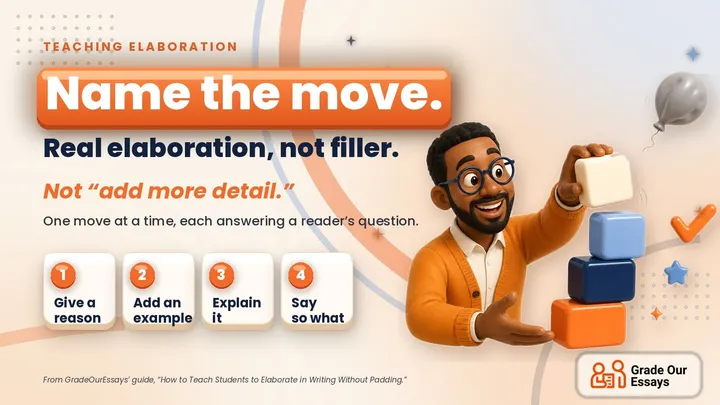
Break the paragraph into four moves and teach them by name. Keep the names on the board for the whole unit.
- State it. Name the opposing claim in one sentence.
- Strengthen it. Give the best reason someone holds that view. This is the step students skip.
- Answer it. Explain why your claim still holds. There are three honest ways to do that: show a limit in the objection, show your reason outweighs it, or show your plan solves the problem the other side cares about.
- Return. One sentence that connects back to your thesis.
Then give a “Yes, but” frame for students who need it:
- “Some people argue that ___ because ___. That’s a fair point, since ___.”
- “However, ___.”
- “That is why ___ (restate your claim in new words).”
Frames are a starting point, not the goal. Tell students up front that by the second argument essay of the year you want the moves without the frame. If your students still struggle to write a claim worth arguing against, fix that first; a counterclaim can’t push back on a thesis that’s really a topic.
The “would they sign it?” test for straw men
Here’s the single most useful question for counterclaims: if a person who truly disagrees with you read your counterclaim sentence, would they sign their name to it?
Run it out loud with the Level 1 sample. “Some people think students should keep their phones.” A parent who wants phone access would sign that, but it’s thin. Push for the reason. Why would a reasonable parent want it? Students usually get there fast: emergencies, coordinating rides, a family situation. Now the counterclaim has teeth, and the rebuttal has something real to answer.
Here’s the same sample paragraph, revised in two stages.
Sample student paragraph (written for this post): Level 3, fair but unanswered Some parents want students to keep phones because they need to reach their kids in an emergency. This is a real worry, especially after school when plans change.
Sample student paragraph (written for this post): Level 4, fair, answered, connected Some parents want students to keep phones because they need to reach their kids in an emergency, and that worry makes sense when after school plans change at the last minute. However, a locker policy doesn’t cut that line. The front office can reach any student in minutes, and students get their phones back at dismissal, which is exactly when ride plans change. Keeping phones in lockers protects class time without taking away the safety net parents care about.
Look at what changed. The Level 4 version doesn’t add a new argument. It answers the specific worry (emergencies and ride changes) with a “fix it” rebuttal, then returns to the thesis in new words. That’s the move to point out when you project it.
This is also a good moment to revisit how argument differs from other genres. A narrative never has to answer an opponent, and that’s part of what makes argument hard.
A 25 minute mini-lesson you can run this week
This fits in one class period alongside drafting time.
- Hook (3 minutes). Put the Level 1 sample on the board. Ask: “Would a parent who disagrees sign this sentence?” Take three answers.
- Model (7 minutes). Revise it live into the Level 4 version, thinking aloud at each of the four moves. Mark each move with a different color.
- Sort (7 minutes). Hand pairs four anonymous sample counterclaims (write your own, one per bucket). They label the bucket and the missing move.
- Apply (8 minutes). Students highlight their own counterclaim paragraph, run the “would they sign it?” test, and rewrite only the Strengthen and Answer sentences.
Collect only the rewritten paragraph. Thirty counterclaim paragraphs read much faster than thirty essays, and they tell you which bucket most of the class is still in.
When the four move routine helps, and when it doesn’t
This works best in grades 7 to 10, for single source or short multi source argument essays where the opposing view is easy to name. It also works for argument ECRs on state tests, as long as the student’s counterclaim draws on the passages provided.
It helps less in two situations. First, if students don’t know enough about the topic, they can’t strengthen the other side; give them a short reading that argues the opposite position before drafting. Second, with strong 11th and 12th grade writers, a fixed counterclaim paragraph can make essays feel mechanical. Once the moves are automatic, let those students weave the opposing view in wherever it matters most instead of saving it for paragraph four.
One more caution: don’t let the frame turn every rebuttal into “however, they are wrong.” If the Answer sentence doesn’t explain why, it’s still a Level 2 paragraph in a nicer outfit. Students who drop quotes without explaining them have the same habit, and the fix for restating quotes works here too: make them write the “because.”
How Grade Our Essays helps with counterclaim feedback
The slow part of teaching counterclaims is the feedback. Each student needs to know which bucket they’re in and what to change, and writing that 30 times is where evenings go.
Grade Our Essays scores each essay trait by trait on the state writing rubric you choose, including argumentative rubrics for grades 3 to 12. Each score quotes the student’s own sentence as evidence, and each student gets drafted revision steps in plain language: what needs work, where to look, the revision move to make, and a self-check. Nothing reaches students until you review it, and you can change any score or comment first.
Take the Level 3 sample paragraph above as a worked example. On a rubric where responding to an opposing claim falls under a development or organization trait, the useful feedback follows that same pattern. A note in that shape might read: “Organization: your counterclaim is fair. You wrote, ‘This is a real worry, especially after school when plans change.’ Now answer it. Add one sentence that explains why your locker policy still works even with that worry, then one sentence that connects back to your claim. Self-check: could a parent who disagrees see that you took their reason seriously?” Your job is to read the drafted feedback, decide whether it fits your student, and release it when you’re ready.
For you, that means the whole class set is scored on the same rubric language, consistently, and your time goes to the students stuck in the straw man bucket instead of to rewriting the same comment. For students, it means a specific next step tied to their own sentence while the essay is still fresh, instead of “develop counterclaim” two weeks later. Students join with a class code, no accounts, and the tool is FERPA and COPPA compliant. There’s a free 14 day trial with no credit card required if you want to try it on your current argument unit.
Try This Tomorrow
- Project one anonymous Level 1 counterclaim and ask, “Would someone who disagrees sign this?”
- Write the four move names (State, Strengthen, Answer, Return) on the board and leave them up all unit.
- Sort your current stack of drafts into the four buckets before commenting. Count which bucket is biggest and teach to that one.
- Have students rewrite only the Strengthen and Answer sentences of their counterclaim.
- Before the next argument draft, give students a short reading that argues the other side.
Frequently Asked Questions
What is the difference between a counterclaim and a rebuttal?
A counterclaim is a reasonable position that disagrees with the writer’s claim, stated fairly. The rebuttal is the writer’s answer, explaining why their own claim still holds.
Where should the counterclaim go in an essay?
For most middle school essays, a separate paragraph before the conclusion is a fine default. Stronger high school writers can address the opposing view wherever it matters most, sometimes right after the thesis.
How many counterclaims should students include?
One well developed counterclaim with a real rebuttal beats three thin ones. Add more only when the prompt or rubric asks for it.
What grade do students start writing counterclaims?
In the Common Core standards, students start acknowledging opposing claims in grade 7, distinguish their claim from them in grade 8, and develop counterclaims fairly in grades 9 and 10. Check your own state’s standards, since wording varies.
Does a counterclaim weaken the argument?
Not when it’s answered. A fair objection followed by a clear rebuttal shows the reader you considered the other side and your claim still stands.